ADAMI and SPEDIDAM: The Complete Guide for Performing Artists

You record tracks, you play on stage, you participate in studio sessions. But are you actually collecting all the rights you are owed as a performing artist? If you do not know ADAMI and SPEDIDAM — or worse, if you confuse the two — there is a good chance you are leaving money on the table. Every year, millions of euros in rights go unclaimed by performing artists, simply because they do not know which organization to register with or how to declare their participations.
In this guide, we explain everything: the difference between ADAMI and SPEDIDAM, who can register, how to declare your sessions and concerts, what grants are available, and most importantly how to avoid the mistakes that cost you money.
Introduction: why you need to know ADAMI and SPEDIDAM
In France, performing artists’ rights are managed by two collective management organizations (CMOs): ADAMI (Administration des Droits des Artistes et Musiciens Interprètes) and SPEDIDAM (Société de Perception et de Distribution des Droits des Artistes-interprètes). These two bodies are complementary but serve different profiles.
Unlike SACEM, which manages copyright (composition, lyrics), ADAMI and SPEDIDAM manage neighboring rights — the rights related to the performance of a work. If you sing on a track, play guitar on an album, or do backing vocals in the studio, you have performer rights. And those rights generate money.
Key takeaway: Copyright (SACEM) and neighboring rights (ADAMI/SPEDIDAM) are two completely different things. You can collect both if you are both a songwriter-composer AND a performer.
What is a performing artist?
Before discussing registration, let us clarify what a performing artist is. Under the French Intellectual Property Code (article L.212-1), a performing artist is a person who represents, sings, recites, declaims, plays, or otherwise performs a literary or artistic work.
Concretely, this includes:
- Singers (soloists and backing vocalists)
- Musicians (guitarists, drummers, keyboardists, bassists, etc.)
- Rappers
- Actors (dubbing, film, theater)
- Dancers
- Conductors and musical directors
What distinguishes a performing artist from a songwriter-composer is that they do not create the work: they perform it. Of course, in many cases, the same person is songwriter, composer, and performer — the classic ACI status (Auteur-Compositeur-Interprète). In that case, you can be registered with SACEM AND with ADAMI or SPEDIDAM.
The key distinction: lead artist vs. backing artist
This distinction determines which organization you should register with:
-
Lead artist: the person whose name appears on the cover, who is identified as the main performer of the phonogram. This is the lead singer, the soloist, the artist under contract with the label. They fall under ADAMI.
-
Backing artist: the person who participates in the recording or concert without being identified as the lead artist. This is the session guitarist, the backing vocalist, the additional musician. They fall under SPEDIDAM.
Key takeaway: It is not your talent that determines your organization, it is your role on the recording. A virtuoso guitarist playing on another artist’s album is a backing musician in SPEDIDAM’s terms.
ADAMI: the organization for lead artists
ADAMI (Administration des Droits des Artistes et Musiciens Interprètes) was created in 1955. It manages the rights of lead performing artists — those whose name is credited on the phonogram or audiovisual production.
Who can register with ADAMI?
- Solo singers
- Artists whose name appears on the album cover
- Rappers as lead artists
- Actors (film, television, dubbing)
- Dancers identified as soloists
- Conductors
How ADAMI distributes rights
ADAMI uses a distribution system based on popularity and broadcast frequency. Concretely, the more your tracks are broadcast (radio, TV, streaming, public venues), the more rights you receive. ADAMI identifies broadcasts through play reports from radio stations, TV channels, and platforms.
Distribution takes into account:
- The number of broadcasts of your tracks
- The media on which you are credited (albums, singles, compilations)
- Secondary uses (advertisements, films, sync)
The amounts: what to expect
Amounts vary enormously from one artist to another. An artist with heavy radio rotation can earn several thousand euros per year via ADAMI. An emerging artist with a few tracks in their catalog might receive a few dozen or hundred euros. But it is money that is owed to you and that you will not receive if you are not registered.
SPEDIDAM: the organization for backing musicians
SPEDIDAM (Société de Perception et de Distribution des Droits des Artistes-interprètes) was created in 1959. It manages the rights of performing artists who are not identified as lead artists on recordings.
Who can register with SPEDIDAM?
- Session musicians (guitarists, drummers, keyboardists, etc.)
- Backing vocalists
- Orchestra musicians
- Extras in audiovisual productions
- Corps de ballet dancers
- Any performing artist participating in a recording without being credited as lead
How SPEDIDAM distributes rights
Unlike ADAMI, which bases distribution on popularity and broadcast frequency, SPEDIDAM primarily works from declared working time. Each registered artist declares their recording sessions and live performances, and distribution is based on activity volume.
SPEDIDAM distributes:
- Private copying remuneration (levy on blank media)
- Equitable remuneration (broadcast in public venues)
- Exclusive rights collectively assigned
An essential point: declaring sessions
At SPEDIDAM, you declare your participations. If you play bass on 15 albums in a year but declare nothing, you receive nothing. This is the main mistake backing musicians make: they think rights arrive automatically. They do not.
Key takeaway: At SPEDIDAM, no declaration = no payment. It is that simple. Keep a record of all your sessions and declare them systematically.
ADAMI vs SPEDIDAM: comparison table
Here is a clear summary of the differences between the two organizations:
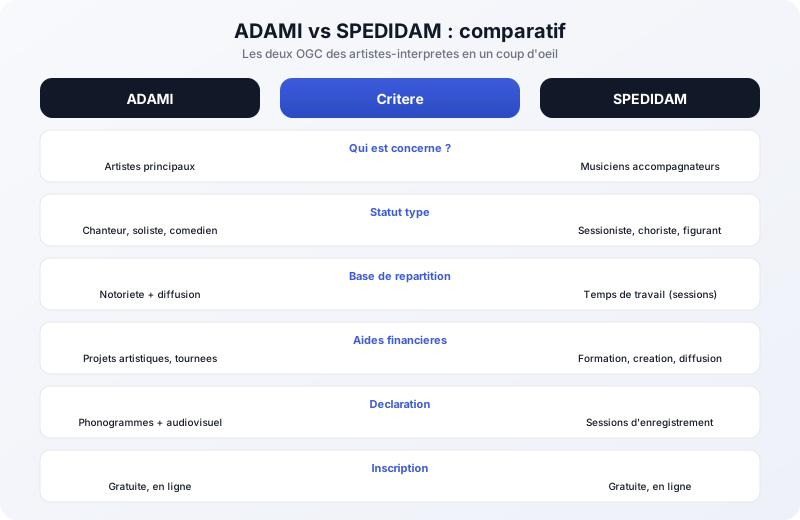
ADAMI vs SPEDIDAM comparison: the key criteria at a glance.
| Criterion | ADAMI | SPEDIDAM |
|---|---|---|
| Target audience | Lead artists | Backing artists |
| Examples | Lead singer, soloist, actor | Session player, backing vocalist, extra |
| Distribution basis | Popularity + broadcasts | Working time (declared sessions) |
| Registration | Free, online | Free, online |
| Declaration | Phonograms + audiovisual | Recording sessions + live |
| Financial grants | Artistic projects, tours, creation | Training, creation, distribution |
| Revenue collected | Private copying, equitable remuneration, exclusive rights | Private copying, equitable remuneration, exclusive rights |
| Number of members | ~40,000 | ~60,000 |
How to register with ADAMI or SPEDIDAM
Registration with both organizations is free and done online. Here are the concrete steps.
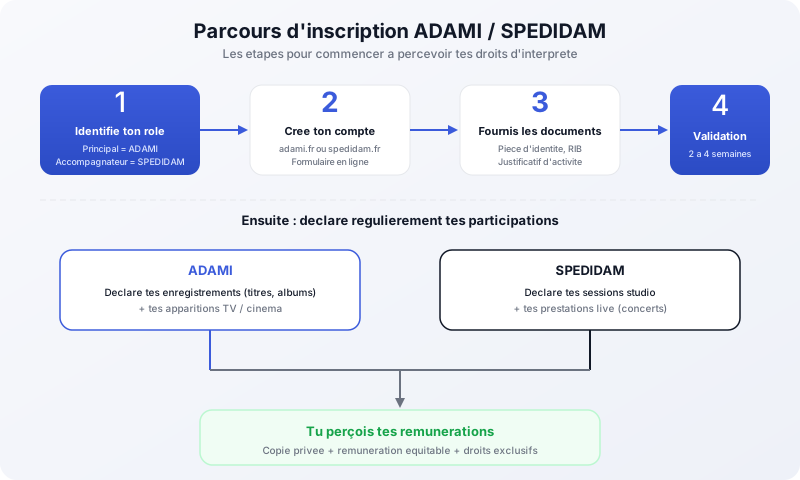
The steps to register and start collecting your performer rights.
Registering with ADAMI
- Go to adami.fr and create your artist account
- Complete the membership form with your personal information
- Provide supporting documents:
- Valid ID
- Bank details (for rights payments)
- Proof of artistic activity (recording contract, album cover with your name, link to your tracks on platforms)
- Sign the management mandate authorizing ADAMI to collect and distribute your rights
- Wait for validation: processing usually takes 2 to 4 weeks
Registering with SPEDIDAM
- Go to spedidam.fr and access the registration section
- Complete the form with your details and artistic activity
- Provide supporting documents:
- Valid ID
- Bank details
- Proof of participation in a recording or session contract
- Sign the management mandate
- Receive your member number after validation
Documents to prepare
For both organizations, prepare in advance:
- A valid ID (national ID card, passport)
- Bank details in your name
- Proof of activity: contracts, attendance sheets, album credits, streaming platform screenshots
- Your social security number
Key takeaway: Registration is free and involves no financial commitment. There is no annual fee. You have literally no reason not to register if you are a performing artist.
How to declare your participations
Registration is not enough. To collect your rights, you must regularly declare your participations in recordings and performances.
Declaring to ADAMI
At ADAMI, declarations concern your phonograms (music recordings) and videograms (music videos, films, series). For each recording, you must provide:
- The title of the track or production
- The artist name (you, in this case)
- The label or producer
- The ISRC code of the track (if available)
- The release date
You can make these declarations directly from your personal space on the ADAMI website. The organization then cross-references this information with broadcast reports to calculate your rights.
Declaring to SPEDIDAM
At SPEDIDAM, you declare your recording sessions and live performances. For each session, indicate:
- The date of the session
- The location of the recording or concert
- The lead artist name you performed for
- Your instrument or role
- The duration of the session
- The producer or organizer
SPEDIDAM provides online declaration forms. The more precise and regular your declarations, the more you maximize your rights.
The ideal frequency
Do not let declarations pile up. The ideal is to declare as you go, after each session or each release. If you wait until the end of the year to declare everything at once, you risk forgetting participations — and therefore losing money.
Key takeaway: Create a routine: after every studio session, every concert, or every track release, take 5 minutes to make your declaration. It is a minimal investment for a potentially significant return.
Income sources for performing artists
Where does the money that ADAMI and SPEDIDAM pay you actually come from? There are three main revenue sources.
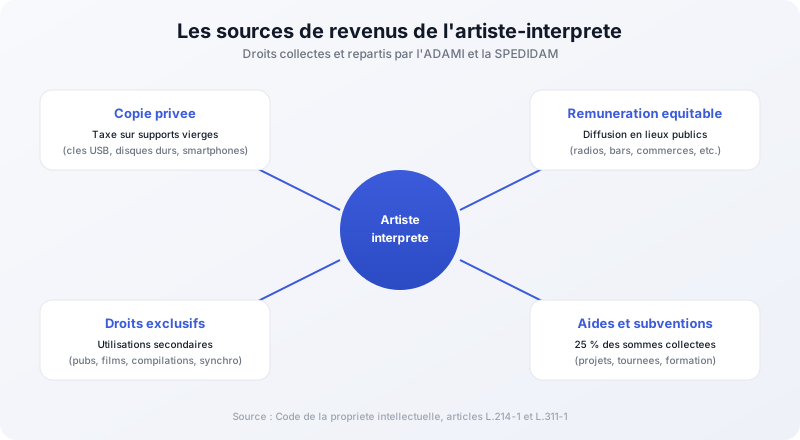
The four revenue streams managed by ADAMI and SPEDIDAM.
1. Private copying remuneration
Every time a consumer buys blank media (USB drive, external hard drive, smartphone, tablet), a levy is collected. This levy compensates for the fact that the consumer will likely copy protected works onto that media. A portion of this levy goes to performing artists via ADAMI and SPEDIDAM.
In 2025, private copying generated over 300 million euros in total collection, with a significant share going to performing artists.
2. Equitable remuneration
When your music is played in a public venue — a bar, a restaurant, a shop, a waiting room, a radio station — the establishment pays a fee called equitable remuneration. This fee is collected by SPRE (Société pour la Rémunération Équitable), then redistributed to performing artists via ADAMI and SPEDIDAM.
3. Exclusive rights
When one of your recordings is used in an advertisement, a film, a series, a video game, or any other secondary use, rights are generated. These rights are collected and distributed by ADAMI and SPEDIDAM depending on the type of use.
4. The 25% dedicated to grants
French law requires ADAMI and SPEDIDAM to dedicate 25% of amounts collected from private copying to supporting creation, live performance distribution, and training. This is what funds the grant programs discussed in the next section.
Available financial grants
Beyond simple rights distribution, ADAMI and SPEDIDAM offer concrete grant and subsidy programs for performing artists.
ADAMI grants
ADAMI funds artistic projects through several programs:
- Live performance creation grant: up to 15,000 EUR to produce a show (music, theater, dance)
- Recording grant: partial funding for album production
- Audiovisual capture grant: to film a concert or show
- Festival support: funding for events that program performing artists
- Awards: ADAMI presents annual awards to emerging artists
SPEDIDAM grants
SPEDIDAM also has a substantial grant budget:
- Live performance distribution grant: funding for tours and concerts
- Phonographic production grant: support for album recording
- Professional training grant: funding for performer training (masterclasses, technical workshops)
- Emergency aid: one-off financial support for artists in difficulty
- Structural support: funding for organizations that support performing artists
How to apply
Grant application forms are available on the ADAMI and SPEDIDAM websites. Each program has its own criteria and submission dates (usually several rounds per year). Review committees examine applications and notify results within a few weeks.
Key takeaway: ADAMI and SPEDIDAM grants are often unknown, but they represent significant amounts. If you are preparing an album, a tour, or a video, always check whether you are eligible for a grant.
The most common mistakes
After years of supporting artists, here are the mistakes we see most often regarding ADAMI and SPEDIDAM.
1. Not registering at all
This is the number one mistake. Many artists think performer rights arrive automatically, like SACEM royalties. They do not. If you are not registered with ADAMI or SPEDIDAM, you receive nothing. And unclaimed amounts are redistributed to other members after the statute of limitations expires.
2. Registering with the wrong organization
A singer who registers with SPEDIDAM instead of ADAMI, a session player who registers with ADAMI instead of SPEDIDAM. It happens more often than you think. The result: your declarations do not match your profile, and your rights are not correctly distributed.
3. Forgetting to declare
You are registered, great. But if you do not declare your participations, the system cannot know you played on a given album or concert. Result: zero euros.
4. Late or incomplete declarations
Late or incomplete declarations (missing ISRC code, missing producer name, missing exact date) slow processing and can reduce your rights. Be thorough.
5. Confusing copyright and neighboring rights
ADAMI and SPEDIDAM do not replace SACEM. If you are a songwriter-composer-performer, you must be registered with both systems: SACEM for your copyright, and ADAMI or SPEDIDAM for your performer rights.
Can you be registered with both?
Yes, absolutely. If you are both a lead artist on some projects and a backing musician on others, you can — and should — be registered with both organizations.
Concrete example: you are the singer and leader of your own band (you are the lead artist, so ADAMI), but you also play guitar on other artists’ albums as a session player (you are a backing musician, so SPEDIDAM).
In that case, you declare:
- Your own recordings to ADAMI
- Your sessions for other artists to SPEDIDAM
This is perfectly legal and even recommended. Do not leave any rights behind.
How Muzisecur handles all of this for you
Let us be honest: between registration, regular declarations, session tracking, ISRC code verification, grant applications, and administrative deadlines, managing your performer rights can quickly become an administrative nightmare.
That is exactly why Muzisecur exists.
What Muzisecur handles
- ADAMI and/or SPEDIDAM registration: we take care of the form, the documents, and follow-up until validation
- Declaring your participations: you send us your sessions and releases, we file the declarations properly
- Tracking your rights: we verify that amounts paid match your actual activity
- Grant applications: we identify the programs you are eligible for and build the applications for you
- Administrative monitoring: we notify you of deadlines, new available grants, and regulatory changes
The goal is simple: you focus on your music, we handle the rest.
Key takeaway: With Muzisecur, you no longer need to navigate between the ADAMI and SPEDIDAM websites, fill out forms, or chase down documents. We handle everything so you collect all your performer rights.
FAQ: ADAMI and SPEDIDAM
What is the difference between ADAMI and SPEDIDAM?
ADAMI manages the rights of lead artists (solo singers, actors, artists credited on the cover). SPEDIDAM manages the rights of backing artists (session musicians, backing vocalists, extras). Both collect and distribute the same types of rights (private copying, equitable remuneration), but for different groups.
Is registration free?
Yes. Registration with both ADAMI and SPEDIDAM is entirely free. There is no annual fee or membership charge. The organizations fund themselves through a deduction on collected rights (management fees).
How long does it take to receive your first rights?
After registration and your first declaration, it typically takes 6 to 12 months to receive the first payment. Distributions happen once or twice a year, depending on the organization and type of rights.
Can I be registered with SACEM AND ADAMI?
Yes. SACEM manages your songwriter-composer rights (lyrics and music). ADAMI manages your performer rights. These are two distinct rights. If you are a songwriter-composer-performer, you should be registered with both to collect all your royalties.
I am a beatmaker — which organization should I register with?
If you produce instrumentals and are credited as the lead artist (the beat is released under your name), you fall under ADAMI. If you provide instrumentals for other artists without being credited as lead, you fall under SPEDIDAM. In practice, many beatmakers are registered with both.
Are ADAMI/SPEDIDAM rights retroactive?
Rights are subject to a 5-year statute of limitations. If you register today, you can potentially claim rights for the past 5 years of activity. All the more reason not to wait.
How do I know if I have unclaimed rights?
Contact ADAMI or SPEDIDAM directly with your identity and discography. They can check if any amounts are awaiting distribution in your name. You can also go through Muzisecur, which performs this verification for you.
Conclusion
ADAMI and SPEDIDAM are not optional: they are fundamental rights you must activate as a performing artist. Whether you are a solo singer, session guitarist, backing vocalist, or actor, there is an organization collecting money on your behalf. You just need to register and declare your participations.
To summarize:
- You are a lead artist (your name is on the cover) — register with ADAMI
- You are a backing musician (you play for others) — register with SPEDIDAM
- You do both — register with both
- You do not want to handle the admin — hand everything over to Muzisecur
Do not leave a single euro of performer rights on the table. Registration is free, declarations take a few minutes, and the amounts at stake can represent a meaningful income supplement — especially over the long term.
And if all of this still feels too complicated, Muzisecur handles registration, declarations, and tracking for you. You create the music, we protect your rights.
Related articles

Neighboring Rights in Music: How to Collect All Your Royalties as a Producer
SCPP or SPPF? Equitable remuneration, private copying, exclusive rights: understand the 3 revenue streams from neighboring rights and stop leaving money on the table.

Music Copyright: How It Actually Works
Songwriter, composer, producer, performer: who gets paid what and why? Understand copyright, neighboring rights, and private copying in music.

Annual Sales Declaration SCPP SPPF: The Complete Guide to Collecting Your Neighboring Rights
How to declare your sales to SCPP or SPPF and collect your producer neighboring rights. The 5 steps, the pitfalls, and the essential codes.