Music Copyright: How It Actually Works

You create music, you produce beats, you record tracks — but do you actually know how many “revenue boxes” you’re leaving empty every month? Music rights are the system that lets an artist earn far beyond the studio fee or the live gig. This guide gives you the full tour of the mechanism — no unnecessary jargon.
What is music copyright?
The moment you create something — a melody, lyrics, an arrangement — you automatically hold rights over that creation. This is what we call copyright, and it exists without any administrative procedure. Copyright protects your creations from the instant they come into existence, with no formalities required.
These rights fall into two categories:
Moral rights — they are perpetual and inalienable. You will always remain the author of your work, even if you assign all your economic rights to a label. No one can take that from you.
Economic rights — this is the financial dimension. They allow you to receive payment every time your work is exploited: on radio, via streaming, at a concert, in an audiovisual sync, etc. In France, copyright protection lasts up to 70 years after the author’s death.
Key takeaway: Copyright does not protect an idea, but its concrete expression. Once your melody exists as a recording or a score, it is protected.

The 3 types of music rights and their respective collecting organizations.
SACEM: the central hub for protecting works
SACEM (Societe des Auteurs, Compositeurs et Editeurs de Musique) is the French collecting society that collects and distributes copyright royalties for songwriters and composers. It plays a dual role: it protects your work by establishing your authorship, and it acts as an intermediary between you and all broadcasters (radio stations, platforms, concert venues, commercial premises with background music, etc.).
When a radio station wants to play your track, it doesn’t ask you directly — it goes through SACEM, to which it pays a fee. SACEM collects, then pays you your share.
The numbers speak for themselves: SACEM’s copyright collections grew by 8% in 2024, reaching 1.6 billion euros, including 650 million euros from online music. Streaming is now SACEM’s top revenue source — and therefore yours if you’re a member.
In 2024, SACEM managed the rights of 238,000 songwriters, composers, and publishers and distributed royalties to over 510,000 rights holders worldwide. The society redistributes 85% of collected funds. The remaining 15% covers management fees.
Key takeaway: You can join SACEM as soon as you’ve created your first work. Registration costs around 60 euros in entry fees, but the investment pays for itself once your work starts getting airplay. Find all the steps in our complete SACEM registration guide.
Muzisecur helps you centralize tracking of your SACEM declarations and ensures every work is properly registered.
Phonographic rights: when the work comes to life on a recording
Copyright protects the creation (the lyrics, the melody, the composition). But there is a second level of rights that applies as soon as a work is recorded: phonographic rights, also known as master rights.
Here’s how it works: you wrote and composed a track (copyright = yours). A producer funds the studio recording and brings in a performing artist to bring the track to life. From the moment the track exists as a sound recording, the producer becomes the holder of phonographic rights over that recording.
These phonographic rights allow the producer to earn revenue every time the recording is exploited: digital sales, streaming, sync placements, compilations, etc.
Key takeaway: If you’re an independent artist funding your own recordings, you are both songwriter/composer (SACEM rights) AND producer (phonographic rights). It’s an extremely advantageous position — provided you properly register both.
Neighboring rights: ADAMI and SPEDIDAM — who gets what?
Performer neighboring rights are added on top of phonographic rights. They compensate performing artists (the lead singer, session musicians) every time the recording is publicly broadcast.
Two organizations manage this in France:
- ADAMI — for lead performers (singers, soloists, conductors, etc.)
- SPEDIDAM — for session musicians (session guitarist, drummer, keyboardist, etc.)
In 2023, over 346 million euros were collected under neighboring rights in France.
What this means in practice: a guitarist who plays on a worldwide hit can receive neighboring rights for years after the studio session, without doing anything else. The condition? Having properly declared their contribution to the work.
The equitable remuneration split (public broadcast of sound recordings):
| Beneficiary | Share | Organization |
|---|---|---|
| Phonographic producer | 50% | SCPP or SPPF |
| Performing artists | 50% | ADAMI or SPEDIDAM |
Key takeaway: If you perform on tracks as a session musician, register with SPEDIDAM. If you’re the lead artist, it’s ADAMI. Find the details in our ADAMI & SPEDIDAM guide.
The producer and neighboring rights: SCPP or SPPF
The phonographic producer collects neighboring rights through two organizations depending on their profile:
| Organization | Typical profile | Membership |
|---|---|---|
| SCPP | Majors and large structures | By application |
| SPPF | Independent labels | By application |
You can only join one of the two. As an independent label, SPPF is your natural point of contact.
These producer neighboring rights are collected for every broadcast of the recording — radio, streaming, TV, commercial premises, etc. — on top of direct exploitation revenue (digital sales, streaming).
Key takeaway: That’s why starting your own label isn’t just about “having a name.” It also means accessing an additional revenue layer on every track you fund. Don’t forget to file your annual sales declaration to collect your share of private copying levies. To go further, check out our complete guide to producer neighboring rights.
Private copying and equitable remuneration
Two lesser-known but very real mechanisms round out the picture:
Private copying
Private copying is a levy applied to all storage devices sold in France: smartphones, hard drives, USB sticks, tablets. A customer buying a USB stick pays roughly 1.50 euros in private copying fees; the price of a smartphone includes on average 10 euros in private copying levies.
These amounts are then redistributed to rights holders based on their market share. The bigger and more commercially active your catalog, the more you receive.
Equitable remuneration
Equitable remuneration applies every time a sound recording is played in a public venue: restaurant, shop, hotel, waiting room, nightclub. It is collected by SPRE (the French society for equitable remuneration collection) and shared between producers and performing artists.
Both of these revenue streams work in the background, without you having to file a specific declaration each time — but only if you are a member of the relevant organizations.
Key takeaway: Private copying and equitable remuneration are passive income streams that accumulate as soon as your music circulates. But without registration with the right organizations (SACEM, ADAMI/SPEDIDAM, SCPP/SPPF), you’ll never see a cent.
The role of the music publisher
The publisher is a partner who takes charge of the commercial exploitation of your works. In return, they receive a share of the royalties collected by SACEM.
The standard SACEM revenue split is as follows:
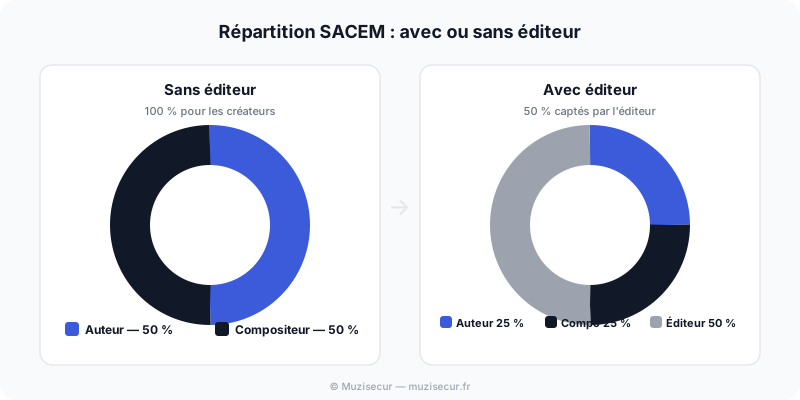
SACEM royalty split: without a publisher, creators share 100%. With a publisher, they take 50%.
| Situation | Songwriter | Composer | Publisher |
|---|---|---|---|
| Without publisher | 50% | 50% | — |
| With publisher | 25% | 25% | 50% |
In exchange for this share, the publisher must concretely:
- Ensure the distribution and commercialization of the work
- Track exploitations to verify everything is properly collected
- Protect the work against plagiarism and unauthorized use
- Manage authorizations (sync, covers, etc.)
- Provide administrative and legal follow-up
Caution: a publisher is only useful if they actually do the work. Otherwise, you lose 50% of your publishing rights for nothing. Today, many independent artists choose self-publishing — they register their works themselves and keep 100% of the creator’s share.
Key takeaway: Before signing with a publisher, ask yourself whether they will actually add value (sync placements, international sub-publishing, network of contacts). If the answer is no, self-publishing is the best option.
Tarik Hamiche’s take
Founder of Producteur a Succes, multi-gold and platinum certified independent producer
“What most artists don’t realize is that a properly declared and well-distributed track is a passive income machine. SACEM royalties, ADAMI neighboring rights, producer neighboring rights via SPPF, private copying — every exploitation generates money, even years after release. I’ve seen session musicians earn thousands of euros per year from a single track because they took the time to properly declare their contribution. And I’ve seen others miss out on all of it because they didn’t know it existed. The problem isn’t the rights — the system works. The problem is that nobody teaches you how to plug your name into it.”
FAQ: music copyright
Do I need to register with SACEM to be protected?
No — your work is automatically protected from the moment of creation. But without SACEM registration, you won’t receive any royalties from its exploitation. Registration is therefore essential if you want to monetize your music.
What is the difference between copyright and neighboring rights?
Copyright pays the creators of a work (lyricist, composer) and is managed by SACEM. Neighboring rights pay those who contributed to the recording (performer, musicians, producer) and are managed by ADAMI, SPEDIDAM, SCPP, or SPPF depending on the case.
Can an independent artist collect both types of rights?
Yes — and it’s one of the biggest advantages of being self-produced. If you write, compose, AND fund your recordings, you collect both copyright royalties (SACEM) and producer neighboring rights (SPPF/SCPP). Many independent artists who understand their catalog’s value do exactly this.
Do rights really accumulate with every broadcast?
Yes. Every radio play, every stream, every public broadcast generates royalties. They are collected by the relevant organizations and distributed according to payment schedules. The per-play amount is small, but it adds up as the track gains traction.
Do I need a publisher to collect my SACEM royalties?
No. You can register your works directly with SACEM without going through a publisher, and collect 100% of the creator’s share. A publisher is only useful if they provide real commercial value in exchange for their share of the rights.
Conclusion
Music rights are not a bureaucratic headache — they are the financial engine that allows an artist to make a living from music in the long term. Every properly declared track, every correctly activated organization is a revenue stream running in the background while you create.
SACEM for songwriters and composers, ADAMI and SPEDIDAM for performers, SPPF or SCPP for producers, private copying for everyone — these five entry points are there. The question is how many of them you’ve opened for your catalog.
Muzisecur helps you manage all the admin tied to your music career: work declarations, rights tracking, contracts, label management — everything centralized on a single platform.
Related articles

ADAMI and SPEDIDAM: The Complete Guide for Performing Artists
ADAMI or SPEDIDAM? Understand the difference, register with the right organization, and finally collect your performer rights. Practical guide with steps, grants, and mistakes to avoid.

Music Publishing: Everything You Need to Know About the Publisher's Role
Music publisher, publishing deal, SACEM splits, sync, sub-publishing: the complete guide to music publishing in France and how to decide between a publisher and self-publishing.

Neighboring Rights in Music: How to Collect All Your Royalties as a Producer
SCPP or SPPF? Equitable remuneration, private copying, exclusive rights: understand the 3 revenue streams from neighboring rights and stop leaving money on the table.