Do You Know What the Intermittent Performer Status Is?

You work in music, theater, film, or dance. You chain short-term contracts, sessions, and concert dates. And someone has already told you about the intermittent performer status — without really explaining what it is, how it works, or whether you’re eligible.
This guide is for you. We’ll break down everything: the 507-hour rule, the difference between annex 8 and annex 10, how your benefit is calculated, what a performance fee is, why your paid leave is handled by a special fund, and all the mistakes that cost you rights without you even realizing it. By the end, you’ll have a clear and complete picture of the intermittent regime — and you’ll know exactly what you can receive.
What is the intermittent performer status?
Contrary to what you often hear, the intermittent performer status isn’t a legal status. It’s a special unemployment insurance regime, defined by two specific annexes to the unemployment insurance convention: annex 8 (technicians and crew) and annex 10 (performing artists).
In practice, an intermittent performer is an employee — they pay contributions, have pension rights, and are covered by Social Security. But they don’t work under a permanent contract: they chain CDDU (fixed-term contracts of use), meaning short-term contracts that are standard in the performing arts sector. Between contracts, they receive benefits from France Travail under rules specific to their regime.
This system has existed since 1964 (annex 8) and 1967 (annex 10). It recognizes a reality: in the performing arts, discontinuous employment is the norm, not the exception. A musician can’t have a permanent contract to play concerts. An actor can’t work 35 hours a week at the same company. The intermittent regime structurally compensates for this discontinuity.
Key takeaway: You’re not a freelancer, you’re not self-employed. You’re an employee — with all the benefits that implies (healthcare, pension, paid leave, unemployment insurance) — but under a regime adapted to the reality of the cultural sector.
In France, approximately 120,000 people receive benefits under this regime each year. Management is handled by France Travail Spectacle (formerly Pole Emploi Spectacle), a dedicated branch of France Travail with specialized advisors.
Annex 8 and annex 10: the fundamental distinction
This is the first question to ask yourself: which annex do you fall under? It’s not a question of talent or level — it’s a question of your role on the employment contract.
Annex 8 — Technicians and crew
Annex 8 covers all technical professionals who contribute to producing a show, film, or music production: sound engineers, stage managers, stagehands, lighting designers, editors, costume designers, etc.
They are paid by the hour. Their threshold is 507 actual hours over 365 days.
Annex 10 — Performing artists
Annex 10 covers artists: singers, musicians, actors, dancers, backing vocalists, and since 2016, artistic directors. They are paid by performance fee (see dedicated section). Their threshold is 43 fees minimum (1 fee = 12 hours, totaling 516 hours).
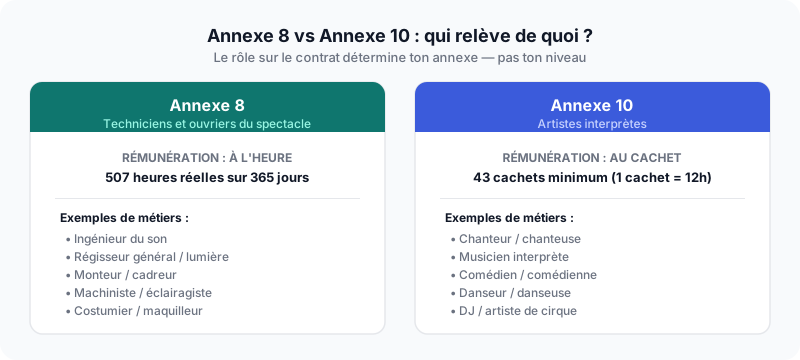
Comparison
| Criterion | Annex 8 | Annex 10 |
|---|---|---|
| Profile | Technicians and crew | Performing artists |
| Pay method | Actual hours | Performance fees (12h/fee) |
| Access threshold | 507 hours | 43 fees (approx. 516h) |
| Minimum daily benefit (gross) | 38 EUR | 44 EUR |
| Maximum daily benefit (gross) | 174.80 EUR | 174.80 EUR |
| Monthly hours cap | 208h/month | 28 fees/month |
Key takeaway: Just because you play music doesn’t mean you automatically fall under annex 10. If you’re a sound technician on a production, you’re annex 8. If you’re a performing musician credited on the production, you’re annex 10. The role on the contract takes precedence.
Which professions are covered?
Annex 10 — Artists
- Singers (soloists, backing vocalists, choir members)
- Musicians (guitarist, drummer, keyboardist, bassist, etc.)
- Rappers
- Actors (theater, film, dubbing, voice-over)
- Dancers (classical, contemporary, hip-hop, jazz)
- Circus artists and acrobats
- Puppeteers and performers
- Orchestra conductors and musical directors
- Choreographers (as performers)
- Artistic directors (since 2016)
- DJs and disc jockeys (depending on the nature of the performance)
Annex 8 — Technicians and crew
Sound and image: Sound engineer, camera operator, editor, video operator, boom operator, colorist, VFX technician
Lighting and structure: Lighting designer, lighting stage manager, rigger, chief electrician, structure technician
Sets and costumes: Stagehand, props master, costume designer, makeup artist, wig maker, set designer, set carpenter
Stage management and production: General stage manager, floor stage manager, assistant stage manager, tour logistics coordinator
Post-production: Sound/picture editor, 2D/3D animator, graphic designer, compositing artist
Key takeaway: Your profession must appear on the official list recognized by France Travail. The exact job title on your employment contract and your employer’s NAF code are decisive for validating your hours.
The 507-hour rule
This is the heart of the regime. To open rights as an intermittent performer, you must prove 507 hours of work in performing arts professions over a maximum period of 365 days. This 365-day period is called the Affiliation Search Period (PRA).
How the PRA is calculated
The PRA doesn’t start from the date you register with France Travail. It’s calculated going backward from the end date of your last eligible contract. Specifically:
- France Travail identifies your last CDDU under annex 8 or 10
- It goes back 365 days from the end of that contract
- It counts all hours (or fees) worked within that window
What counts toward the 507 hours
In addition to actual work hours, certain assimilated periods count:
- Professional training funded by an OPCO
- Maternity / paternity leave (under conditions)
- Sick leave (with maintained assimilation rights)
- Artistic teaching (under strict conditions)
Resigning from a general regime job
If you resigned from a standard salaried position (permanent or fixed-term contract under the general regime) before switching to intermittent work, France Travail applies a penalty: you must prove 962 hours instead of 507 (507 + 455 additional). This is a penalty for voluntary resignation.
| Situation | Hours required |
|---|---|
| Standard case | 507 hours |
| After resigning from a general regime job | 962 hours |
| After initial admission under the general regime | Case-by-case review |
Key takeaway: The timing of your France Travail registration is crucial. If you register too early or too late, the PRA may not cover your 507 hours, even if you actually worked them. Plan ahead and calculate before registering.
How to open your rights
Step 1 — Verify your hours
Before registering, calculate: you need 507 hours within the 365 days preceding your last contract end date. To do this, collect all your monthly employer certificates (AEM) or ask your employers for DSN declarations.
Step 2 — Identify your last contract end date
This date anchors your PRA. If you wait too long after your contract ends to register, older hours will fall outside the 365-day window.
Step 3 — Register with France Travail
Call 39 49 or register online at francetravail.fr. If you’re in a major city, head to a specialized France Travail Spectacle agency (Paris: Saint-Denis, Lyon, Marseille, etc.). Specialized performing arts advisors know the regime and process cases faster.
Step 4 — Provide supporting documents
- Your employment contracts (CDDU)
- Your monthly employer certificates (AEM) or end-of-contract certificates
- Proof of assimilated hours if needed (training certificates, sick leave, etc.)
Step 5 — Complete your monthly declaration
Every month, you must declare your situation (hours worked, income) to France Travail. Warning: forgetting to declare worked hours on your monthly update can cost you rights at readmission.
The anniversary date
Your rights are open for 12 months maximum. At your anniversary date (12 months after opening), France Travail checks whether you’ve accumulated 507 new hours in the preceding 12 months. If yes, readmission. If not, you fall back to the general regime.
How much you receive: benefit calculation
The daily benefit (AJ) is calculated using a formula that accounts for both your income and your volume of hours worked. It’s not a flat rate — it’s personalized.
The formula: AJ = A + B + C
The formula uses three components:
A — based on your wages (the more you earned, the higher A is)
B — based on your number of hours worked (the more you worked, the higher B is)
C — a fixed component specific to each annex
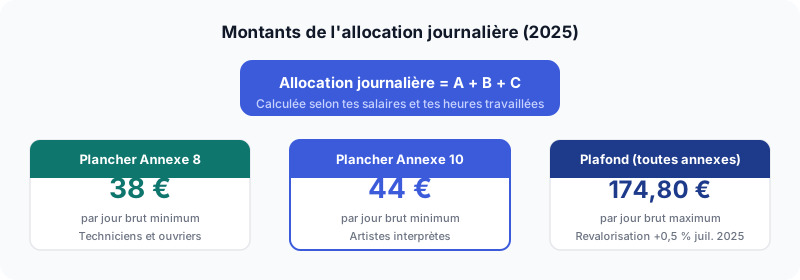
Reference values (2025)
| Parameter | 2025 value |
|---|---|
| Reference daily benefit (AJmin) | 31.96 EUR/day |
| Annex 8 floor | 38 EUR/day gross |
| Annex 10 floor | 44 EUR/day gross |
| All-annex ceiling | 174.80 EUR/day gross |
| July 1, 2025 revaluation | +0.5% |
Concrete example
A female musician (annex 10) who worked 600 hours and earned 13,000 EUR gross wages during her reference period receives approximately 59 EUR net per day in benefits. Over a full year with interspersed work periods, she’ll average between 1,300 and 1,400 EUR per month (wages + benefits combined).
Key takeaway: The more you work and the more you earn, the higher your benefit — up to the ceiling. The regime is designed to supplement your activity income, not to replace it entirely.
Waiting periods and deductions
Your rights don’t start the day after they open. Four mechanisms reduce the number of actually compensated days.
1. The waiting period — 7 fixed days
At each opening or readmission of rights, 7 days are uncompensated at the start. Exception: if you’re readmitted less than 12 months after your previous opening (and the waiting period was already applied), it’s not reapplied.
2. The paid leave deduction
Calculated as: days worked x 2.5 / 24, capped at 30 calendar days. It’s spread over the first months: 2 days/month if the total is 24 days or less, 3 days/month above that. It prevents double payment between France Travail and the Entertainment Industry Leave Fund.
3. The salary deduction
Proportional to your income during the reference period. The more you earned, the longer this deduction. It’s spread over the first 8 months of benefits and is uncapped.
4. The specific deferral
Only applies to above-statutory severance pay (rare in short performing arts CDDU contracts). Capped at 75 days.
In practice
| Mechanism | Typical duration |
|---|---|
| Waiting period | 7 days |
| Paid leave deduction | 5 to 15 days depending on activity |
| Salary deduction | 2 to 20 days depending on income |
| Actually compensated days over 12 months | 330 to 350 days |
Key takeaway: Out of 365 days of rights, you’ll be compensated for roughly 330 to 350 days in practice. Deductions are unavoidable — but they run out, and the last months are the most “profitable.”
The performance fee: a specificity for artists
If you’re an artist (annex 10), you’re not paid by the hour — you’re paid by performance fee (cachet). It’s a flat-rate compensation corresponding to an artistic performance, regardless of its actual duration.
What a performance fee is worth to France Travail
For benefits calculation, 1 fee = 12 hours of work. Whether you performed for 2 hours or 8 hours, the fee always counts as 12 hours toward the 507-hour threshold.
You can receive multiple fees on the same day from different employers. This is legal and common for session musicians and voice actors.
Number of fees to open rights
43 fees minimum = 43 x 12h = 516 hours (slightly above the theoretical 507h threshold).
Minimum fee amounts (2025)
| Type of performance | Minimum amount |
|---|---|
| Rehearsal (live entertainment convention) | From 106.03 EUR |
| Show (live entertainment convention) | From 159.05 EUR |
| Musician SNAM (3-hour session) | From 107.30 EUR |
Key takeaway: For artists, the performance fee is both the compensation unit AND the rights-counting unit. A poorly labeled fee (wrong job title, wrong collective agreement) may not be recognized by France Travail. Systematically check your contracts.
Combining employment and benefits
One of the strengths of the intermittent regime is allowing simultaneous work and benefits: you can work AND receive benefits in the same month.
How the deduction works
France Travail doesn’t eliminate your benefits on days you work — it reduces them. The calculation is based on hours worked, not wages:
- Annex 8: hours worked / 8 x 1.4 = number of uncompensated days
- Annex 10: hours worked / 10 x 1.34 = number of uncompensated days
The monthly cap
There’s a ceiling above which France Travail pays no benefits for the month in question. In 2025, this ceiling is set at 1.18 x the monthly Social Security ceiling, or 4,325.88 EUR gross/month.
If your wages for the month exceed this threshold, you receive no benefits that month — but your rights continue to run.
| Parameter | 2025 |
|---|---|
| Monthly cap | 4,325.88 EUR gross |
| Annex 8 deduction formula | hours / 8 x 1.4 |
| Annex 10 deduction formula | hours / 10 x 1.34 |
Key takeaway: About 95% of intermittent performers combine wages and benefits within the same year. This is the normal operating model of the regime — not an exception.
Entertainment industry paid leave
This is one of the least-known specifics of the regime: your paid leave isn’t paid by your employers but by a dedicated fund managed by Audiens — the Entertainment Industry Leave Fund (Caisse des Conges Spectacles).
Why a separate fund?
Because you constantly change employers. If each employer had to pay you leave, your entitlements would be scattered across dozens of employers. The fund centralizes everything.
How it works
Every employer who signs you on a CDDU (of less than 12 months) contributes to the Entertainment Industry Leave Fund at a rate of 15.50% of your gross salary (2025-2026 rate, period from April 1, 2025 to March 31, 2026). It’s entirely the employer’s responsibility — it doesn’t come out of your pay.
The reference period for leave entitlements runs from April 1 (year N) to March 31 (year N+1).
How to claim your leave
- Submit your request from mid-April each year (after the period closes)
- Respect a minimum of 15 days before your desired leave start date
- Deadline: March 31 of the following year. After this date, you permanently lose the period’s rights
- The request is made online through your personal Audiens account (with your registration number) or by mail to: Audiens — Conges Spectacles — TSA 90406 — 92177 Vanves Cedex
- Payment is made by bank transfer
Key takeaway: Thousands of euros in entertainment leave go unclaimed every year because artists and technicians don’t submit their request before March 31. This is money that belongs to you — don’t leave it on the table.
Retirement and contributions with Audiens
The supplementary pension scheme
Since January 2019, the AGIRC and ARRCO schemes have merged into AGIRC-ARRCO. For performing arts artists and technicians, Audiens centralizes and manages all supplementary pension rights.
The system works on points: with each contribution, you accumulate points. At retirement, these points are multiplied by their unit value to calculate your supplementary pension.
Artist specificity: the 30% allowance
Performing artists benefit from a 30% reduction on their gross salary for calculating certain contributions (health, old age, workplace accidents, family benefits). This historical advantage compensates for the structural precariousness of the profession.
Note: This reduction doesn’t apply to CSG/CRDS.
Main contributions (2025)
| Contribution | Employee share | Employer share |
|---|---|---|
| Unemployment insurance (annexes 8/10) | 2.40% | 4.05% + 5% specific |
| CDDU under 3 months (surcharge) | — | 11.90% total |
| Basic pension (capped) | 4.83% | 5.99% |
| Supplementary pension T1 (artists) | 4.44% | 4.45% |
| Entertainment Leave Fund | — | 15.50% |
| Deductible CSG | 6.80% | — |
| Non-deductible CSG + CRDS | 2.90% | — |
Key takeaway: The unemployment contribution rate for annexes 8/10 is higher than the general regime. This is what funds the intermittent regime. For CDDU contracts under 3 months, employers pay a surcharge — an incentive to offer longer contracts.
What changed in 2025
The 2025-2028 convention
On November 15, 2024, a new unemployment insurance convention was signed for the 2025-2028 period (effective January 1, 2025, progressive implementation through April 1, 2025). Good news: the rules of annexes 8 and 10 are maintained without substantial changes.
What actually changed
- Rights maintenance age: formerly set at 62, now aligned with the legal retirement age (62 to 64 depending on birth year). An intermittent performer who reaches this age during their 12-month benefit period can maintain their rights until pension liquidation.
- Revaluation: +1.2% on July 1, 2024, +0.5% on July 1, 2025.
- CSG/CRDS exemption threshold: raised to 60 EUR/day from November 1, 2024.
- Employer contribution reduced to 4% from May 1, 2025 (decrease in the general employer unemployment contribution).
What didn’t change
- The 507-hour threshold: maintained
- The 12-month maximum benefit duration: maintained
- The annex 8 and 10 system: maintained
Performing arts unions had resisted an employer attempt to cut regime spending by 15%. This restrictive reform did not happen.
The most common mistakes
After years of supporting artists and technicians, here are the mistakes that cost the most.
| Mistake | Consequence |
|---|---|
| Registering with France Travail too early or too late | The PRA doesn’t cover the 507h, fall back to general regime |
| Incorrect job title on the AEM | Hours are not counted |
| Employer’s NAF code not eligible | Hours don’t count, even if the position is correct |
| Employer without a performing arts license | Hours are not recognized |
| Forgetting to declare hours in the monthly update | Hours lost for readmission, even if the AEM exists |
| Resigning from a permanent job before switching | 962h required instead of 507h |
| Confusing fees and actual hours | 1 fee = 12h flat rate, not the actual performance duration |
| Not claiming Entertainment Leave before March 31 | Permanent loss of that year’s rights |
| Exceeding the monthly cap | No benefits paid for that month |
| Not checking the applicable collective agreement | Fees below the conventional minimum = URSSAF audit |
Key takeaway: Most of these mistakes are invisible in the moment. You only realize it months later, when France Travail tells you that you don’t have the 507 hours. Prevention is worth 100 times the fix.
How Muzisecur helps you
Managing your intermittent performer status means navigating between France Travail, Audiens, the Entertainment Leave Fund, AEM certificates, CDDU contracts, monthly declarations, and anniversary dates. For an artist or technician focused on their craft, it’s a considerable administrative burden.
That’s exactly why Muzisecur exists.
What Muzisecur handles
- Rights verification: we analyze your AEM certificates, count your hours, and calculate your PRA before you register — to avoid nasty surprises
- Anniversary date tracking: we alert you well in advance so you’re never caught off guard
- Contract verification: we check job titles, NAF codes, contribution rates — everything that could disqualify an hour
- Entertainment Leave: we handle the Audiens paperwork so you never lose your rights on March 31
- Monthly declarations: we remind you of deadlines and verify consistency with your AEM certificates
- Accounting coordination: we link your activity income and benefits to optimize your combined earnings
The goal is simple: you make music, you perform, you record — we protect your rights and handle the admin.
Key takeaway: With Muzisecur, you never miss an hour, never lose entertainment leave, and never discover at your anniversary date that you’re 15 hours short.
FAQ: intermittent performer status
What exactly is the intermittent performer status?
It’s not a “status” in the legal sense, but a special unemployment insurance regime (annexes 8 and 10 of the UNEDIC convention) that allows performing arts employees working on short-term contracts (CDDU) to receive benefits between assignments. You remain a full employee — with pension contributions, Social Security, and paid leave.
Who can be an intermittent performer?
Any employee working in the performing arts sector (live, audiovisual, cinema) under CDDU contracts, holding a position recognized in annex 8 (technicians) or annex 10 (artists), and proving 507 hours within the 365 days preceding their last contract end date.
How many hours are needed to open your rights?
507 hours over the 365 days preceding your last eligible contract end date. For artists (annex 10), the equivalent is 43 performance fees (43 x 12h = 516h).
How long do the rights last?
12 months maximum (365 days). At your anniversary date, you must have accumulated 507 new hours to be readmitted. If you haven’t, you fall back to the general unemployment insurance regime.
How much do intermittent performers receive?
The daily benefit is calculated using a personalized formula (A + B + C) based on your wages and hours worked. It ranges from 38 EUR/day (annex 8 floor) to 174.80 EUR/day (ceiling). On average, intermittent performers receive between 1,300 and 1,400 EUR per month combining wages and benefits.
Can you work and receive benefits at the same time?
Yes, it’s even the norm: 95% of intermittent performers combine work and benefits within a year. Days worked proportionally reduce benefit days (deduction formula based on hours), up to a monthly ceiling of 4,325.88 EUR (2025).
What is the anniversary date?
It’s the date when France Travail reassesses your rights. It corresponds to 12 months after your rights were opened. On that date, if you’ve accumulated 507 new hours over the preceding 12 months, you’re readmitted for another 12 months.
What is a performance fee?
A performance fee (cachet) is the compensation unit for performing artists (annex 10). It’s a flat rate — regardless of the actual duration of the performance. For France Travail, 1 fee = 12 hours. You can receive multiple fees on the same day from different employers.
What is entertainment industry paid leave?
Paid leave for intermittent performers isn’t paid by the employer but by a dedicated fund managed by Audiens. The employer contributes 15.50% of gross salary to this fund. Every year, you must claim your leave before March 31 — past that deadline, you lose the period’s rights.
What’s the difference between annex 8 and annex 10?
Annex 8 covers technicians and crew (paid by the hour), annex 10 covers performing artists (paid by performance fee). Both give access to the same unemployment insurance regime, with slightly different parameters (benefit floor, calculation formula).
Can you be both an artist AND a technician, combining both annexes?
No, you can’t combine both annexes simultaneously. France Travail examines your contracts and determines which annex you primarily fall under. If you do both types of work, hours are generally counted under the annex of your most recent rights-qualifying activity.
Is registration free?
Yes, registering with France Travail is free. Unemployment contributions are deducted from wages at the time of each contract (2.40% employee, ~9% employer). There are no membership fees.
What happens if I don’t have my 507 hours at the anniversary date?
You fall back to the general unemployment insurance regime. If you’ve contributed enough under the general regime otherwise, you may have some rights. If not, you receive no benefits. This is the “gap” that intermittent performers dread — all the more reason to track your hours throughout the year.
Can I be both an intermittent performer and a freelancer (auto-entrepreneur)?
Yes, but with caution. Your freelance activity must be declared to France Travail. Freelance income is deducted from benefits according to specific rules. However, freelance hours don’t count toward the 507 hours (which only count salaried hours under CDDU contracts).
Are there different minimum performance fees depending on the collective agreement?
Yes. Minimum amounts vary by the applicable collective agreement (private live entertainment, phonographic production, audiovisual, etc.). Generally, the minimum is around 106 to 160 EUR per fee. Some agreements set higher minimums. Checking the applicable agreement for each contract is essential.
How can Muzisecur help me specifically?
Muzisecur tracks your anniversary date, verifies your AEM certificates, checks your contracts (job titles, NAF codes, contributions), handles your entertainment leave paperwork with Audiens, and coordinates your monthly France Travail declarations. You no longer manage the admin — you focus on your music.
Conclusion
The intermittent performer regime is one of the most adapted social protection systems for the reality of work in the cultural sector. It recognizes the inherent discontinuity of the industry and allows artists and technicians to make a living from their profession without bearing the full brunt of precariousness. But it’s also one of the most technical regimes: the 507-hour rule, deductions, anniversary dates, performance fees, entertainment leave — every detail matters.
To summarize:
- You’re a technician — annex 8, count your actual hours
- You’re a performing artist — annex 10, count your fees (43 minimum)
- You have 507h over 365 days — open your rights, anticipate your anniversary date
- You want to delegate everything — entrust your tracking to Muzisecur
Don’t let admin prevent you from benefiting from rights you’ve legitimately earned. Every hour counts, every fee counts, every entertainment leave claim counts. And if you have the slightest doubt about your hour count or your situation, act now — not the day before your anniversary date.
Related articles

Cover Songs: What Rights, Permissions, and Royalties Apply?
Covering a song in France involves specific rights. This guide details the permissions, licenses, and royalties for every platform.

Music Rights: The Complete Guide for Independent Artists (2026)
Copyright, neighboring rights, SACEM, ADAMI, SPEDIDAM, SCPP, SPPF: finally understand all music rights and how to collect every euro you are owed as an independent artist.

Featuring Contract: What You Must Plan Before Recording
No featuring contract = no protection. Rights split, exploitation authorization, negotiation points: everything you need to plan before recording.