Cover Songs: What Rights, Permissions, and Royalties Apply?

Covering an existing song is one of the most common practices in music. Whether it’s a cover on YouTube, a live performance, or a studio version distributed on Spotify, independent artists do covers every day. But behind every cover lie precise legal questions: do you need permission? Who earns the royalties? What do you risk if you get it wrong?
This guide explains everything you need to know before covering a song in France: the difference between a cover, arrangement, and adaptation, the rights on each platform, the revenue breakdown, and the mistakes to avoid.
Cover, arrangement, adaptation: what’s the difference?
First things first: French law distinguishes three very different situations when you cover a song. This distinction determines everything else: the permissions required, the steps to follow, and the legal risks involved.
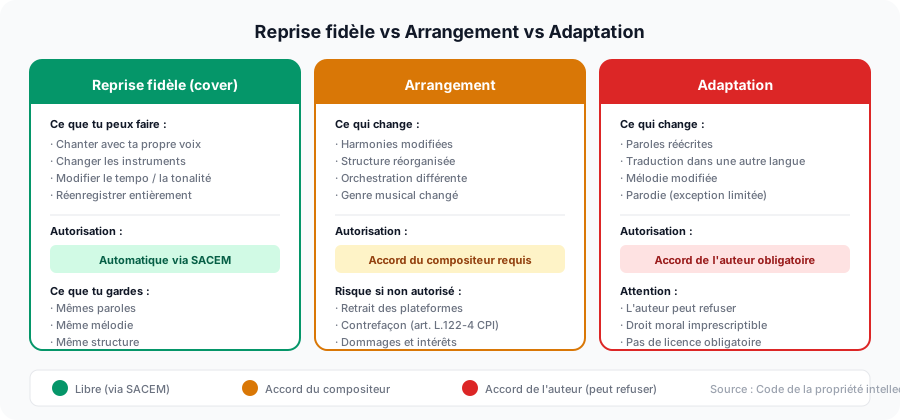 The line between a cover and an adaptation is the most sensitive point in cover song law.
The faithful cover
You perform an existing song with your own voice and your own instruments, but you keep the same lyrics, the same melody, and the same structure. You can change the tempo, key, or instrumentation — as long as the work remains recognizable and faithful to the original.
Permission: automatic via SACEM. You don’t need to contact the author.
The arrangement
You modify the musical composition: rewritten harmonies, reorganized structure, completely changed genre (a jazz version of an electronic track, for example). The lyrics and melody remain the same, but the musical work is substantially different.
Permission: you must obtain the consent of the original composer (or their publisher). SACEM cannot grant you this permission — you need to contact the rights holders directly.
The adaptation
You modify the lyrics (rewriting, translation into another language) or the melody. This is the most sensitive case, as it touches the moral rights of the author — a perpetual and inalienable right under French law (Article L.121-1 of the Intellectual Property Code).
Permission: you must obtain the explicit consent of the original author, who has the right to refuse. There is no compulsory license for adaptations in France.
Key takeaway: the threshold is low. The French Supreme Court has ruled that works must be protected against “any alteration or modification, regardless of its significance.” When in doubt, ask for permission.
The rights at stake when you cover a song
Several layers of rights stack on top of a musical work. Understanding which ones your cover affects helps you avoid confusing what’s allowed and what isn’t.
Copyright (economic rights)
Copyright protects the musical work itself: the lyrics and the composition. It belongs to the authors, composers, and publishers, and is collectively managed by SACEM in France.
For a faithful cover, these rights are automatically covered by SACEM’s agreements with streaming platforms, YouTube, and event organizers. You don’t need to take any individual steps.
For a physical release (CD, vinyl), mechanical reproduction rights are managed by SDRM (a SACEM subsidiary). You must obtain authorization before pressing and pay a royalty of 7.4% of the retail price (minimum 0.50 EUR per copy).
To understand copyright in detail, check out our complete guide to music copyright.
Moral rights
Moral rights are specific to French law. They are perpetual, inalienable, and imprescriptible — even after the author’s death. They include:
- The right of attribution: you must always credit the original author.
- The right of integrity: your cover must not distort the original work.
In practice, a faithful and respectful cover poses no problem. But a parody version, use in a degrading context, or an unauthorized modification can be challenged on moral rights grounds — even if you’ve paid all the royalties.
Recording rights (master)
The original recording (the master) is separately protected by neighboring rights. These rights belong to the producer and performing artists of the original recording.
Key point: when you do a cover, you re-record the track with your own interpretation. You create a new master that you own. You don’t touch the original master — and that’s what makes the cover possible without the original producer’s consent.
However, if you use an excerpt from the original master (even a few seconds), you’re doing sampling, which requires separate authorization from the master rights holder (the label or producer).
To learn more about neighboring rights, check out our guide to neighboring rights in music.
Releasing a cover on streaming platforms
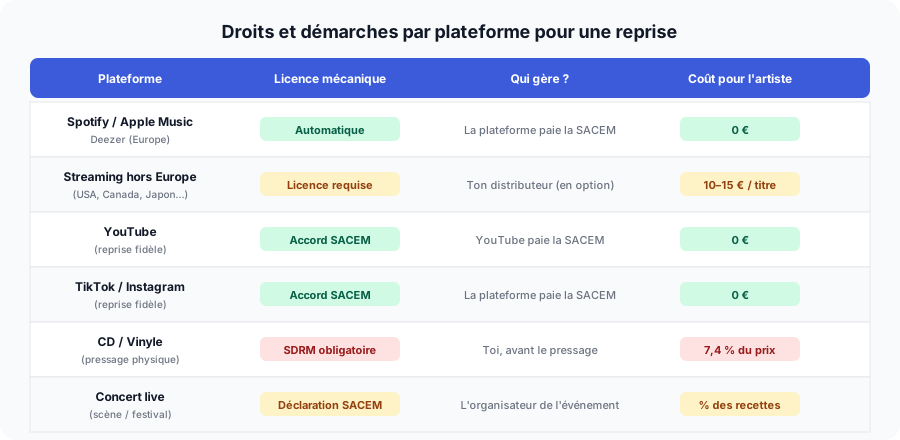 The steps vary depending on the platform and distribution territory.
In Europe: it’s (almost) automatic
Good news if you distribute in France and Europe: streaming platforms (Spotify, Apple Music, Deezer, Amazon Music, Tidal, etc.) have direct agreements with SACEM covering mechanical reproduction rights. In practice:
- You record your cover with your own resources.
- You distribute it through your usual distributor (DistroKid, TuneCore, CD Baby, iMusician, etc.).
- You declare that it’s a cover and credit the original authors in the metadata.
- Platforms automatically pay royalties to the rights holders via SACEM.
You don’t pay anything beyond your usual distribution fees. If you’re looking for the best distributor, check out our digital distribution comparison.
Outside Europe: a mechanical license is required
To distribute your cover in the United States, Canada, Japan, India, and other territories not covered by SACEM agreements, you need a mechanical license.
Most distributors offer this service:
| Distributor | Service | Approximate cost |
|---|---|---|
| DistroKid | Built-in Cover Song Licensing | ~$12/year/track |
| TuneCore | Via Harry Fox Agency | ~10 EUR/track |
| CD Baby | Via Easysong | ~15 EUR/track |
Rules to follow on all platforms
- Keep the original title of the song — don’t modify it.
- Don’t put the original artist’s name in your track title.
- Use your own cover art — not the original album artwork.
- Credit the authors and composers in the metadata.
- Record your own version — never use the original master.
Publishing a cover on YouTube, TikTok, and Instagram
YouTube and the SACEM agreement
Since 2010, YouTube and SACEM have had a license agreement covering 127 territories. This agreement allows users to publish faithful covers without individual authorization. YouTube pays royalties to SACEM, which redistributes them to authors, composers, and publishers.
In practice:
- You record your cover (audio or video).
- You publish it on YouTube, crediting the original authors in the description.
- The Content ID system may detect the work and apply a “claim.”
- The rights holder can then choose to monetize your video (place ads and collect revenue), track it, or block it.
Watch out: Content ID is not a license. Being “allowed” by Content ID doesn’t mean you have legal authorization. The SACEM-YouTube agreement covers faithful covers, but an adaptation (modified lyrics, changed melody) is not covered and can be taken down.
TikTok and Instagram (Reels)
TikTok and Meta (Instagram, Facebook) also have license agreements with SACEM. Faithful covers published on these platforms are therefore covered, and royalties are paid automatically to rights holders.
The same rules apply: a faithful cover is authorized, an adaptation requires the author’s consent.
Playing covers at live shows
When you play covers live, copyright is managed by SACEM through performance rights. But it’s not your responsibility to pay — it’s the event organizer’s.
The organizer’s obligations
- Request authorization from SACEM at least 15 days before the event (to benefit from a 20% discount).
- Submit the program of works performed after the event.
- Pay the royalties calculated as a percentage of revenue or according to a flat-rate schedule.
How much does it cost?
Since January 2025, SACEM applies simplified rate schedules:
- Events up to 5,000 EUR budget: flat-rate pricing.
- Above 5,000 EUR: percentage of revenue or expenses.
- Discounts available: -20% if the request is made 15 days early, -12.5% for popular education associations, -5% for associations with free entry.
Important: even free events require SACEM authorization if protected works are performed. To learn more about organizing concerts, check our guide to booking and touring.
How much do the original authors earn — and you?
This is the question everyone asks. Here’s how revenue is split when your cover is exploited.
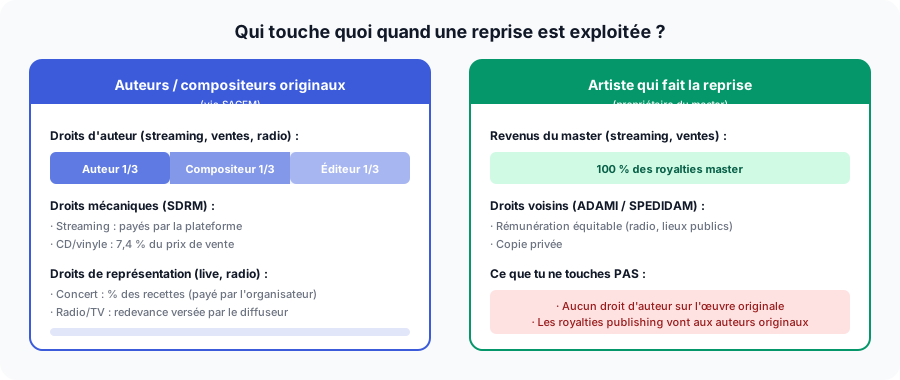 The cover artist earns the master revenue, but not the copyright from the original work.
What the original authors earn
Copyright is distributed by SACEM according to the following rule (for a published work):
- 1/3 to the author (lyricist)
- 1/3 to the composer
- 1/3 to the publisher
For an unpublished work (no publisher):
- 50% to the author
- 50% to the composer
These percentages apply to all royalties collected by SACEM: streaming, physical sales, radio/TV broadcasts, concerts.
What you earn as the cover artist
As the artist performing the cover, you are the owner of the master (the recording). You earn:
- 100% of the master royalties paid by streaming platforms (the “recording” share, after deduction of copyright).
- Neighboring rights via ADAMI and SPEDIDAM if your recording is broadcast on radio, TV, or in public spaces (equitable remuneration, private copying levy).
What you do NOT earn
- No copyright on the original work — it goes entirely to the original authors, composers, and publishers.
- No publishing royalties — even if your cover generates millions of streams.
Key takeaway: covering a song is profitable if you treat it as a tool for visibility and audience growth, not as a primary revenue source. Copyright goes to the original creators, and that’s as it should be. To understand the rights split between co-authors on your own works, check our guide to split sheets.
The public domain: when a work becomes free
A work enters the public domain in France 70 years after the death of its last author (lyricist or composer), in accordance with Article L.123-1 of the CPI.
What changes
When a work is in the public domain:
- You no longer need to pay copyright (economic rights) to cover it.
- You can modify, arrange, or adapt it freely.
- You don’t need SACEM authorization to exploit it.
What remains protected
Moral rights are perpetual under French law. Even for a public domain work:
- You must credit the original author.
- You must not distort the work disrespectfully.
Watch out for wartime extensions
Certain works benefit from wartime extensions that lengthen the protection period:
- 6 years and 152 days for works published before January 1, 1948 (World War I and II).
- 8 years and 120 additional days for authors who “died for France.”
Example: a composer who died in 1940 and did not “die for France” would see their economic rights expire not in 2010 (1940 + 70 years), but around 2016 (with the wartime extension).
How to check if a work is in the public domain
- Identify the authors (lyrics and music) and their date of death.
- Add 70 years to the death date of the last surviving author.
- Check for any applicable wartime extensions.
- Consult the SACEM catalog to verify the work’s status.
The 7 most common mistakes with covers
1. Confusing “cover” with “adaptation” You change a single line of the lyrics? That’s an adaptation. You translate the text into another language? Adaptation. And in both cases, the original author can refuse.
2. Forgetting the mechanical license for distribution outside Europe SACEM agreements cover Europe. For the rest of the world, your distributor must obtain a separate license — otherwise your cover can be pulled from platforms in those territories.
3. Using the original recording (sampling) Covering a song means re-recording your own version. If you use a sample of the original master (even 2 seconds), you need the consent of the producer/label that holds the master rights — a completely different process.
4. Treating Content ID as a license Content ID is a detection tool, not a legal authorization. Just because YouTube doesn’t block your video doesn’t mean you have the right to publish it.
5. Not crediting the original authors Forget this and you violate the author’s moral rights — an imprescriptible right in France. Credit is mandatory in the metadata and in your video description.
6. Using the original album artwork Your cover must have its own artwork. Using the original artwork is a violation of the designer’s and label’s rights.
7. Believing the original artist must give consent This is a myth. The original performer (the singer, the band) has no right over whether or not someone covers their song. Only the authors, composers, and publishers control this authorization, via SACEM.
FAQ — Cover songs
Can you cover a song without permission?
Yes, if it’s a faithful cover (same lyrics, same melody). SACEM handles the authorization automatically through its agreements with platforms and event organizers. However, if you modify the lyrics, melody, or structure, you must obtain explicit consent from the original author.
Do you need to pay royalties to cover a song at a concert?
It’s not your responsibility: the event organizer must declare the works performed to SACEM and pay the royalties. This applies even for free events.
Can you release a cover on Spotify without a mechanical license?
In Europe, yes. Streaming platforms have direct agreements with SACEM covering mechanical reproduction rights. Outside Europe (USA, Canada, Japan, etc.), a separate mechanical license is needed — your distributor can handle it for about 10 to 15 EUR per track.
Can you monetize a cover on YouTube?
You can publish a faithful cover on YouTube thanks to the SACEM-YouTube agreement. However, Content ID may detect the work and redirect ad revenue to the original rights holders. Shared monetization depends on the rights holder’s policy.
What’s the difference between a cover and an adaptation?
A faithful cover keeps the lyrics, melody, and structure of the original work. An adaptation modifies one or more of these elements (new lyrics, translation, changed melody). An adaptation requires the explicit consent of the author, who may refuse.
How do you know if a song is in the public domain?
In France, a work enters the public domain 70 years after the death of its last author (lyrics or music). Watch out for wartime extensions that can lengthen this period. The SACEM catalog lets you check a work’s status.
What are the risks of releasing a cover without permission?
For a faithful cover, the risk is low because SACEM handles the rights automatically. For an unauthorized adaptation, you face an infringement lawsuit (Article L.122-4 of the CPI): removal of the work, damages, and even criminal prosecution.
Conclusion
Covering a song is one of the most natural things in music — but it involves a legal framework you need to understand. The good news: for a faithful cover, the French system works smoothly. SACEM, streaming platforms, and YouTube handle permissions and royalties automatically. You can cover a track and distribute it without contacting anyone.
Where it gets complicated is when you modify the work. A translation, a lyric change, a melodic rewrite — and you’ve crossed into adaptation territory, which requires the author’s consent. Consent they can refuse.
To properly structure your cover on Muzisecur — credit the original authors, document the rights, and generate the contracts — check out our guides:
Related articles

Music Rights: The Complete Guide for Independent Artists (2026)
Copyright, neighboring rights, SACEM, ADAMI, SPEDIDAM, SCPP, SPPF: finally understand all music rights and how to collect every euro you are owed as an independent artist.

Featuring Contract: What You Must Plan Before Recording
No featuring contract = no protection. Rights split, exploitation authorization, negotiation points: everything you need to plan before recording.

The Essential Contracts for Independent Artists
Assignment contract, management deal, split sheet, distribution agreement... Discover the 10 essential contracts every independent artist must know to protect their music and revenue.