Music Rights: The Complete Guide for Independent Artists (2026)

In 2024, the French recorded music market crossed the one-billion-euro mark — 1.031 billion to be exact. Yet a majority of independent artists collect only a fraction of what they should be earning. The reason? They do not know all the music rights they have access to, or they are simply not registered with the right organizations.
If you are a songwriter, composer, performer, beatmaker, or independent producer, this article will show you every type of right that exists in music in France, every organization to join, and above all how to recover every euro you are owed. No unnecessary jargon, just concrete information.
An artist who knows their rights is an artist who can make a living from music.
Copyright in music: the foundation of everything
Copyright forms the bedrock of every music creator’s compensation. In France, copyright is protected by the Intellectual Property Code (articles L. 111-1 and following). You need no formalities to benefit from it: as soon as you create an original work, you are automatically protected.
Concretely, if you write lyrics (author), compose the melody or arrangement (composer), or both, you hold copyright over that work. These rights break down into two major categories every artist must understand: moral rights and economic rights.
Who is concerned?
All creators of original musical works are concerned by copyright. This includes authors (lyricists), composers (melodists, arrangers), songwriter-composers, and beatmakers who create original compositions. Important: a performer who does not compose or write lyrics does not hold copyright on the track (they benefit from neighboring rights, covered later).
Key takeaway: Copyright arises automatically upon creation of the work. No filing is required to benefit from it, but registering with SACEM enables you to collect revenue from your works’ exploitation.
Moral rights vs economic rights: two pillars not to confuse
This is a fundamental distinction that many artists overlook, often to their detriment.
Moral rights: perpetual and inalienable
Moral rights are attached to you as the creator. They are perpetual, inalienable, and imprescriptible — meaning they never expire, you can neither sell nor waive them, and they pass to your heirs after your death. Moral rights comprise four essential prerogatives.
The right of disclosure allows you to decide when and how your work is first revealed to the public. You choose the release date, format, and conditions.
The right of attribution guarantees your name is always mentioned as author or composer, regardless of the context in which your work is used.
The right of integrity prohibits any modification, distortion, or mutilation of your work without your consent. Nobody can remix, re-cut, or alter your creation without permission.
The right of withdrawal allows you to pull your work from circulation, even after assigning it for exploitation, provided you compensate the assignee.
Economic rights: your revenue source
Economic rights are the financial rights. They are what earn you money. They comprise two major branches.
The reproduction right covers any material fixation of the work: studio recording, CD pressing, vinyl, digital download, streaming (which is considered a temporary reproduction).
The performance right concerns any communication of the work to the public: radio broadcast, TV, concert, live streaming, broadcast in bars and restaurants, nightclubs.
These economic rights last for the author’s lifetime, then 70 years after their death (article L. 123-1 of the Intellectual Property Code). After that period, the work enters the public domain — but moral rights persist indefinitely.
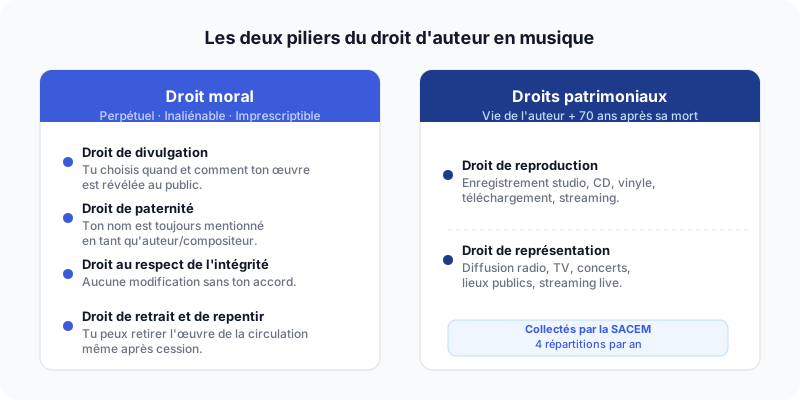
The two pillars of copyright — moral rights never expire, economic rights last 70 years after the author’s death.
SACEM: how it collects and distributes your copyright
SACEM (Société des Auteurs, Compositeurs et Éditeurs de Musique) is the collective management organization that collects and pays you your copyright royalties in France. It is the essential intermediary between you and everyone who uses your music.
How does SACEM work?
The principle is simple. Every time your music is publicly broadcast (radio, TV, concert, bar, nightclub, streaming, download), the person or company broadcasting it must pay royalties to SACEM. SACEM collects these sums, then distributes them to rights holders according to precise rules.
SACEM manages two categories of copyright.
DEP (Public Performance Rights) cover any public broadcast: radio plays, TV, concerts, broadcast in shops, clubs, and festivals. The statutory split is one-third for the author, one-third for the composer, one-third for the publisher (if you have no publisher, you receive two-thirds).
DRM (Mechanical Reproduction Rights) cover the reproduction of the work on a medium: CD, vinyl, USB drive, digital download, and streaming. The split depends on the contract between author, composer, and publisher.
Registering with SACEM: how much and how?
SACEM registration costs 154 EUR (10 EUR capital share + 144 EUR membership fee). It is a one-time payment with no annual dues. The capital share (10 EUR) is returned if you resign.
To join, you must complete an online application on sacem.fr and demonstrate initial exploitation of your work: a streaming platform listing, a YouTube broadcast, or a concert is sufficient.
Once a member, you can declare as many works as you want, free and unlimited.
The SACEM payment calendar
SACEM makes 4 main distributions per year: in January, April, July, and October. Each distribution covers broadcasts from a past period (there is always a delay of several months between broadcast and payment).
Tarik Hamiche’s advice (founder of Producteur a Succes): “A tip I give all my students: regularly contact SACEM to request a rights verification. Many artists do not know they have unclaimed amounts. I have seen students recover hundreds, even thousands of euros simply by requesting a check. SACEM will not necessarily come looking for you — it is up to you to verify.”
Neighboring rights: the second income source 80% of artists forget
Neighboring rights are distinct from copyright. They do not compensate the creation of the work, but its performance and production. They are the rights of those who bring the work to life: performers (singers, musicians, DJs) and phonographic producers (those who fund the recording).
Who benefits from neighboring rights?
The list is broader than most people imagine. Beneficiaries include singers (lead or backing), musicians (instrumentalists, including session players), conductors and artistic directors, beatmakers (considered performers when they play or program instruments), DJs who mix live, artistic producers, and phonographic producers (the person or entity that funds the recording).
Crucial point: you do not need to be a professional to receive neighboring rights. If you are an accountant by day and play bass on a recording on weekends, you are entitled to neighboring rights on that recording.
What is the difference between copyright and neighboring rights?
Copyright pays the creator of the work (the one who writes lyrics or composes music). Neighboring rights pay the performer (the one who sings or plays) and the producer (the one who funds the recording). A songwriter-composer-performer who self-produces accumulates both types and can receive revenue from all sources: SACEM + ADAMI + SPEDIDAM + SCPP or SPPF.
The protection period for neighboring rights is 70 years from the first publication of the phonogram (since the law of February 20, 2015, which extended the period from 50 to 70 years).
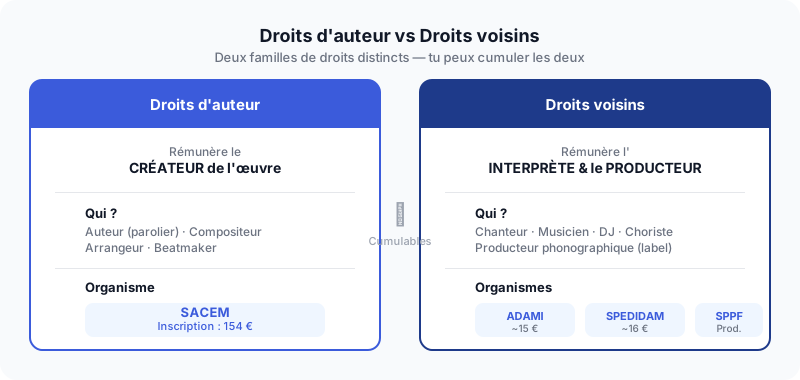
Copyright and neighboring rights are two distinct families — a songwriter-composer-performer can accumulate both.
ADAMI and SPEDIDAM: the two organizations for performing artists
These are the two collective management societies that collect and distribute performing artists’ neighboring rights in France. Yes, there are two, and yes, you should register with both.
ADAMI (Société civile pour l’Administration des Droits des Artistes et Musiciens Interprètes)
ADAMI manages the rights of performing artists whose name appears on the phonogram label or audiovisual credits. Historically, it represents so-called “lead” or “solo” artists — the lead singer, the individually credited guitarist, etc.
ADAMI registration costs approximately 15 EUR. ADAMI individually collects and distributes amounts owed to artists for the use of their recordings: radio and TV broadcast, private copying, equitable remuneration.
Beyond rights distribution, ADAMI offers financial grants for artistic projects: creation aid, live performance support, and recording grants. This is a resource many independents underuse.
SPEDIDAM (Société de Perception et de Distribution des Droits des Artistes-Interprètes)
SPEDIDAM, founded in 1959, manages the rights of performing artists whose name does not necessarily appear on the label — historically backing musicians, studio musicians, and backing vocalists. But this historical distinction is increasingly blurred.
SPEDIDAM registration costs approximately 16 EUR. SPEDIDAM collects and distributes rights related to recording broadcasts, and also offers grants and subsidies for music projects (recording, touring, festivals).
Can you be registered with both?
Yes, and you SHOULD be. An artist can — and should — join both ADAMI AND SPEDIDAM simultaneously. On the same project, you might be credited as lead artist (ADAMI) on one track and as backing musician (SPEDIDAM) on another. For a total investment of about 31 EUR, you gain access to two distinct revenue streams.
Tarik Hamiche’s take (founder of Producteur a Succes): “A songwriter-composer-performer who self-produces has access to 3 revenue sources via collective management organizations: SACEM for copyright, ADAMI and SPEDIDAM for performer neighboring rights. That is part of my 5 income sources that I teach. And I still see artists who are only registered with SACEM… they are literally leaving money on the table.”
The phonographic producer’s rights: SCPP and SPPF
The phonographic producer — the one who funds the recording of a phonogram (master) — also holds neighboring rights. If you are an independent artist who self-funds your recordings, you are a phonographic producer. If you have created a label, your label is the producer.
SCPP or SPPF: which to choose?
There are two producer societies in France.
SCPP (Société Civile des Producteurs Phonographiques) historically groups the majors (Universal, Sony, Warner) and some independent labels. It manages a very large catalog.
SPPF (Société civile des Producteurs de Phonogrammes en France) was created in 1986 specifically by and for independent labels. It administers a catalog of over 5 million phonograms and more than 30,000 music videos, representing approximately 80% of French independent production in terms of distributed rights.
As an independent artist or small label, you will generally join the SPPF. Management fees are approximately 5.5% for phonograms and 6% for music videos on collected rights.
Why does this matter?
As a producer (even a self-producer), you receive via SCPP or SPPF your share of equitable remuneration (50% on the producer side) and private copying. Without registration, these amounts simply are not paid to you.
Additionally, SPPF offers creation grants of up to 40% of your project’s total budget if your application is accepted. This is a considerable funding lever for an independent label.
Equitable remuneration: what radios and public venues owe you
Equitable remuneration is a legal mechanism established by the French Intellectual Property Code (article L. 214-1). Every time a commercially released phonogram is played in a public venue — radio, TV, bar, restaurant, nightclub, waiting room — a fee is owed to performing artists and producers.
How does it work?
SPRE (Société pour la Perception de la Rémunération Équitable) collects this fee from broadcasters. SPRE is a joint society of the four neighboring rights organizations.
Equitable remuneration rates are set by regulation. For radio stations, the rate is 5% of revenue (including advertising). For television, it is 2% of revenue. For nightclubs and broadcast venues, rates depend on the type and size of the establishment.
How is it distributed?
After deducting management fees, SPRE distributes collected amounts according to the legal split: 50% to the “Producer” group (via SCPA, the joint society of SCPP and SPPF) and 50% to the “Performing Artist” group (via ADAMI and SPEDIDAM).
In other words, to receive your share of equitable remuneration, you must be registered on the right side: with ADAMI and/or SPEDIDAM as a performer, and with SCPP or SPPF as a producer.
Key takeaway: Equitable remuneration is an automatic right. As soon as your music plays on radio or in a public venue, you are entitled to it. But you still need to be registered to receive it.
Private copying: a revenue source nobody explains
Private copying remuneration is a French (and European) mechanism that compensates rights holders for copies of works made for personal use. In practice, a levy is charged on the sale price of every blank recording medium or digital device sold in France: smartphones, USB drives, hard drives, tablets, etc.
How much does it represent?
The amounts are significant. On average, a smartphone sold in France includes approximately 10 EUR in private copying levy. A USB drive approximately 1.50 EUR. A hard drive under 5 TB approximately 6 EUR. These sums are collected by Copie France from manufacturers and importers.
How is it distributed?
Distribution is split between three major families of rights holders: 37.5% for creators and publishers (via SACEM notably), 18.75% for performing artists (via ADAMI and SPEDIDAM), and 18.75% for producers (via SCPP and SPPF). The remaining 25% funds creation support and live performance grants.
As an independent artist registered with the right organizations, you receive your share of private copying proportional to the broadcast and commercialization of your recordings.
Synchronization: selling your music to the screen
The synchronization right is the right to combine a musical work with an image: film, TV series, advertisement, video game, documentary, YouTube content. It is one of the most lucrative revenue sources in the music industry, and often underexploited by independent artists.
How does it work?
To use your music in an audiovisual production, the producer of that production must obtain two separate authorizations: consent from the work’s rights holders (author/composer or their publisher, for copyright) and consent from the phonographic producer (the master holder, for neighboring rights).
If you are both songwriter-composer AND master owner (which is the case if you self-produce), you control both sides of the equation. This is a huge competitive advantage of independence: you can say yes quickly, without going through a major’s approval chain.
How much does it pay?
Sync fees vary enormously. A brand’s Instagram story placement might bring a few hundred euros. A national TV ad placement can range from 5,000 to 50,000 EUR or more. A placement in a hit film or series can generate recurring revenue for years through broadcast royalties.
There is no regulated pricing for sync — it is a free negotiation between parties. That is why it is essential to know the value of your music and your rights so you do not undervalue your catalog.
Streaming and rights: who gets what in 2026?
Streaming now represents the top revenue source for recorded music in France. In 2024, streaming platform subscriptions (Spotify, Deezer, Apple Music, Amazon Music, YouTube Music, Qobuz) generated 522 million euros, or 60% of total market revenue. Streaming plays totaled 138 billion plays for 27 million users.
How are streaming revenues distributed?
When a listener plays your track on Spotify or Deezer, multiple rights streams are triggered simultaneously.
The digital distributor (TuneCore, DistroKid, Believe, iMusician, etc.) receives streaming royalties and pays them to the producer (you or your label), after deducting their commission. This is your “digital sales” revenue.
SACEM collects copyright royalties on streaming in parallel (mechanical reproduction right + performance right) and pays them to authors and composers during quarterly distributions.
ADAMI and SPEDIDAM collect the performer share of neighboring rights from streaming and distribute it to performing artists.
SCPP or SPPF collect the producer share of neighboring rights from streaming.
In other words, for a single stream, a songwriter-composer-performer-producer can receive revenue from four different sources. That is why being registered everywhere is not optional.
How much does a stream pay?
The amount per stream varies by platform, listener’s country, and subscription type (free or paid). In rough terms for France in 2025-2026, a paid Spotify stream pays between 0.003 and 0.005 EUR to the producer via the distributor. SACEM royalties are added on top and paid separately. Neighboring rights (ADAMI/SPEDIDAM/SPPF) are added on top of that.
It is the combination of all these streams that makes streaming viable, not any single one in isolation.
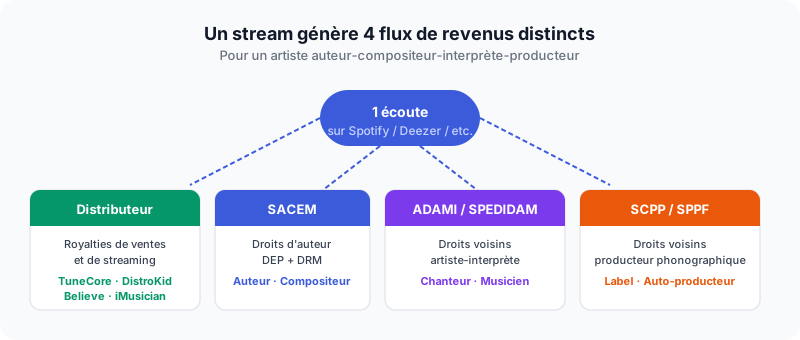
For a self-produced ACI artist, each stream simultaneously activates 4 distinct revenue sources.
This is exactly the kind of multi-source tracking that Muzisecur automates for you. No more juggling 15 Excel files to figure out how much you earn and from where.
Summary table: all music rights and associated organizations
Here is the overview you need to memorize. This table summarizes all types of rights, who benefits, and which organization manages them.
| Type of right | Beneficiary | Organization | Registration cost | What it collects |
|---|---|---|---|---|
| Copyright (DEP + DRM) | Author, composer, publisher | SACEM | 154 EUR (one-time) | Radio, TV, concerts, streaming, download, reproduction |
| Performer neighboring rights (lead) | Credited performing artist | ADAMI | ~15 EUR | Radio/TV broadcast, private copying, equitable remuneration |
| Performer neighboring rights (backing) | Musician, backing vocalist, DJ | SPEDIDAM | ~16 EUR | Radio/TV broadcast, private copying, equitable remuneration |
| Producer neighboring rights (independent) | Phonographic producer / indie label | SPPF | Variable | Equitable remuneration, private copying |
| Producer neighboring rights (major) | Phonographic producer / major | SCPP | Variable | Equitable remuneration, private copying |
| Equitable remuneration | Performers + producers | SPRE (collector) | — | Public venue broadcasts, radios, TV |
| Private copying | All rights holders | Copie France (collector) | — | Levy on blank media and devices |
| Synchronization | Author + master producer | Direct negotiation | — | Music-to-image placement (ad, film, series, video game) |
| Sales / Streaming | Producer (or self-produced artist) | Digital distributor | Variable | Sales and streaming royalties |
How to collect all your rights: the concrete action plan
Now that you know all the types of rights, here is the 5-step action plan to never leave a single euro on the table.
Step 1: Register with SACEM (if you are an author and/or composer)
Go to sacem.fr, create your account, pay the 154 EUR membership fee, and declare all your works. Every song you have written or composed must be declared — that is the condition for collecting your copyright royalties.
Step 2: Register with ADAMI AND SPEDIDAM (if you perform)
Go to adami.fr and spedidam.fr. Register with both. Total cost: about 31 EUR. Declare your participations in recordings. These are your performer neighboring rights.
Step 3: Register with SPPF (if you produce your recordings or have a label)
Go to sppf.com and build your membership file. You will need to demonstrate that you are the phonographic producer of your recordings. Your producer neighboring rights will then be collected and distributed.
Step 4: Choose a digital distributor for your sales and streaming
Distribute your music via an aggregator (TuneCore, DistroKid, iMusician, Believe, CD Baby…). These are your direct sales and streaming royalties — the first of your 5 revenue sources.
Step 5: Centralize tracking of all your revenue
With 4 to 5 different revenue sources (distributor + SACEM + ADAMI + SPEDIDAM + SPPF), tracking can quickly become a nightmare. That is exactly the purpose of Muzisecur: centralizing the administrative management of your music in one place, so you can focus on your music.
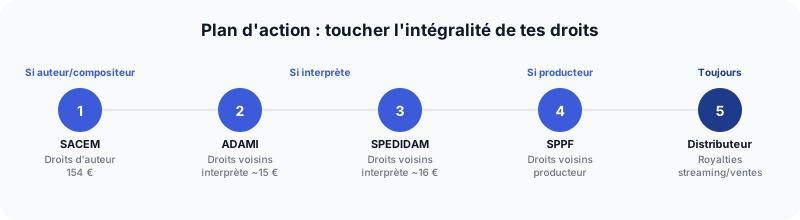
The 5 registrations to complete so you never leave a single euro on the table.
FAQ: music rights
What is the difference between copyright and neighboring rights?
Copyright pays the creators of the musical work (lyricist, composer). Neighboring rights pay those who perform the work (singer, musician) and those who fund its recording (producer). A songwriter-composer-performer who self-produces accumulates both.
Is SACEM registration mandatory?
No, SACEM registration is not legally mandatory. You can manage your copyright yourself in theory. But in practice, it is virtually impossible to individually collect royalties from every radio station, bar, streaming platform, and concert venue that plays your music. SACEM makes this collection possible and automatic.
Can you be registered with ADAMI and SPEDIDAM at the same time?
Yes, and it is even recommended. ADAMI and SPEDIDAM manage complementary rights. An artist can be credited as a lead performer on one recording (rights managed by ADAMI) and as a backing musician on another (rights managed by SPEDIDAM). Registration with both costs about 31 EUR total.
How much do neighboring rights pay per year?
Amounts vary enormously depending on the artist’s profile, number of recordings, and their broadcast frequency. An emerging artist with a few tracks on radio might receive a few dozen to a few hundred euros per year. An artist with an established catalog and regular radio and TV plays can receive several thousand euros annually. The key is to be registered so you do not lose anything.
Do you need a label to collect your rights?
No. As a self-produced independent artist, you can register with all organizations (SACEM, ADAMI, SPEDIDAM, SPPF) without a label or structure. If you fund your own recordings, you are the phonographic producer yourself and have access to producer neighboring rights via SPPF. A label facilitates management, but it is not a prerequisite.
How much does it cost to register with all organizations?
The total budget to register with all key organizations is approximately 200 EUR: 154 EUR (SACEM) + 15 EUR (ADAMI) + 16 EUR (SPEDIDAM) + variable fees (SPPF). That is a trivial investment compared to potential revenue over an entire career.
Conclusion
Music rights are not a side topic — they are the backbone of your compensation as an independent artist. Copyright via SACEM, performer neighboring rights via ADAMI and SPEDIDAM, producer rights via SPPF, equitable remuneration, private copying, synchronization, streaming and sales revenue: every stream counts, and every registration with an organization opens access to revenue you deserve.
The French music market exceeds one billion euros. That money is distributed among those who know the system and are registered within it. It is up to you to be one of them.
Want to centralize the tracking of all your music rights and revenue in one place? Discover Muzisecur — the SaaS that simplifies administrative management for independent artists and labels, so you can focus on what truly matters: your music.
Related articles

Cover Songs: What Rights, Permissions, and Royalties Apply?
Covering a song in France involves specific rights. This guide details the permissions, licenses, and royalties for every platform.

Featuring Contract: What You Must Plan Before Recording
No featuring contract = no protection. Rights split, exploitation authorization, negotiation points: everything you need to plan before recording.

Do You Know What the Intermittent Performer Status Is?
Complete guide to France's intermittent performer status: the 507-hour rule, annexes 8 and 10, benefit calculation, performance fees, leave, common mistakes, and full FAQ.