Split Sheet: How to Share Music Rights Between Co-Writers

You just wrapped up a studio session with a beatmaker, a topliner, and a lyricist. The track is incredible. Everyone’s pumped. People are already talking about the release date, the music video, the promo. But nobody asks the awkward question: who gets what?
That’s exactly where everything falls apart. Not today, not tomorrow — but six months from now, when the track starts generating revenue, and everyone has a different version of what was “agreed verbally.” The split sheet is the document that prevents this nightmare. And yet, it’s probably the most neglected document in the entire music industry.
In this article, we break down the split sheet from A to Z: what it is, why it’s essential, how to write one, and most importantly how to avoid the mistakes that cost artists thousands of euros every year.
Why the split sheet is essential
Let’s start with a reality many musicians discover too late: co-writing without a split sheet is a ticking time bomb. As long as the track earns nothing, everything’s fine. But as soon as the first revenue comes in — streams, syncs, radio plays — the problems begin.
Without a written document, it’s impossible to prove who did what. And in the absence of an agreement, French law (Article L113-3 of the Intellectual Property Code) presumes an equal split among all co-writers. That means if you wrote 80% of the lyrics and composed the melody, but your friend only added two words to the chorus, you each get 50%. That’s the law.
The split sheet solves this problem by putting in black and white each person’s contribution and the percentage of rights they receive.
Key takeaway: Without a signed split sheet, the presumption of equal shares applies. Regardless of your actual contribution, you’ll be paid equally with all other co-writers.
The concrete consequences of not having a split sheet
Here’s what happens when you release a track without a split sheet:
- Blocked at SACEM: to register the work, you need to enter percentages. Without an agreement, the work is either poorly registered or not registered at all.
- Conflicts between co-writers: six months later, the beatmaker thinks they deserve 50%, so does the topliner, and so do you. Total: 150%. That doesn’t work.
- Frozen revenue: platforms and collecting societies can freeze payments as long as there’s a dispute over the rights.
- Lawsuits: in extreme cases, you end up before a judge. Time wasted, money wasted, relationships destroyed.
What is a split sheet exactly
A split sheet (literally a “distribution sheet”) is a document that identifies all contributors to a track and defines the percentage of rights each one holds in the work.
It’s not an assignment contract. It’s not a license deal. It’s a distribution agreement between co-writers and co-composers. It doesn’t transfer any rights to a third party — it simply clarifies who owns what within the group of creators.
The split sheet is a legal document in its own right. Once signed by all parties, it serves as evidence in case of a dispute. It’s the proof of what was agreed between the co-writers.
What a split sheet is NOT
To avoid any confusion:
- It’s not a publishing contract: the publisher is a third party who exploits the work. The split sheet only concerns the creators.
- It’s not a production contract: production (the master) is covered by separate agreements (artist contract, license deal, neighboring rights assignment).
- It’s not a distribution contract: distribution concerns getting the music onto platforms, not how rights are split.
The 3 types of rights to split
Before talking percentages, you need to understand which rights are at stake. In music, there are three broad categories of rights, and the split sheet doesn’t always cover all three.
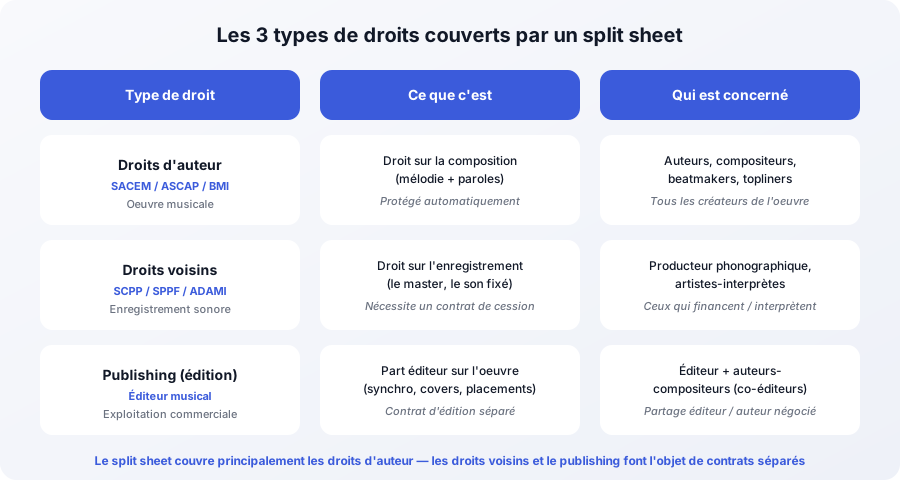
The three categories of rights in the music industry and their scope.
Copyright (composition + lyrics)
This is the core of the split sheet. Copyright protects the musical work itself: the melody, the harmony, the rhythm (when it’s original), and the lyrics. In France, these rights are managed by SACEM (the French collecting society for songwriters and composers).
The split sheet distributes these rights among everyone who contributed to creating the work: lyricists, melody composers, beatmakers (for the composition portion of the instrumental).
Neighboring rights (master / recording)
Neighboring rights concern the sound recording — the master. They are distinct from copyright. The phonographic producer (the one who funds the recording) and the performing artists hold these rights.
A split sheet can include a neighboring rights split, but it’s less common. Typically, the master rights split is covered by a separate assignment contract or production contract.
Publishing
Music publishing concerns the commercial exploitation of the work. If you have a publisher, they take a share of your copyright in exchange for placements (syncs, ads, films). The split sheet doesn’t directly deal with publishing, but the percentages it defines serve as the basis for the publishing contract.
Key takeaway: The split sheet primarily covers copyright on the musical work. Neighboring rights (master) and publishing are handled by separate contracts, but the split sheet is the foundation.
How to determine the percentages
This is the trickiest part. There is no universal rule for splitting percentages on a track. Every collaboration is unique, and it’s up to the co-writers to reach an agreement.
That said, here are the most common approaches in the industry.
Approach 1: Contribution-based split
This is the most logical approach. You evaluate each person’s contribution and assign a proportional percentage.
| Role | Typical contribution | Usual range |
|---|---|---|
| Lyricist | Full lyrics | 20% – 50% |
| Composer (melody) | Main melody, chords | 20% – 50% |
| Beatmaker | Complete instrumental | 20% – 50% |
| Topliner | Vocal melody + sometimes lyrics | 15% – 40% |
| Arranger | Musical arrangement | 5% – 15% |
| Featured artist (who co-writes) | Verse or chorus | 10% – 25% |
Approach 2: Equal split
Some groups and collectives choose to split everything equally, regardless of individual contributions. This is the case for many rock or pop bands: 4 members = 25% each.
The advantage: no discussion, no tension. The downside: it’s often unfair, and it can create long-term frustration if one person consistently contributes more than the others.
Approach 3: Music / lyrics split
The traditional approach divides the work into two blocks:
- 50% for the music (composition, melody, instrumentation)
- 50% for the lyrics (text)
Then, you split each block among the relevant contributors. If two people wrote the lyrics, each gets 25% (half of the 50%). If the beatmaker did all the music alone, they get 50%.
This is the approach used by most collecting societies, including SACEM.
Concrete split sheet example
Let’s take a real case. Imagine an R&B/rap track created by three people:
- Lila (topliner): she composed the vocal melody for the chorus and wrote part of the chorus lyrics
- DJ Kore (beatmaker): he produced the entire instrumental (beat, bass, chords, arrangement)
- Manu (lyricist): he wrote the verses and part of the chorus
Here’s how they might split the rights:
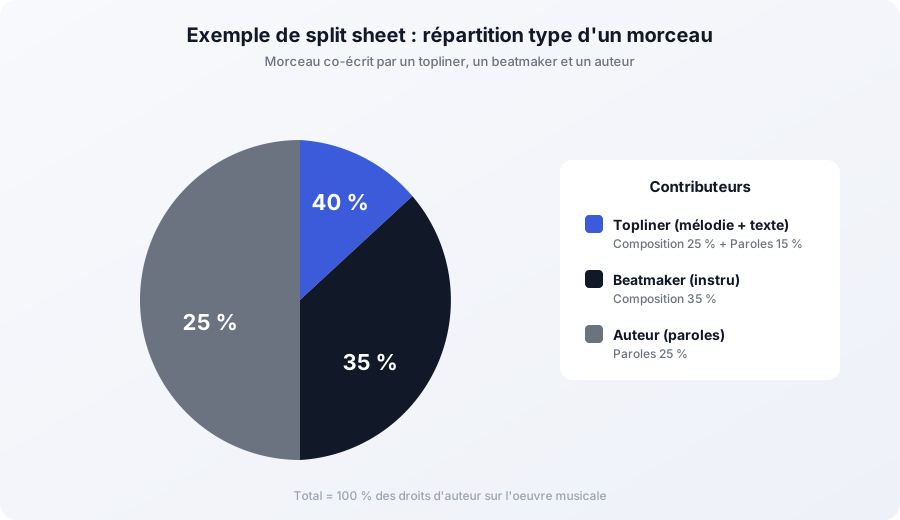
Typical split for a co-written track between three contributors.
The reasoning behind these percentages
Using the music/lyrics approach (50/50):
Music block (50%):
- DJ Kore (complete instrumental): 35%
- Lila (vocal chorus melody): 15%
Lyrics block (50%):
- Manu (verses + chorus co-writing): 25%
- Lila (chorus co-writing): 10%
Totals:
- Lila: 15% + 10% = 25%
- DJ Kore: 35%
- Manu: 25% + 15% (considering his larger lyrics contribution) = 40%
The total adds up to 100%. Each contributor signs the split sheet and validates these percentages. Done. No nasty surprises in six months.
What this represents in revenue
To give you an order of magnitude: if this track generates 10,000 EUR in SACEM copyright royalties over a year (which would correspond to roughly 2-3 million streams), here’s what each person earns:
| Contributor | Split | Annual revenue |
|---|---|---|
| Manu (lyricist) | 40% | 4,000 EUR |
| DJ Kore (beatmaker) | 35% | 3,500 EUR |
| Lila (topliner) | 25% | 2,500 EUR |
| Total | 100% | 10,000 EUR |
When to write the split sheet
The answer is simple: as soon as possible after the track is created. Ideally, the same day as the writing session.
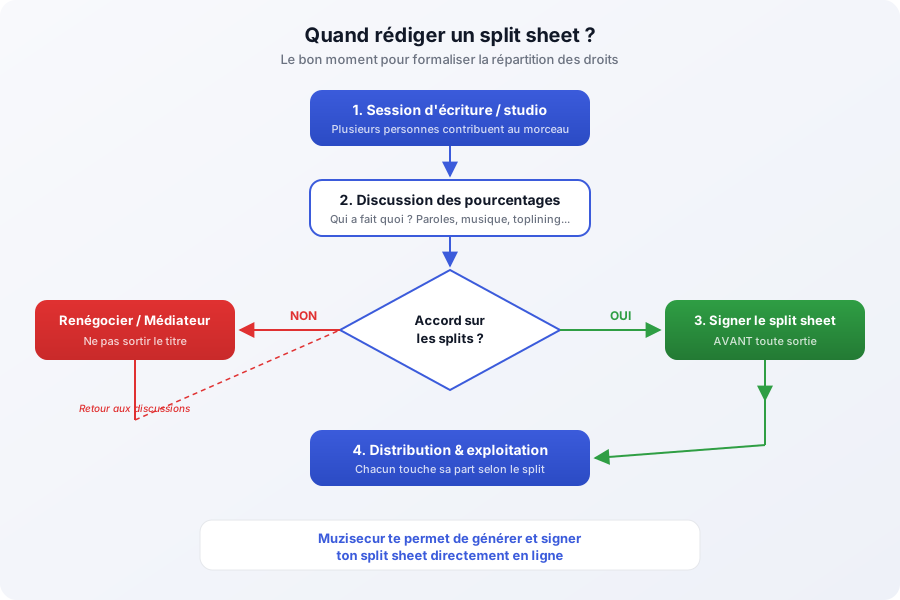
The right time to formalize the rights split between co-writers.
Why you shouldn’t wait
The longer you wait, the more memories fade. Three months after the session, nobody remembers exactly who suggested the chord change on the bridge, who tweaked the second line of the chorus, or who came up with the hook. And that’s where conflicts are born.
The golden rule
Before any release, the split sheet must be signed. This is non-negotiable. Before sending the track to the distributor, before posting it on social media, before launching the promo — the split sheet must be validated and signed by all co-writers.
If you use Muzisecur, you can automatically generate a split agreement as soon as the track is ready. Each contributor receives the document, validates it, and signs it electronically. It’s done in minutes, not weeks.
Key takeaway: Write the split sheet the day of the session. Sign it before any release. No exceptions.
What a complete split sheet must contain
An effective split sheet must be clear, complete, and unambiguous. Here are the essential elements.
Information about the work
- Track title (working title + final title if different)
- Creation date (day of the writing session)
- Approximate duration
- Musical genre
- ISRC code (if already assigned)
- ISWC code (if already assigned by the collecting society)
Information about each contributor
For each co-writer/co-composer:
- Full legal name
- Artist name / pseudonym
- Role (lyricist, composer, beatmaker, topliner, arranger…)
- IPI/CAE number (SACEM or other collecting society identifier)
- Collecting society (SACEM, ASCAP, BMI, PRS…)
- Publisher (if applicable, with name and publishing percentage)
- Percentage of rights assigned
Essential clauses
- Work registration: who is responsible for registering the work with SACEM (or other organization)?
- Right to modify: can the work be modified without the consent of all co-writers?
- Exploitation: which exploitations are authorized (streaming, sync, sampling…)?
- Duration: are the percentages valid for the entire duration of copyright (70 years post mortem in France)?
- Signatures of all contributors
- Signature date
Split sheet template
Here’s a standard template you can adapt to your situation. For a legally solid document, we always recommend using a professional tool like Muzisecur which generates contracts compliant with French law.
Simplified template
SPLIT SHEET — RIGHTS DISTRIBUTION AGREEMENT
Work title: [Track title] Creation date: [DD/MM/YYYY] Genre: [Musical genre]
| # | Full name | Stage name | Role | IPI/CAE | Society | Publisher | % |
|---|---|---|---|---|---|---|---|
| 1 | [Name] | [Stage name] | Songwriter-Composer | [No.] | SACEM | [Publisher] | [X]% |
| 2 | [Name] | [Stage name] | Composer | [No.] | SACEM | — | [X]% |
| 3 | [Name] | [Stage name] | Songwriter | [No.] | SACEM | — | [X]% |
Total: 100%
The undersigned declare that they are the sole authors and composers of the work mentioned above and accept the rights distribution as defined in this document.
The registration of the work with SACEM will be carried out by: [Name of responsible party].
Done at [City], on [Date].
Signatures:
- Contributor 1: _______________
- Contributor 2: _______________
- Contributor 3: _______________
Key takeaway: This template is a starting point. For a legally complete and compliant document, use Muzisecur which automatically generates your split agreements with integrated electronic signatures.
Mistakes that cost real money
In over a decade in the music industry, we’ve seen dozens of situations that could have been avoided with a simple split sheet. Here are the most common — and most expensive — mistakes.
Mistake 1: Agreeing “verbally”
This is the classic mistake. “Don’t worry, we’ll do 50/50, it’s settled.” Except six months later, one person remembers “60/40” and the other remembers “50/50.” Without a written document, it’s your word against theirs.
Potential cost: months of negotiation, frozen revenue, and sometimes the end of a promising artistic collaboration.
Mistake 2: Forgetting the beatmaker
In rap and urban music, this is epidemic. The artist buys a beat (or gets it for free), releases the track, and never credits the beatmaker as a co-composer. But the beatmaker is the author of the composition. If they’re not credited and don’t receive their share, they can have the exploitation of the track blocked.
Potential cost: track removed from platforms, lawsuit, damages.
Mistake 3: Not distinguishing between buying a beat and rights assignment
Buying a beat on BeatStars for 30 EUR doesn’t mean you own the copyright on the composition. Most beat licenses are non-exclusive licenses that don’t transfer composition rights. The beatmaker remains the co-writer and co-composer of the work.
Only an exclusive assignment contract (buyout) can transfer all rights from the beatmaker. And even then, under French law, copyright is inalienable — the beatmaker always retains their status as author.
Mistake 4: Percentages that add up to more than 100%
This happens more often than you’d think. Each contributor negotiates their percentage separately, and in the end the total exceeds 100%. Result: impossible to register the work with SACEM, and everyone has to renegotiate.
Mistake 5: Confusing publisher shares and songwriter shares
If you have a publisher who takes 30% of your share, it doesn’t change the split sheet. The split sheet distributes 100% of the copyright among the creators. The publisher share comes afterward, deducted from each songwriter’s share who signed a publishing deal.
Example: if you hold 40% of the track and your publisher takes 30% of your share, you effectively earn 28% (40% x 70%) and your publisher earns 12% (40% x 30%). But on the split sheet, it’s 40% that appears under your name.
Mistake 6: Not updating the split sheet after changes
The track evolves. A new verse is added by another writer. The producer completely redoes the instrumental. If the original split sheet isn’t updated to reflect these changes, you’ll have a document that no longer matches reality.
Key takeaway: A split sheet isn’t “final” until the track is released. If the composition evolves, the split sheet must evolve with it.
Split sheets and beatmakers: a special case
Sharing royalties with a beatmaker is probably the topic that generates the most conflicts in urban music and the beat-making industry. Here are the rules to know.
The beatmaker is a songwriter-composer
Under French law, the creator of an instrumental is a songwriter-composer under the Intellectual Property Code. They are not a mere “technical provider.” Their contribution is an original work protected by copyright.
Concretely, this means:
- The beatmaker must be declared as a co-writer/co-composer with SACEM
- They are entitled to a share of the copyright royalties generated by the exploitation of the work
- This share must appear on the split sheet
The different scenarios
Scenario 1: Beat created during a joint session Everyone is in the studio, the beat takes shape alongside the lyrics and melody. The split sheet is straightforward: everyone negotiates their share based on their overall contribution.
Scenario 2: Beat purchased under non-exclusive license You buy a beat online. The beatmaker retains their copyright. You must credit them and grant them a percentage of the copyright (usually between 20% and 50% of the composition share).
Scenario 3: Beat purchased exclusively (buyout) The beatmaker sells you the beat exclusively. You get exclusive use, but under French law, the beatmaker remains a co-author. A split sheet is still needed to set the SACEM percentages.
Scenario 4: Beat as production (beatmaker is also the producer) The beatmaker produces the track and invests in the recording. They then hold both copyright (split sheet) AND neighboring rights (production contract). Two separate documents are needed.
Typical beatmaker percentages
In the industry, sharing royalties with a beatmaker generally follows these standards:
| Situation | Beatmaker share (composition) |
|---|---|
| Simple beat, lyrics-heavy track | 15% – 25% |
| Complex beat, heavy arrangement | 30% – 40% |
| Beat + toplining (vocal melody) | 40% – 60% |
| Beat sold exclusively | Variable (negotiated by contract) |
FAQ: split sheets and rights distribution
Is a split sheet legally required?
No law requires you to write a split sheet. But without one, the law presumes equal shares among co-writers. A split sheet is therefore essential in practice to protect everyone’s interests.
Can you modify a split sheet after signing?
Yes, provided all signatories agree. An addendum to the original split sheet can be drafted and signed by all parties. On Muzisecur, you can generate an addendum in a few clicks.
Does the split sheet replace the SACEM registration?
No. The split sheet is a private agreement between co-writers. Registering the work with SACEM is a separate step required to collect royalties. But the split sheet serves as the basis for filling out the SACEM registration form.
What happens if a co-writer refuses to sign?
If a co-writer refuses to sign the split sheet, you have two options: (1) negotiate until you reach an agreement, or (2) don’t release the track. Releasing a track without all co-writers agreeing on the split exposes you to legal action.
Do split sheets apply to remixes too?
Yes. A remix creates a derivative work. The remixer may be considered a co-writer if they make an original creative contribution. A separate split sheet for the remix must be established, in addition to the authorization from the original author.
Do I need a split sheet for every track?
Yes, absolutely. Each track is a distinct work with potentially different contributors and percentages. Even if you always work with the same people, contributions vary from one track to the next.
How do you handle a split sheet when co-writers are in different countries?
This is increasingly common with remote sessions. The split sheet remains valid internationally. The key is that each co-writer indicates their collecting society (SACEM in France, ASCAP/BMI in the US, PRS in the UK, GEMA in Germany). Collecting societies have reciprocal agreements to transfer royalties to each other.
Can you make a split sheet without being registered with SACEM?
Yes, the split sheet is a private document that requires no prior registration. However, to actually collect your copyright royalties, you’ll eventually need to join a collecting society.
Conclusion
The split sheet is a simple document, quick to write, and one that can save you years of headaches. If you take away one thing from this article, it’s this: never release a co-written track without a signed split sheet.
The discussion about percentages can be uncomfortable, especially between friends or regular collaborators. But that 15-minute conversation in the studio can save you thousands of euros and preserve artistic relationships in the long run.
With Muzisecur, you can automatically generate your split and rights assignment agreements. Each contributor is identified, percentages are formalized, and electronic signatures let you wrap everything up before you even leave the studio. No more approximate Word templates or endless discussions — the tool handles the admin for you, and you can focus on what matters: the music.
The split sheet isn’t a formality. It’s the foundation of every healthy music collaboration.
Related articles

Featuring Contract: What You Must Plan Before Recording
No featuring contract = no protection. Rights split, exploitation authorization, negotiation points: everything you need to plan before recording.

Independent Label: How to Structure the Admin Management of Your Artists
Contracts, distribution, rights, accounting, promotion: the 5 admin pillars of an independent label and how to structure them without drowning.

Music Publishing: Everything You Need to Know About the Publisher's Role
Music publisher, publishing deal, SACEM splits, sync, sub-publishing: the complete guide to music publishing in France and how to decide between a publisher and self-publishing.