Independent Label: How to Structure the Admin Management of Your Artists

You have just created your independent label — or you are seriously considering it. You have the artistic vision, the talent roster, maybe even your first tracks online. But there is a subject nobody covers in YouTube tutorials: administration. Contracts, distribution, rights, accounting, promotion — everything that makes a label actually work, beyond the music.
In France, creating an independent label is relatively straightforward legally. But running it day-to-day, with multiple artists, several releases per month, dozens of organizations to contact, royalties to split, and legal obligations to meet — that is a different story. And that is precisely where the majority of independent labels fail: not from a lack of artistic talent, but from poor administration.
This article is a complete guide to structuring your label’s administrative management, pillar by pillar. Whether you have 2 or 10 artists on your roster, you will find the tools, processes, and best practices to stop drowning in paperwork.
Why administration is the lifeblood of a label
Let us be honest: nobody starts a label to do paperwork. You start a label because you believe in artists, because you want to build a catalog, because you have a musical vision. Admin is what comes after — and what catches up with everyone.
Here is what an independent label must manage daily:
- Contracts with every artist, every collaborator, every service provider
- Distribution of every release to platforms (and sometimes physical)
- Rights declarations to SACEM, SCPP, SPPF, CNM
- Accounting: revenue, expenses, VAT, royalty splits
- Promotion: press relations, playlisting, radio, social media
Multiply that by the number of artists on your roster, and you quickly understand why independent label founders spend more time on Excel than on Ableton.
Key takeaway: A label that does not structure its administration from the start accumulates an organizational debt that becomes unmanageable at 3-4 artists. Better to lay the foundations early.
The 5 admin pillars of an independent label
Before diving into each pillar, here is the overview. A label’s administration rests on 5 fundamental functions, all interconnected:
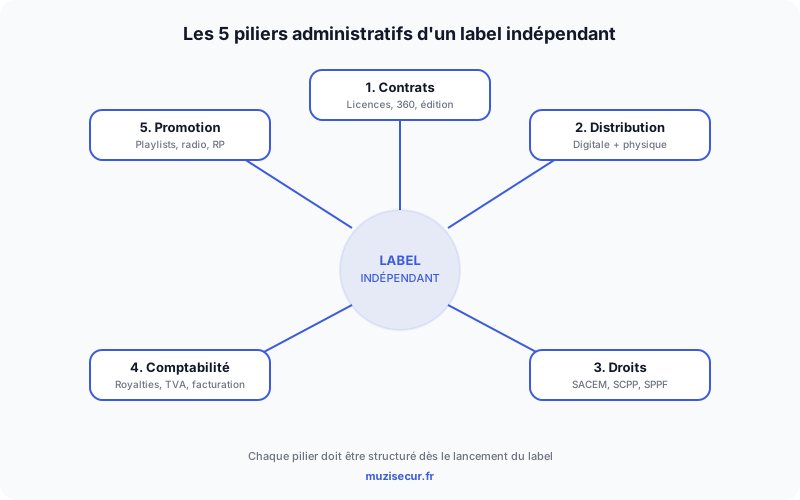
The 5 administrative pillars of an independent label — each feeds the others.
If even one of these pillars is weak, the whole structure wobbles. A poorly drafted contract creates royalty split problems. Mismanaged distribution prevents rights collection. Sloppy accounting erodes your artists’ trust. Everything is connected.
Pillar 1: Contracts
The legal foundation of every label
The contract is the document that defines the relationship between your label and each artist. Without a contract, you have no legal basis to exploit the music, collect revenue, or make decisions on the artist’s behalf.
As an independent label in France, you will mainly use three types of contracts:
The artist contract (or exclusive recording contract)
This is the music industry’s historic contract. The artist assigns the label the right to exploit their recordings (masters) in exchange for an advance and royalties. The label funds production, distribution, and promotion.
Pro: you control the masters, you decide the strategy. Con: you bear all the financial risk.
The license deal
The artist produces their own master and “licenses” it to you for a set period. You do not own the recording — you have the right to exploit it temporarily.
Pro: less upfront investment, more balanced relationship. Con: you do not build a catalog asset.
For a deeper look at different contract types, check out our full article on essential contracts for independent artists.
The distribution contract
Even if you distribute yourself, you need a contract governing the relationship with your digital distributor. This contract specifies territories, duration, commission, and termination conditions.
The essential clauses to never forget
| Clause | Why it matters |
|---|---|
| Duration and territory | Limits your commitments in time and space |
| Revenue split | Prevents conflicts — everything is in black and white |
| Master ownership | Who owns what, and for how long |
| Exit conditions | How the artist (or label) can end the contract |
| Obligations of each party | Who does what — production, promotion, distribution |
| Review clause | Checkpoint to renegotiate if the project evolves |
Key takeaway: Never copy a contract found on the Internet without adapting it to your situation. Every artist-label relationship is unique. A poorly adapted standard contract is worse than no contract at all — because it gives a false sense of security.
Pillar 2: Distribution
Getting the music onto platforms
Distribution is the act of making your label’s music available where people listen: Spotify, Apple Music, Deezer, Amazon Music, YouTube Music, Tidal, and 150+ other streaming platforms.
Two options for an independent label
Option 1: Third-party distributor You go through an aggregator like DistroKid, TuneCore, Believe, The Orchard, or IDOL. They handle the technical encoding, delivery to platforms, and revenue collection.
Option 2: Direct distribution deal Some labels big enough negotiate directly with platforms. This is rare for a startup independent label, but it is a medium-term goal for some.
For a detailed distributor comparison, check out our digital distribution comparison.
What you need to structure on the distribution side
- A standardized release process: identical checklist for every release (artwork, metadata, ISRC, release date, playlist pitch)
- An editorial calendar: plan all your artists’ releases to avoid date conflicts and maximize visibility
- Metadata tracking: every track must have complete credits, its ISRC code, UPC code, and correctly entered rights splits
- A performance dashboard: track streams, revenue, and trends by artist, by track, by platform
The classic mistake
Many beginner labels create a separate distributor account per artist. Result: you end up with 8 different dashboards, 8 passwords, 8 reports to manually consolidate. The ideal is a single label account with sub-accounts per artist — which centralizes everything.
Pillar 3: Rights management
The most complex subject — and the most profitable
Rights management is what allows your label and your artists to collect the money they deserve. In France, the music rights system relies on several organizations, each with a specific role.
The organizations you need to know
| Organization | Role | Who receives |
|---|---|---|
| SACEM | Copyright (composition, lyrics) | Authors, composers, publishers |
| SCPP | Neighboring rights (phonographic producers) | Labels, producers |
| SPPF | Neighboring rights (independent producers) | Independent labels |
| ADAMI | Neighboring rights (performing artists) | Lead artists |
| SPEDIDAM | Neighboring rights (session musicians) | Backing musicians |
| CNM | Centre National de la Musique (grants, subsidies) | Labels, artists, producers |
What you must do for each release
- Verify SACEM registration of every songwriter-composer on your roster
- Declare the works to SACEM (declaration bulletins)
- Register your label with SCPP or SPPF (depending on eligibility)
- Declare your phonograms to the chosen organization
- Assign ISRC codes correctly (one unique code per recording)
- Track distributions quarterly or semi-annually
The trap of unclaimed rights
Every year, millions of euros in rights go undistributed in France, simply because rights holders have not made the proper declarations. For an independent label, failing to declare a phonogram to the SCPP means giving up revenue from private copying, radio and TV broadcast, and secondary uses.
Key takeaway: Neighboring rights (SCPP/SPPF) are often overlooked by beginner labels. Yet they are a significant revenue source that can represent several thousand euros per year, even for a small catalog.
Pillar 4: Accounting and royalties
Money is trust
An independent label’s accounting is not just a legal obligation — it is the foundation of trust with your artists. An artist who does not understand how much they earn, who does not receive their royalties on time, or who suspects errors in the calculations, is an artist who will leave.
A label’s financial flows
A label manages multiple inflows and outflows:
Revenue:
- Streaming royalties (via the distributor)
- Neighboring rights (via SCPP/SPPF)
- Synchronizations (ad, film, series, video game placements)
- Physical sales (vinyl, CD, merchandise)
- Grants (CNM, regional subsidies)
Expenses:
- Artist advances
- Production costs (studio, mixing, mastering)
- Distribution (subscriptions, commissions)
- Promotion (PR, marketing, advertising)
- Operating costs (office, software, accountant)
Royalty splits
This is the most sensitive point. Each contract specifies a split percentage, but the actual calculation is often more complex than it seems:
- Gross revenue received by the label
- Minus the distributor’s commission
- Minus recoupable costs (advance, production costs)
- Equals net revenue to split
- Multiplied by the artist’s contractual percentage
Every artist is entitled to a transparent royalty statement, at least semi-annually. This statement must detail revenue by source, deductions applied, and the net amount paid.
Your accounting obligations in France
- Legal structure: SARL, SAS, association loi 1901, or sole trader — each status has its own accounting obligations
- VAT: most label activities are subject to 20% VAT (except live performance at 5.5%)
- Social declarations: if you have employees or pay intermittent performers
- Annual accounts: mandatory filing if you are a company
Key takeaway: Invest in accounting software from the very first euro of revenue. Excel spreadsheets work for 1 artist. For 5 or 10, they guarantee errors and conflicts.
Pillar 5: Promotion and marketing
Making your roster’s music known
A label that only distributes music without promoting it is a pipe without water. Promotion is the pillar that transforms a catalog into a career for your artists.
Promotion channels for an independent label
Press and media relations:
- Specialized music press officer
- Press releases and assets (bio, HD photos, excerpts)
- Targeting relevant media based on genre
Playlisting:
- Editorial pitch to platforms (Spotify for Artists, Apple Music for Artists)
- Relationships with independent playlist curators
- Optimized release strategy (date, exclusivity, pre-save)
Radio:
- Sending to radio programmers (national and local)
- Tracking broadcasts via a monitoring tool
- Relationships with radio pluggers
Digital and social media:
- Content strategy for each artist
- Targeted advertising (Meta Ads, YouTube Ads, TikTok Ads)
- Community management
What you need to structure
For each release, create a standardized promotion plan with clear deadlines:
| Timing | Action |
|---|---|
| D-45 | Finalize artwork, bio, press assets |
| D-30 | Send to press officers and radio |
| D-21 | Pitch editorial playlists |
| D-14 | Launch pre-save and social teasers |
| D-7 | Press follow-ups, activate advertising |
| Release day | Release, massive sharing, newsletter |
| D+7 | Analyze first results, adjust |
| D+30 | Campaign report, artist debrief |
The complete release workflow for an independent label
Now that you know the 5 pillars, here is how they come together for an actual release:
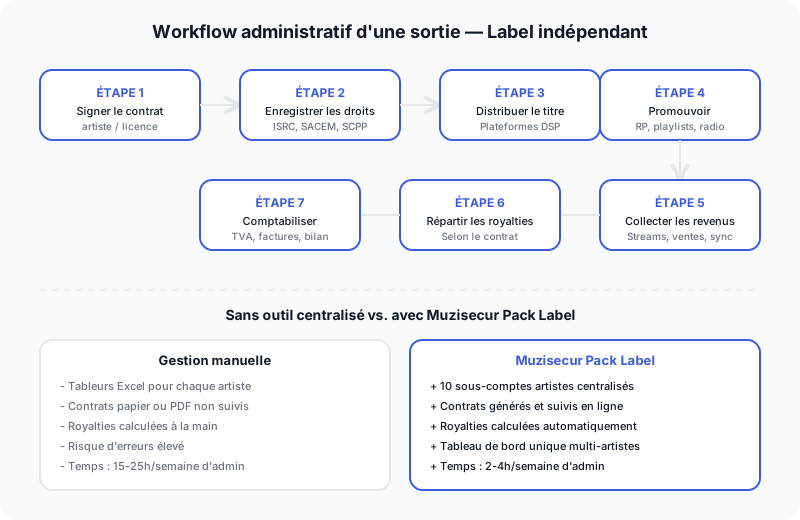
The administrative workflow of a release — 7 steps that mobilize all 5 pillars.
Every release follows the same cycle: contract, rights, distribution, promotion, collection, split, accounting. The more you standardize this process, the less time and money you waste.
The 7 beginner mistakes that sink a label
After supporting dozens of independent labels, here are the mistakes we see come up systematically:
Mistake 1: No written contract
“We know each other, we trust each other.” That is the most dangerous sentence in the music industry. Without a written contract, you have zero protection in case of conflict — and conflicts always arise when money starts flowing.
Mistake 2: Confusing label and distributor
Distributing music on platforms does not make you a label. A label provides added value: artistic direction, funding, promotion, network, support. If all you do is distribute, you are a useless middleman.
Mistake 3: Neglecting neighboring rights
Not registering your label with SCPP or SPPF means giving up substantial revenue. Private copying, radio and TV broadcast rights — none of this falls from the sky; you have to declare it.
Mistake 4: No accounting tracking
“I will do the accounting later.” Later is when you have 200 revenue lines to reconcile, 5 artists waiting for their royalties, and an accountant charging you double because everything is a mess.
Mistake 5: The same contract for every artist
Every artist has a different situation: developing artist, established artist, artist who brings their own master, artist who needs production funding. The contract must reflect the reality of each relationship.
Mistake 6: No editorial calendar
Releasing 3 singles in the same month internally means cannibalizing yourself. A good label plans its releases to maximize attention on each project.
Mistake 7: Doing everything yourself for too long
The founder’s pride: “I handle everything.” You may handle everything, but you handle it poorly. Past a certain volume, you need to either hire or delegate to a specialized partner.
Key takeaway: Most independent labels that close within the first 3 years do not die from a lack of artistic talent. They die from a lack of administrative structure.
DIY vs. delegated admin: an honest comparison
This is the central question: should you manage everything in-house or delegate part (or all) of the administration?
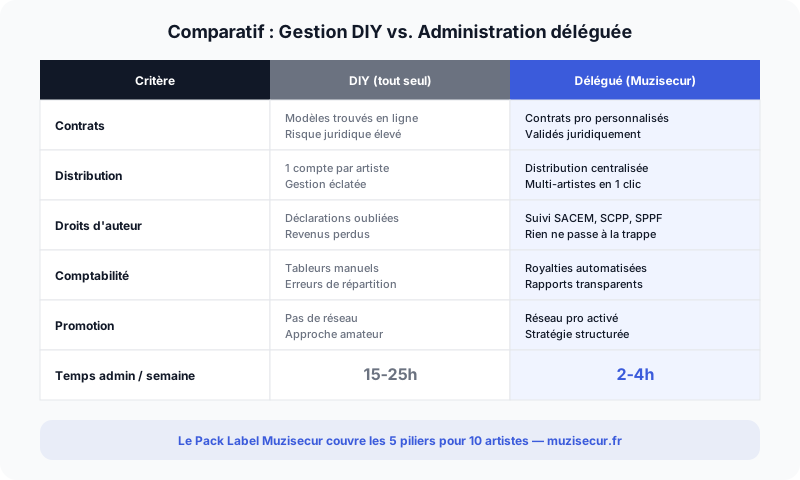
Manual management vs. delegated administration — time is a label’s most precious resource.
When DIY makes sense
- You have 1-2 artists maximum
- You have time to dedicate to admin (10-15h/week)
- You have basic legal and accounting skills
- You are in a testing phase and want to understand every mechanism before delegating
When DIY becomes a bottleneck
- You exceed 3-4 artists on your roster
- You spend more time on admin than on music
- You start making mistakes (missed declarations, late payments)
- Your artists complain about lack of transparency or responsiveness
When should you delegate your label’s administration
The short answer: as soon as admin prevents you from doing what you created the label for — namely developing artists and building a catalog.
Here are the warning signs:
- You systematically postpone SACEM/SCPP declarations
- Your artists have been waiting for their royalty statements for months
- You have signed contracts but no longer know exactly what they contain
- You discover errors in your revenue splits after the fact
- You have no consolidated visibility on your label’s financial health
If you check 2 or 3 of these boxes, it is time to get structured — either by hiring an administrator or by using a tool that centralizes everything.
Muzisecur Label Pack: centralized admin for 10 artists
This is exactly the need that Muzisecur designed the Label Pack for: a complete administration solution built for independent labels that want to professionalize without blowing their budget.
What the Label Pack includes
- 10 artist sub-accounts: each artist has their own space, data, and statements — and you get a consolidated view of the entire roster
- Contract management: creation, tracking, and archiving of all your artist contracts from a single dashboard
- Centralized distribution: all your label’s releases managed from one tool, with standardized metadata
- Rights tracking: help with SACEM, SCPP/SPPF declarations, distribution tracking
- Accounting and royalties: automatic royalty calculation based on each contract’s terms, transparent statements for every artist
- Promotion tools: shared editorial calendar, centralized assets, campaign tracking
Why it is different
Most tools on the market cover only one pillar: either distribution, or accounting, or contracts. Muzisecur’s Label Pack is the only one to cover all 5 pillars from a single interface. You no longer juggle between 6 different tools — everything is in one place.
Who it is for
- Independent labels with 2 to 10 artists
- Artist collectives looking to structure as a label
- Managers handling multiple artistic projects
- Producers releasing music under their own structure
FAQ: independent label admin management
What legal structure should you choose to create an independent label in France?
The most common structures are the SAS (simplified joint-stock company) for its flexibility, the SARL for its simplicity, and the association loi 1901 for non-profit projects. The sole trader status is possible to start but quickly limiting (revenue cap, no expense deductions). The choice depends on your project, investors, and tax strategy — consult a culture-specialized accountant.
How much does it cost to manage an independent label’s administration?
In DIY mode, expect between 200 and 500 euros per month in software subscriptions (distributor, accounting, CRM, email) plus the time you invest. By delegating to a service like Muzisecur, you reduce the number of tools and reclaim time. The real cost is the opportunity cost: every hour spent on admin is an hour not spent developing your artists.
Should you register your label with SCPP or SPPF?
If you are a phonographic producer (you fund or co-produce recordings), yes. The SCPP groups the majors and some independents, while the SPPF is reserved for independent producers. Both collect and distribute neighboring rights (private copying, public broadcast). As an independent label, the SPPF is usually the most natural choice.
How do you calculate royalties for your artists?
The calculation depends on the contract. Generally: (gross revenue - distributor commission - recoupable costs) x artist percentage = net royalties. Typical rates range from 15 to 25% on a traditional artist deal, and 50 to 80% on a license deal. Be transparent about the calculation method and provide detailed statements.
How many releases per month can a small label handle?
With good organization, a label of 5-8 artists can handle 2 to 4 releases per month (singles and EPs). Beyond that, without a centralized tool, promotion quality and admin tracking deteriorate. The goal is not to release as much music as possible, but to release each project under the best conditions.
Can you run an independent label as a sole trader?
Technically yes, but it is limiting. The revenue cap (77,700 euros for services in 2026) is quickly reached if your label generates significant income. Additionally, you cannot deduct expenses (studio, advances, promotion), which distorts your real profitability. The sole trader status works for a testing phase, not for a structured label.
Conclusion
Creating an independent label is an artistic act. Running one is an organizational act. Both are indispensable, but the latter is too often neglected.
The 5 pillars — contracts, distribution, rights, accounting, promotion — are not chores to endure. They are the foundations that allow your artistic vision to stand. A well-administered artist is an artist who trusts their label. A well-structured label is a label that lasts.
You have two options: build everything in-house, brick by brick, dedicating considerable time. Or centralize everything with a tool designed for it, like the Muzisecur Label Pack, and dedicate your energy to what truly matters — the music and developing your artists.
Whichever option you choose, one thing is certain: administration is not the enemy of creation. It is what protects it.
Related articles

French Music Tax Credit (CIPP): Are You Eligible? (And How Much Can You Recover)
The French phonographic tax credit can reimburse up to 40% of your production costs. Eligibility criteria, amounts, and steps: everything you need to know.

Split Sheet: How to Share Music Rights Between Co-Writers
The split sheet is the most important (and most forgotten) document in music. How to write one, what to include, and why you should never release a track without it.

Artist Contract vs License Deal: Which One Should You Choose?
Artist contract or license deal? Discover the key differences (royalties, masters, duration) and choose the right contract for your situation as an independent artist.