Music Publishing: Everything You Need to Know About the Publisher's Role

If you ask ten musicians what a music publisher does, you will get eleven different answers — and most will be wrong. Music publishing is probably the most misunderstood link in the entire music value chain. And yet it is a massive revenue lever: the French music publishing market reached 597 million euros in 2024, up 6%, according to the CSDEM (Chambre Syndicale de l’Édition Musicale) barometer.
The problem is that many independent artists and producers confuse the publisher with the distributor, the label, or even SACEM. Result: they sign deals they do not understand, or they miss out on revenue they could generate on their own. This article sets the record straight — with numbers, concrete examples, and zero unnecessary jargon.
What is music publishing?
Music publishing refers to all activities related to the commercial exploitation of a musical work — meaning the composition (melody) and the lyrics. Important: we are talking about the work itself, not the recording. The recording (the master) is the territory of the phonographic producer. Publishing is the territory of intellectual creation.
Concretely, when you write and compose a song, you hold copyright over that work. This copyright entitles you to revenue every time the work is exploited: radio broadcast, streaming, concert, synchronization in an ad or film, cover by another artist, etc. All of this is managed by SACEM in France.
The music publisher is the person (or company) to whom you assign a portion of these rights in exchange for exploitation work. Their role: make your work live commercially, place it, promote it, protect it — and generate maximum revenue for you (and for themselves).
Key takeaway: Music publishing concerns copyright (composition + lyrics), not master rights. If you want to understand the difference between these two types of rights, check out our guide on music copyright.
The concrete role of the music publisher
A good music publisher does not just sign a deal and collect their share. They have four main missions:
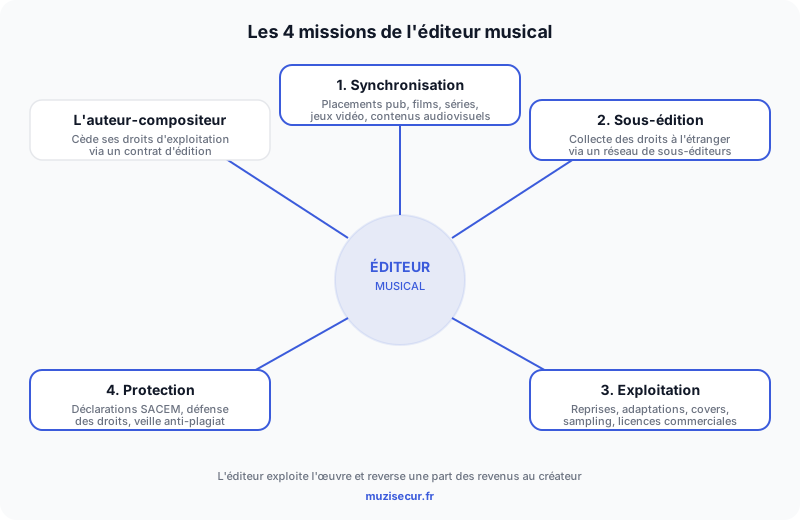
The 4 main missions of a music publisher.
1. Sync placement
This is often the most lucrative mission. The publisher has a network of music supervisors — the people who choose music for ads, films, series, and video games. They actively pitch your works for these placements, negotiate rates, and handle authorizations. Sync revenue reached 105 million euros in France in 2024 — a constantly growing market.
2. International sub-publishing
When your track is played in Brazil, Japan, or Germany, the royalties are collected by local authors’ societies (GEMA, JASRAC, ECAD, etc.). Without a publisher, these royalties can take years to reach you — or never arrive at all. The publisher has a network of sub-publishers in each territory to ensure your rights are correctly collected everywhere. This segment represents 78 million euros per year for French publishers.
3. Commercial exploitation
The publisher actively seeks opportunities for your work: covers by other artists, adaptations, translations, authorized sampling, use in compilations, licenses for merchandise. Every new exploitation generates additional revenue.
4. Protection and administrative management
The publisher ensures your works are correctly registered with SACEM, monitors unauthorized uses (plagiarism, unauthorized sampling), and defends your interests in case of disputes. It is behind-the-scenes work, invisible but essential.
Key takeaway: The publisher’s role goes well beyond simple administration. A good publisher is a commercial partner who generates revenue you would not have earned alone — in sync, internationally, and through exploitations you would not even have considered.
Publishing deal: how does it work?
The music publishing contract is governed by the French Intellectual Property Code (articles L132-1 to L132-17). It is a contract by which the songwriter-composer assigns the publisher the right to exploit their work, in exchange for remuneration proportional to the revenue.
Key elements of the contract
Duration — A publishing deal can be signed for the full duration of copyright (70 years post mortem) or for a limited period (3 to 10 years, renewable). Limited-duration deals are increasingly common and generally preferable for artists.
Scope — The contract specifies which works are covered: an existing catalog, future works during a given period, or specific works.
Compensation — The publisher pays the author a percentage of generated revenue. The standard split is often 50/50 between publisher and author on publishing income. But this split is negotiable, and some contracts provide more favorable terms for the author (60/40, or even 70/30 for established artists).
Advance — Many publishers pay an advance at signing, recoupable from future revenue. It is the publisher’s investment in the work’s potential. In 2024, advances paid by French publishers increased by 11%, with average investment per project up 13%.
Exploitation obligation — Crucial point: the French Intellectual Property Code imposes a permanent and ongoing exploitation obligation on the publisher. A publisher who signs your catalog and does nothing with it is in breach. You can request contract termination if the publisher fails to exploit your works.
Types of publishing contracts
Preference deal — You commit to assigning your future works to the publisher for a set duration (max 5 years or 5 works according to case law). This is the most common deal for developing songwriters. In 2024, new artists represented 77% of preference deals signed by French publishers.
Assignment deal — You assign the rights to one or more specific, already existing works.
Co-publishing deal — You retain part of your publisher rights (you are both author AND co-publisher of your work). This is the most balanced model for artists who want to keep control.
Key takeaway: Before signing a publishing deal, have it reviewed by an entertainment lawyer. Priority checkpoints: duration, scope of assigned works, termination conditions, and reversion rate. For an overview of all important contracts, check out our guide to essential contracts.
SACEM split with and without a publisher
This is where many artists discover the real cost of a publisher. SACEM distributes rights according to a fixed split that depends on whether or not a publisher is declared on the work.
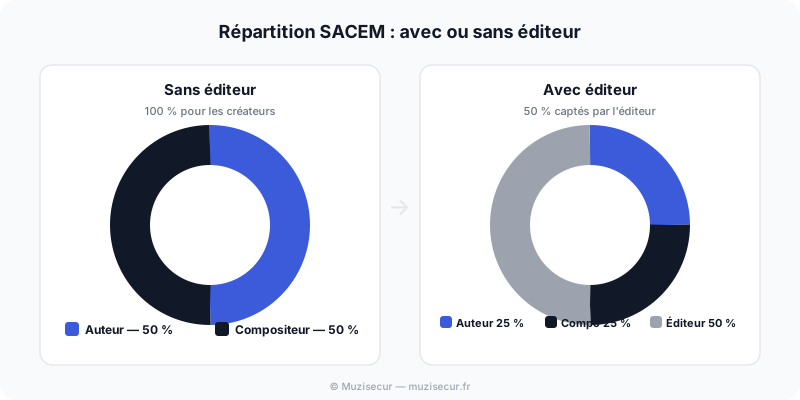
The SACEM split changes drastically depending on whether you have a publisher or not.
Without a publisher
The split is simple:
- Author (lyricist): 50%
- Composer: 50%
If you are a songwriter-composer, you receive 100% of the SACEM royalties on your work. Simple, direct, no intermediary.
With a publisher
As soon as a publisher is declared on the work at SACEM, the split changes:
- Author (lyricist): 25%
- Composer: 25%
- Publisher: 50%
Yes, you read that right: the publisher takes half of the SACEM royalties. This is SACEM’s historic rule, and it applies automatically. If you are a songwriter-composer with a publisher, you go from 100% to 50% — the publisher takes the other half.
The contract vs. the SACEM split
There is an important nuance. The publishing contract between you and your publisher may provide a different split of the publisher’s revenue. For example, if your contract provides a 70/30 reversal in your favor on the publisher share, here is what it looks like:
- SACEM author-composer share: 50% (direct)
- Publisher SACEM share: 50%, of which 70% returned to you = 35%
- Total for you: 85%
- Total for the publisher: 15%
That is better, but it is still 15% of your rights going to the publisher. The question is whether the services provided (sync, sub-publishing, exploitation) are worth that 15%.
Key takeaway: The SACEM split is fixed (25/25/50 with a publisher), but the publishing contract determines how much the publisher actually returns to you from their share. Always negotiate this clause. To understand how splits work between co-writers, check out our split sheet guide.
Self-publishing: keeping 100% of your rights
Self-publishing means doing without a publisher and managing the exploitation of your works yourself. More and more independent artists are making this choice — and for good reasons.
Advantages of self-publishing
100% of SACEM royalties — Without a declared publisher, you receive the full author and composer share. No split of the distribution key.
Total control — You decide how your works are exploited, to whom you grant sync licenses, and under what conditions.
No rights assignment — You remain the full owner of your economic rights. You can always sign with a publisher later if an opportunity arises.
Limitations of self-publishing
No sync network — Unless you have your own contacts with music supervisors, you miss out on placements in ads, films, and series. And that is where the most significant publishing revenue lies.
No international collection — Without sub-publishers abroad, your international royalties are collected with delays (sometimes 2-3 years) or not at all.
Administrative burden — SACEM declarations, exploitation tracking, legal monitoring: everything falls on your shoulders.
No advance — The publisher is often a source of funding through advances. In self-publishing, you do not benefit from this lever.
Who is self-publishing right for?
Self-publishing works well if you check at least two of these boxes:
- Your catalog is primarily exploited in France
- You have no incoming sync requests
- You are rigorous about admin or you use a tool like Muzisecur to centralize your management
- You prefer to keep total control rather than maximize short-term revenue
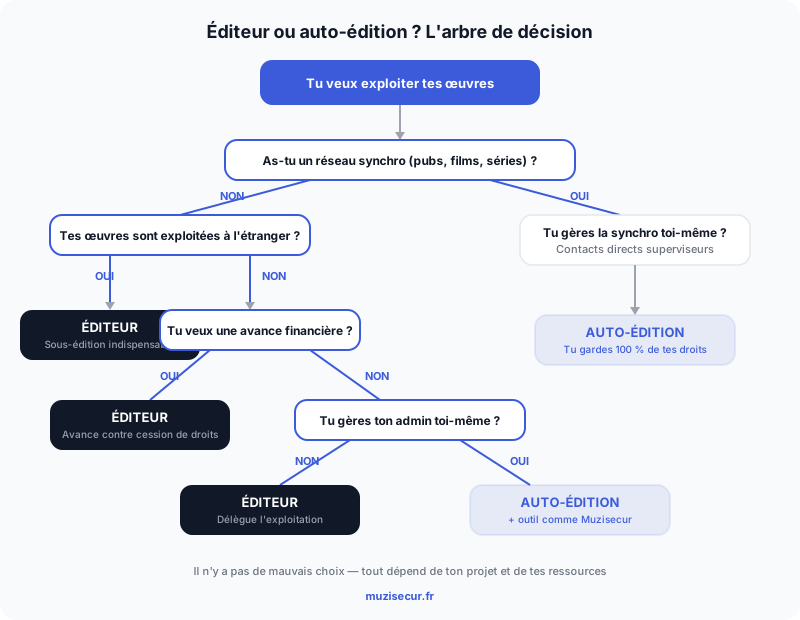
Publisher or self-publishing? The answer depends on your situation.
Key takeaway: Self-publishing is not a default choice — it is a strategic one. But it requires rigor and the right tools to avoid leaving money on the table.
Synchronization: the publishing jackpot
Synchronization (or “sync”) refers to the use of a musical work combined with an image: advertising, film, series, video game, web content. It is the most profitable segment of music publishing, and often the one that single-handedly justifies having a publisher.
Why sync pays so well
A sync placement generates two types of revenue:
Sync fees — A flat fee negotiated case by case for permission to use the work. Amounts vary enormously: from a few hundred euros for web use to tens of thousands of euros for a national TV ad. Placements in international productions (Netflix series, global ads) can reach 100,000 EUR and more per placement.
Broadcast royalties — Every time the audiovisual content is broadcast (TV, cinema, streaming), SACEM collects additional copyright royalties. An ad broadcast heavily for three months can generate considerable broadcast royalties.
The French sync market
The French sync market was worth 105 million euros in 2024, up 2% year-on-year. It is a stable and structurally growing market, driven by the multiplication of audiovisual content (video streaming, social media, podcasts, video games).
How to land sync placements
With a publisher, it is their job: they send your works to music supervisors, maintain their network, and respond to briefs (specific music requests for audiovisual projects).
Without a publisher, you can still access sync:
- Sign up to music libraries (Musicbed, Artlist, Epidemic Sound)
- Directly contact music supervisors at ad agencies and audiovisual production companies
- Polish your metadata: genre, mood, tempo, instrumentation — supervisors search by keywords
- Offer instrumental versions and stems of your tracks
Key takeaway: Synchronization is the area where a publisher provides the most value. If you have no network in audiovisual, a sync-specialized publisher can turn dormant catalog tracks into significant revenue.
International sub-publishing: collecting royalties abroad
When your music is played abroad — on streaming, radio, or in concert — copyright royalties are collected by the local authors’ society of each country. SACEM has reciprocal agreements with over 200 societies worldwide, but international collection remains complex and slow.
The problem of collection without a publisher
Without a publisher (and therefore without a local sub-publisher), here is what happens:
- The local authors’ society (e.g., GEMA in Germany) collects the royalties
- It transfers them to SACEM via reciprocal agreements
- SACEM pays you
This process can take 18 to 36 months, and some royalties may be lost along the way if your works are not correctly identified in local databases.
The role of the sub-publisher
A sub-publisher is a local publisher in a given country, mandated by your main publisher to:
- Register your works with the local authors’ society
- Monitor exploitations and ensure declarations are correct
- Accelerate collection and repatriation of royalties
- Promote your works locally (sync placements, covers)
The sub-publisher takes a commission (typically 15 to 25% of the local publisher share), but this commission is often offset by more complete and faster collection.
International revenue in numbers
Foreign royalties collected by French publishers represented 78 million euros in 2024. For an artist whose music circulates internationally, sub-publishing can represent a significant portion of revenue — especially if you have tracks being played on radio or streaming in multiple countries.
Key takeaway: If your music is primarily listened to in France, sub-publishing is not a priority. But as soon as you have an international audience (even a modest one), a publisher with a strong sub-publisher network can recover royalties you would never receive otherwise.
Tarik Hamiche’s take
“As a multi-gold and platinum certified independent producer, I have seen both sides of the mirror. I have worked with publishers on some projects, and self-published other catalogs. My conclusion after more than fifteen years in the industry: the right publisher at the right time can change a catalog’s trajectory. But signing with a publisher by default, without strategy, means giving away 50% of your SACEM royalties for nothing.
My advice: if you are an independent artist or producer at the start of your journey, begin with self-publishing. Structure your admin, declare your works correctly, and measure your revenue. The day you have sync opportunities or real international exploitation, you can negotiate a publishing deal from a position of strength — with numbers to show and a clean catalog.
That is exactly why I created Muzisecur: so that creators can manage their admin properly, track their rights, and make informed decisions about publishing — without being forced to give everything away for lack of visibility.” — Tarik Hamiche, founder of Muzisecur
FAQ: music publishing
Is a publisher required to collect your SACEM royalties?
No. You can collect your SACEM royalties without a publisher. SACEM will pay you 100% of the author-composer share directly. A publisher is useful for commercial exploitation, not for basic collection.
What is the difference between a publisher and a label?
The label (phonographic producer) funds and exploits the recording (the master). The publisher exploits the work (the composition and lyrics). These are two distinct rights, managed by different organizations: SCPP/SPPF for the label, SACEM for the publisher. To understand the producer’s role, check out our guide on neighboring rights.
Can you get your rights back after signing with a publisher?
Yes, but it depends on the contract. If the contract has a limited duration, the rights revert to you at expiration. If the publisher fails to meet their exploitation obligation, you can seek judicial termination. Some contracts also include reversion clauses if the publisher does not generate minimum revenue.
How much does a publisher take in percentage?
The SACEM split allocates 50% to the publisher. But the contract may provide for a partial return of that share to the author. In practice, the publisher’s net take ranges from 15 to 50% of total rights, depending on the negotiated deal.
What is the CIEM (Tax Credit for Music Publishers)?
The CIEM is a tax incentive that allows music publishers to claim a tax credit on expenses related to artist development. It is managed by the CNM. For producers, a similar scheme exists: the Phonographic Tax Credit (CIPP).
Does a beatmaker need a publisher?
Not necessarily. A beatmaker selling instrumentals via online platforms can work perfectly well as a self-publisher. A publisher becomes relevant when the beatmaker has a substantial catalog with sync or international exploitation potential.
How do you declare a publisher on a work at SACEM?
The publisher must be a SACEM member. When declaring the work (or through a later modification), you enter the publisher on the declaration form. SACEM then automatically applies the publisher split (25/25/50).
Conclusion
Music publishing is a powerful revenue lever — provided you understand exactly what you are giving up and what you receive in return. A good publisher gives you access to sync, international collection, and opportunities you would not have on your own. A bad publisher takes 50% of your SACEM royalties and does nothing.
Before signing, ask yourself the right questions: does my catalog have sync potential? Is my music circulating internationally? Do I need an advance? If the answer is no to all three, self-publishing is probably the best choice — with a tool like Muzisecur to structure your management and keep control.
And if you do decide to sign with a publisher, do it with full knowledge: negotiate the reversion rate on the publisher share, verify the duration and exit conditions, and make sure the publisher has a concrete network of sub-publishers and sync contacts. Music publishing is not a necessary evil — it is a strategic partnership. And like any partnership, it must be win-win.
Related articles

Featuring Contract: What You Must Plan Before Recording
No featuring contract = no protection. Rights split, exploitation authorization, negotiation points: everything you need to plan before recording.

Music Copyright: How It Actually Works
Songwriter, composer, producer, performer: who gets paid what and why? Understand copyright, neighboring rights, and private copying in music.

Split Sheet: How to Share Music Rights Between Co-Writers
The split sheet is the most important (and most forgotten) document in music. How to write one, what to include, and why you should never release a track without it.