Artist Contract vs License Deal: Which One Should You Choose?

Artist Contract vs License Deal: What’s the Difference and Which Should You Choose?
You’re about to sign with a label, or you’re setting up your own structure and wondering what type of deal to offer your artists. Artist contract? License deal? These two contracts are the most common in the music industry, but they have absolutely nothing in common. Confusing the two means risking the loss of ownership of your music for decades — or on the other hand, missing out on the support that could have changed your career. In this article, we break down the difference between an artist contract and a license deal, point by point, so you can make an informed choice.
What is an artist contract?
The artist contract (also called an exclusive recording contract) is the historical deal of the music industry. It’s the one that the majors — Universal, Sony, Warner — and many independent labels have been offering for decades.
The principle is simple: the label funds everything. Production, recording, mixing, mastering, promotion, music videos, marketing, distribution. In exchange, the label becomes the owner of the recordings — what we call the masters.
The artist is paid through royalties that generally range between 5% and 10% of the wholesale price. This percentage can climb to 12-15% for artists with some negotiating power, but that remains the exception.
What this means in practice
When you sign an artist contract, you assign ownership of your recordings to the producer (the label). This means that even after the contract ends, the masters don’t come back to you. The label can continue exploiting your music indefinitely — or not, for that matter; it’s their call.
The artist also commits to exclusivity: for the entire duration of the contract, you can’t record for another label or exploit music on your own (except for negotiated exceptions).
In return, the label takes all the financial risk. If the project fails, it’s the label that loses money, not you.
Key takeaway: In an artist contract, the label invests, the label decides, and the label owns. The artist earns a (small) percentage but takes no financial risk.
What is a license deal?
The license deal works in reverse. Here, the artist (or their label) is the producer. They fund the recording, mixing, and mastering. They arrive with a finished product — a single, an EP, an album — and grant a label (the licensee) the right to exploit that music for a set period.
The licensee label then handles manufacturing (if physical), promotion, marketing, and distribution. But at no point do they become the owner of the masters. The artist remains the master owner.
In terms of payment, royalties are much higher: between 20% and 30% on average for the producer/artist. Some deals even go up to 50% after the licensee’s expenses are recouped.
What this means in practice
The duration of a license deal is generally shorter: 3 to 5 years on average. Once the contract expires, all exploitation rights revert entirely to the artist. You regain 100% control over your music.
However, you must come with a finished product. That means you bear the production costs upfront. If you recorded your album for 6,000 euros, that’s your investment. The licensee label may pay an advance (often between 10,000 and 25,000 euros) to compensate, but it’s not guaranteed and depends on your negotiating leverage.
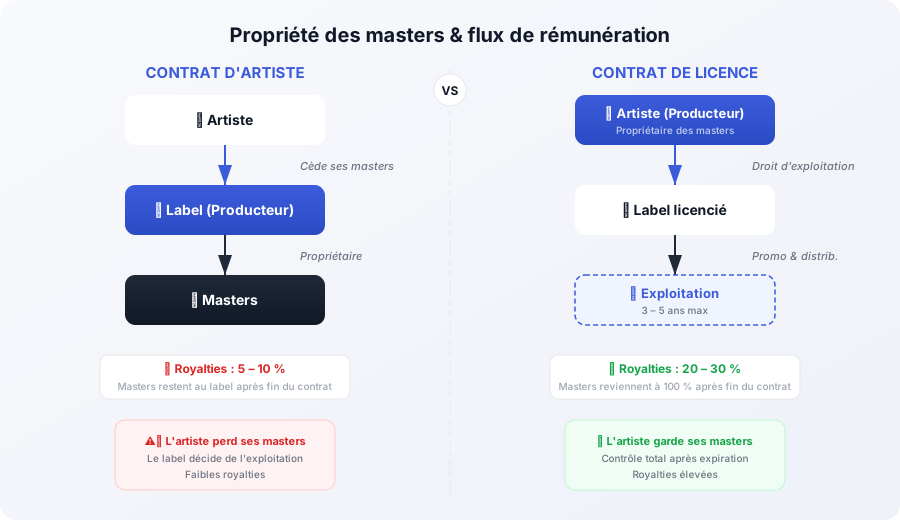
Diagram: the flow of ownership and compensation in each type of contract.
Key takeaway: In a license deal, the artist invests, the artist retains their masters, and the artist earns a much higher percentage. But they also take the initial financial risk.
The 7 key differences between artist contract and license deal
Here are the essential criteria to compare in understanding the difference between an artist contract and a license deal in the music industry.
1. Master ownership
This is THE fundamental difference. Under an artist contract, the label owns the recordings. Under a license deal, the artist retains ownership and only grants a temporary exploitation right.
Concretely, if in 10 years your track is used in a global ad campaign, under an artist contract the label pockets the bulk of the sync fee. Under a license deal, you do.
2. Royalty rate
Under an artist contract, royalties hover around 5 to 10% (sometimes 12-15% for established artists). Under a license deal, they sit between 20 and 30%, or even more after recoupment.
On 100,000 euros in revenue generated, an artist under an artist contract would earn roughly 7,000 euros. The same artist under a license deal would earn 25,000 euros. The difference is massive.
3. Artistic control
Under an artist contract, the label generally has the final say on production choices, lead singles, music videos, and image. The label invests, so the label decides.
Under a license deal, the artist keeps much more control. The licensee label handles promotion and distribution, but rarely interferes with artistic choices — since the product is already finished when it reaches the table.
4. Duration of commitment
An artist contract is often structured by number of albums (2 to 5 firm albums + options) rather than calendar time. That can easily tie you up for 5 to 10 years.
A license deal is limited in time: 3 to 5 years on average. After that, you get everything back.
5. Financial investment
Under an artist contract: zero investment from the artist. The label covers everything.
Under a license deal: the artist funds production (recording, mixing, mastering). Budget typically between 3,000 and 15,000 euros depending on the project’s ambition.
6. Risk level
Under an artist contract, the risk falls on the label. If the project flops, the artist hasn’t lost anything financially (though they may have lost time and masters).
Under a license deal, the risk is shared: the artist invested in production, the label invests in promotion. If it doesn’t work, both lose.
7. Financial advances
Under an artist contract, advances are often larger (sometimes tens of thousands of euros), but they are recoupable — the label recoups them from your future royalties before you earn anything.
Under a license deal, advances also exist (often between 10,000 and 25,000 euros) and are also recoupable, but the mechanism is more favorable to the artist since the royalty rate is higher.
Note: regardless of the contract type, the label-producer can join SCPP or SPPF to collect producer neighboring rights. On their side, the performing artist should register with ADAMI and SPEDIDAM to collect their own neighboring rights — independently of whatever contract is signed.
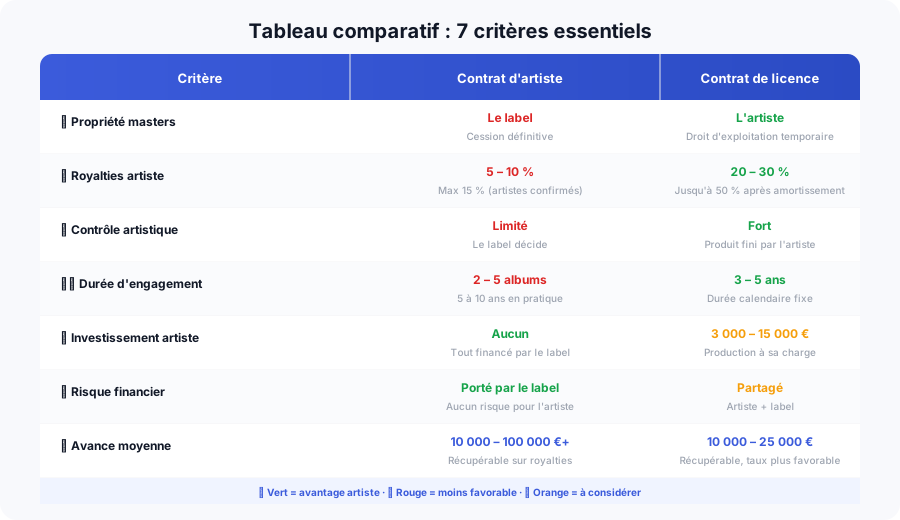
The 7 essential criteria for comparing both contracts.
Comparison table: artist contract vs license deal
| Criterion | Artist contract | License deal |
|---|---|---|
| Master ownership | The label | The artist |
| Artist royalties | 5 to 10% (up to 15%) | 20 to 30% (up to 50%) |
| Artistic control | Limited — the label decides | Strong — the artist arrives with a finished product |
| Duration | 2 to 5 albums (5-10 years) | 3 to 5 calendar years |
| Artist investment | None | Production at their expense (3,000 – 15,000 euros) |
| Financial risk | Borne by the label | Shared (artist + label) |
| Average advance | 10,000 – 100,000+ euros | 10,000 – 25,000 euros |
| After contract ends | Masters stay with the label | Masters revert 100% to the artist |
| Ideal for | Emerging artist without structure or budget | Artist/producer with structure and finished product |
For more on contracts and all business aspects of music, check out Tarik Hamiche’s book: Le Secret pour Vivre de sa Musique — a complete action plan to structure your career and protect your interests (in French).
Which contract to choose based on your situation?
The answer depends on where you are in your career, your financial means, and your long-term vision.
The artist contract is for you if…
You’re starting out, you don’t have a budget to fund your production, and you need full support. You’re looking for a label that will hold your hand: studio, producer, promotion, videos, distribution. You accept giving up your masters in exchange for that investment. It’s a trade-off: less control and lower earnings in the short term, but a potential springboard if the label does its job well.
The license deal is for you if…
You already have a structure (label, association, sole proprietorship), you know how to produce your music (or have the means to get it produced), and you want to stay in control of your career. You arrive with a finished product and you’re looking for a partner for promotion and distribution. It’s the most advantageous contract in the long run, provided you have the means to handle the initial investment.
This is exactly the kind of management — tracking contracts, royalties, rights — that Muzisecur automates for you. Whether you’re on a license deal or managing your own label, you need a tool that centralizes everything. No more juggling 15 Excel spreadsheets.
The hybrid path: start as an artist, evolve into licensing
Many artists sign an initial artist contract to launch their career, gain experience and visibility, then negotiate a license deal for subsequent projects — once they understand the business and have set up their own structure.
This is actually the most common trajectory in the industry in 2026. The license deal is now the most widely used contract in the French music industry, largely because production tools have become accessible (home studios) and digital distribution allows any artist to release music without a label.
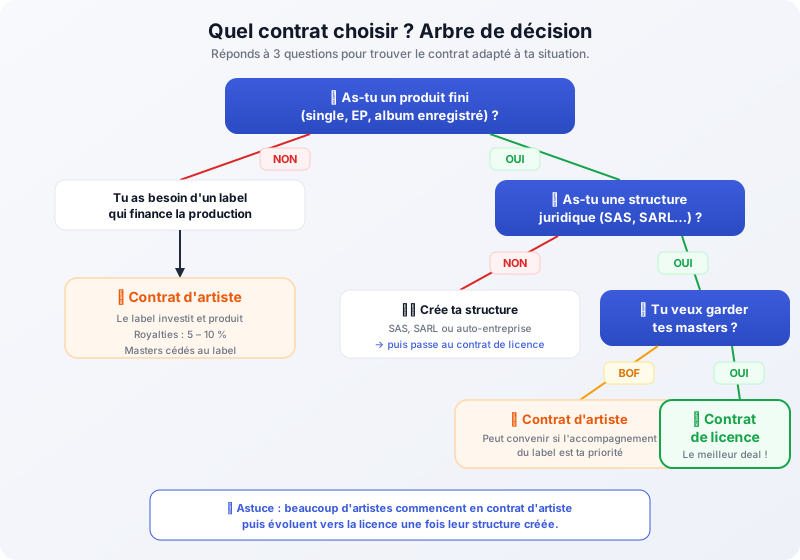
Decision tree: 3 questions to figure out which contract suits you.
Tarik Hamiche’s take (founder of Producteur a Succes)
“The license deal is by far the most advantageous contract for an independent artist or producer. I’ve lived it: when I signed my projects under license deals, I kept ownership of my masters, I earned between 20 and 30% in royalties, and above all — above all — after 3 to 5 years, I recovered 100% of the rights. A 6,000-euro production investment could generate a 30,000-euro advance under a license deal. That’s a 5x return.
But be careful, a license deal is only possible if you have a finished product to offer. That’s why I always recommend setting up your own structure — even a simple company — as early as possible. It’s the key to moving from the status of a “signed” artist to that of a producer who signs deals from a position of strength.
The artist contract makes sense for an artist who’s just starting out and doesn’t have the means to produce. But you need to be lucid: you’re giving up your masters, you earn 7% on average, and you don’t have the final word. If you can avoid it, avoid it. If you can’t, negotiate as hard as you can and plan your exit toward licensing from day one.”
For a step-by-step guide on creating your structure and license deals, check out: Creer son Label de Musique — everything you need to know to start your label and sign license deals (in French).
FAQ: artist contract and license deal
What is the main difference between an artist contract and a license deal?
The fundamental difference is master ownership. Under an artist contract, the label becomes the owner of the recordings. Under a license deal, the artist retains ownership and only grants a temporary exploitation right, typically for 3 to 5 years.
Which contract pays the artist more?
The license deal is significantly more lucrative. The artist earns between 20 and 30% in royalties (versus 5 to 10% under an artist contract). In the long run, the gap is even larger since the artist recovers 100% of the rights when the license deal expires.
Do you need a label to sign a license deal?
Yes, technically you need a legal structure (company, sole proprietorship, or association) to sign a license deal as a producer. This structure will be the contracting party opposite the licensee label.
Can you switch from an artist contract to a license deal?
Yes, and it’s actually the recommended trajectory. Many artists sign an initial artist contract to get started, then set up their own structure and negotiate license deals for subsequent projects. The key is negotiating exit clauses and options in your first contract.
What is a recoupable advance in music?
A recoupable advance is a sum paid by the label to the artist upon signing the contract. It’s “recoupable,” meaning the label deducts it from your future royalties before paying you anything. It’s not a gift — it’s a disguised loan repaid through your sales.
Conclusion
The difference between an artist contract and a license deal comes down to three words: ownership, control, compensation. The artist contract offers full support but at the cost of your masters and low pay. The license deal puts you in the driver’s seat with much higher royalties, but requires having a structure and a finished product.
In 2026, the trend is clearly toward licensing. Independent artists who structure their business — with the right management tools — are the ones getting the most out of today’s music industry.
Running a label or working as an independent artist on a license deal? Muzisecur centralizes the management of your contracts, royalties, and admin. Try it free and focus on what matters: your music.

Read next:
Related articles

Featuring Contract: What You Must Plan Before Recording
No featuring contract = no protection. Rights split, exploitation authorization, negotiation points: everything you need to plan before recording.

Independent Label: How to Structure the Admin Management of Your Artists
Contracts, distribution, rights, accounting, promotion: the 5 admin pillars of an independent label and how to structure them without drowning.

The Essential Contracts for Independent Artists
Assignment contract, management deal, split sheet, distribution agreement... Discover the 10 essential contracts every independent artist must know to protect their music and revenue.