Digital Distribution Comparison 2026: DistroKid, TuneCore, CD Baby, Ditto & More

Digital Distribution Comparison 2026: DistroKid, TuneCore, CD Baby, Ditto & More
You just finished your single, EP, or album. The master is ready. Now what? You need to get it on Spotify, Apple Music, Deezer, Amazon Music, Tidal, and 150+ other streaming platforms. For that, you need a digital distributor. And that is where things get complicated, because there are dozens of them, each with its own pricing model, promises, and fine print. In this article, we break down everything: the real prices, hidden commissions, features that actually matter, traps to avoid, and most importantly, how to choose the one that fits your situation.
What a digital distributor actually does
Before comparing offers, you need to understand what you are buying. A digital distributor is a technical intermediary between you and streaming platforms. Specifically, it does three things:
- It encodes and delivers your files to platforms (Spotify, Apple Music, Deezer, Amazon, Tidal, YouTube Music, etc.) in the technical formats they require.
- It collects your revenue from those platforms and pays you (after potentially taking its commission).
- It manages your metadata: title, artist, ISRC, UPC, artwork, credits, release date.
That is all. A distributor does not promote your music, does not get you on playlists, does not manage your copyright, does not handle your accounting, and does not find you sync deals for TV or film — even though some are starting to offer these as paid add-ons.
Key takeaway: The distributor is a pipe. An essential pipe, but still a pipe. Don’t confuse distribution with support. Distribution alone is not enough to build a career.
Pricing models: subscription, commission, or hybrid
There are three main pricing models in digital distribution. Understanding the difference is essential to avoid getting ripped off.
The subscription model (0% commission)
You pay an annual fee (between 20 and 80 euros depending on the platform), and you keep 100% of your revenue. This is the model used by DistroKid, TuneCore, Ditto Music, and Amuse.
The upside: if you generate a lot of streams, you keep everything. The trap: if you stop paying, some platforms pull your music from stores. You are essentially paying perpetual rent to keep your music online.
The commission model (no subscription)
You pay nothing or almost nothing upfront, but the distributor takes a percentage of every euro you earn. This is the model used by CD Baby (9%), RouteNote free (15%), LANDR (~15%), and UnitedMasters free (10%).
The upside: no financial risk at the start. The trap: the commission is permanent and lifelong on every stream. The more you earn, the more you pay. Over a long career, that can amount to thousands of euros.
The hybrid model
Some platforms offer both options. RouteNote lets you choose between free with 15% commission or premium at ~55 euros/year with 0%. iMusician offers a per-release plan at 9 euros with 10% commission, or an annual subscription at 0%.
Key takeaway: Do the math over 3 to 5 years, not on a single release. A subscription at 25 euros/year costs 125 euros over 5 years. A 9% commission on 5,000 euros of revenue is 450 euros. And it never stops.
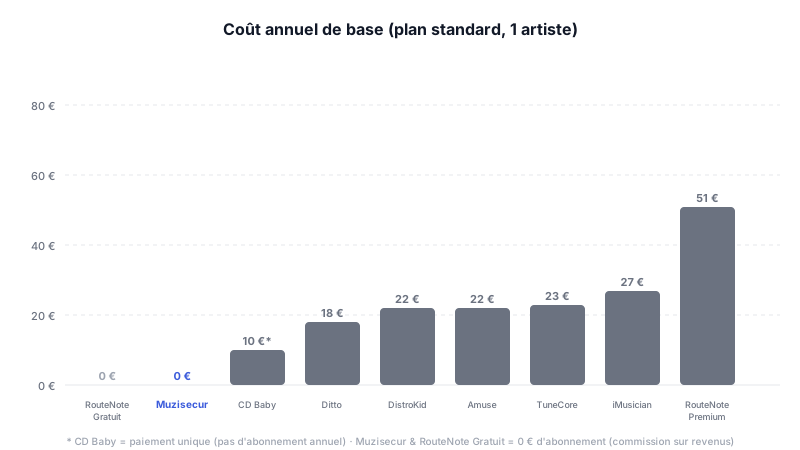
Annual base cost per distributor — note that this chart only shows entry prices, not the real cost including commissions.
DistroKid: the volume king
Pricing
| Plan | Price/year | Artists | Uploads |
|---|---|---|---|
| Musician | ~22 euros | 1 | Unlimited |
| Musician Plus | ~40 euros | 2 | Unlimited |
| Ultimate | ~76 euros | Up to 100 | Unlimited |
What is good
DistroKid is the most popular distributor in the world, and for good reason. The interface is simple, upload is fast, you keep 100% of your royalties, and you can release as many tracks as you want with no extra fees. If you are a prolific artist releasing a single every month, this is probably the best value on the market.
Features are solid: automatic royalty splits, Spotify artist verification, daily stats (on Plus and Ultimate plans), and a customizable label name.
What is problematic
The major trap with DistroKid is that your music is removed from platforms if you stop paying. Your subscription is not a purchase — it is a lease. If you forget to renew, change your mind, or pass away, your music vanishes from Spotify, Apple Music, and every other platform.
To counter this, DistroKid offers an add-on called “Leave a Legacy” at about 4.99 euros per track per year. Yes, you read that right: it is an annual supplement, per song, to keep your music online indefinitely. On a catalog of 50 tracks, that is 250 euros/year just for permanence.
Another point: YouTube Content ID is a paid add-on. And there is no publishing administration (copyright/editorial rights) included.
Verdict: Excellent for artists who release a lot of music and are certain they will renew every year. Less suited if you want a “set it and forget it” solution.
TuneCore: the veteran acquired by Believe
Pricing
| Plan | Price/year | Details |
|---|---|---|
| Rising Artist | ~23 euros | 1 artist, basic features |
| Breakout Artist | ~42 euros | 1 artist, advanced features |
| Professional | ~51 euros | 1 artist, all features |
| Per release (single) | ~23 euros | + annual renewal |
| Per release (album) | ~42 euros | + annual renewal |
What is good
TuneCore is one of the oldest distributors on the market (founded in 2005). It distributes to 150+ platforms, offers YouTube Content ID and Spotify/Apple Music artist verification on all plans. The Professional plan gives access to daily trend reports and editorial playlist pitching.
The acquisition by Believe (the French distribution giant) gives TuneCore an interesting edge: if your career takes off, you can potentially migrate to Believe’s label services, which offer much deeper support (A&R, marketing, radio promo, etc.).
TuneCore also offers a separate publishing administration service that collects your mechanical and performance royalties worldwide.
What is problematic
The per-release model is a long-term money pit. An album at 42 euros/year in renewals represents 210 euros over 5 years for a single album. And note: renewal fees increase (up to 52 euros/year for an album). If you have 3 albums and 5 singles, you can easily exceed 200 euros/year in renewals alone.
Additional artist profiles cost 14 euros each. And like DistroKid, if you stop paying, your music is removed from stores.
Verdict: A good option if you want an established distributor with a complete ecosystem (publishing, Believe as backup). But watch your annual bill closely.
CD Baby: one-time fee with a lifetime commission
Pricing
| Type | One-time price | Commission |
|---|---|---|
| Single | ~9 euros | 9% for life |
| Album | ~14 euros | 9% for life |
What is good
CD Baby is the only major distributor offering a one-time payment: you pay once, and your music stays online forever, with no subscription or renewal. It is the most reassuring option for artists who want to upload their music and never think about it again.
CD Baby has been around since 1998 — it is the oldest independent distributor. It distributes to 150+ platforms, includes YouTube Content ID, provides free ISRC and UPC codes, and offers weekly payments. It also provides physical distribution (CD and vinyl pressing) for those who need it.
What is problematic
The trade-off for the one-time payment is the lifelong 9% commission on all your revenue. And that 9% never goes away. If your track blows up 5 years after release, CD Baby still takes its 9%.
Let’s do the math:
- Modest artist scenario: 500 euros/year in revenue → 45 euros/year in commission → 225 euros over 5 years. With a DistroKid subscription at 22 euros/year, you would have paid 110 euros. CD Baby costs you double.
- Growing artist scenario: 5,000 euros/year in revenue → 450 euros/year in commission → 2,250 euros over 5 years. That is the equivalent of 18 years of DistroKid subscription.
- Hit scenario: 50,000 euros in revenue → 4,500 euros in commission. Non-negotiable.
The CD Baby model is only advantageous if you earn almost nothing. As soon as your revenue exceeds a few hundred euros per year, the commission becomes more expensive than any subscription.
Verdict: Reassuring for beginners who want a one-time payment with no hassle. But financially disadvantageous once your revenue picks up.
Ditto Music: the British contender
Pricing
| Plan | Price/year | Artists | Commission |
|---|---|---|---|
| Starter | ~18 euros | 1 | 0% |
| Pro | ~46 euros | 2 | 0% |
| Labels | Custom quote | 3+ | 0% |
What is good
Ditto distributes to 150+ platforms with 0% commission and unlimited uploads. The Pro plan adds interesting features: sync licensing (TV/film/ad placements), YouTube Content ID, publishing administration, and especially Release Protection — a guarantee that your music stays online even if you cancel your subscription.
Free royalty splits are included, and Ditto offers free collaborator accounts for co-writers.
What is problematic
The Starter plan is very limited: no YouTube Content ID, no publishing, no sync, and most importantly no Release Protection. If you are on the Starter plan and stop paying, your music is removed. Release Protection is reserved for the Pro plan.
The platform is British, which can raise jurisdictional and tax questions for French artists.
Verdict: The Pro plan is competitive with sync licensing and publishing included. The Starter plan is too limited to recommend.
iMusician: Swiss precision
Pricing
| Plan | Price | Commission | Artists |
|---|---|---|---|
| Starter (per release) | ~9 euros | 10% | 1 |
| Rockstar (per release) | ~64 euros | 0% for life | 1 |
| AMPLIFY (subscription) | ~27 euros/year | 0% | 1 |
| AMPLIFY+ | 55-205 euros/year | 0% | 2-20 |
| AMPLIFY Pro | ~278 euros/year | 0% | Unlimited |
What is good
iMusician is based in Switzerland, which presents an often-overlooked tax advantage: no Swiss withholding tax on your revenue. The platform distributes to 200+ stores (more than most competitors) and offers YouTube Content ID on all plans except Starter.
The Rockstar plan is a unique option: you pay 64 euros once per release, 0% commission, and the music stays online forever. It is the CD Baby model without the commission.
Support is multilingual and personalized, with video consultations on the Pro plan. iMusician is particularly valued for managing classical music releases (complex metadata).
What is problematic
The Starter plan with its permanent 10% commission is a trap similar to CD Baby. The AMPLIFY+ plan gets expensive if you manage multiple artists (205 euros/year for 20 artists). And the platform remains less well-known than the American giants, which can limit available community resources and tutorials.
Verdict: The Rockstar plan is the best “one-time payment” deal on the market. AMPLIFY is a solid subscription plan. Excellent choice for European artists.
RouteNote: free but at a cost
Pricing
| Plan | Price | Commission |
|---|---|---|
| Free | 0 euros | 15% |
| Premium | ~51 euros/year | 0% |
What is good
RouteNote is one of the few platforms offering truly free distribution. You upload your music, it reaches the platforms, and you pay nothing — RouteNote makes its money by taking 15% of your revenue. YouTube Content ID is included.
You can switch from free to premium at any time to recover your full 100%.
What is problematic
15% commission is enormous. That is almost double CD Baby (9%). On 1,000 euros of revenue, you give 150 euros to RouteNote for a service others charge 22 euros/year for.
The interface is notoriously less polished than the competition. Support is limited. And the exact number of platforms covered is less documented than competitors.
Verdict: Acceptable for testing distribution when you truly have zero budget. Switch to premium as soon as you start earning anything.
LANDR: distribution as a bonus
Pricing
| Option | Price | Commission |
|---|---|---|
| Per single | ~9 euros | ~15% |
| Per EP | ~23 euros | ~15% |
| LANDR Studio (subscription) | ~23 euros/month | Included in the bundle |
What is good
LANDR is primarily an AI mastering platform and studio tool suite (samples, plugins, collaboration). Distribution is an addition to their offering. If you already use LANDR for mastering, having distribution integrated into the same subscription is convenient.
Your music stays online even after canceling the subscription.
What is problematic
~15% commission is hard to justify in 2026 when competitors offer 0% for 22 euros/year. LANDR is not a specialized distributor — it is a studio tool that also does distribution. If you don’t need AI mastering and samples, you are paying for features you won’t use.
Verdict: Only relevant if you are already a LANDR suite user. As a standalone distributor, the alternatives are much better.
Amuse: from free to paid
Pricing
| Plan | Price/year | Artists | Commission |
|---|---|---|---|
| Artist | ~22 euros | 1 | 0% (15% on YouTube Content ID) |
| Artist Plus | ~37 euros | 2 | 0% |
| Professional | 56-920 euros/year | 3 to unlimited | 0% |
What is good
Amuse used to offer a free plan that attracted many artists. Now paid, it remains competitive with pricing close to DistroKid. The interface is modern, streaming stats are updated daily, and eligible artists can receive royalty advances.
Your music stays online even if you downgrade your subscription.
What is problematic
The base plan applies 15% commission on YouTube Content ID revenue — a detail that can weigh heavily if YouTube is a significant source of income. Delivery times vary by plan (14 days on Artist, 7 days on Pro). And cover song licenses cost an additional 14 euros per track.
Verdict: Decent but with no clear advantage over DistroKid or Ditto, which offer more for the same price.
UnitedMasters: the American bet on brand deals
Pricing
| Plan | Price | Commission |
|---|---|---|
| Free | 0 euros | 10% |
| Select | ~5 euros/month (~56 euros/year) | 0% |
What is good
UnitedMasters has a unique selling point: brand partnerships. The company has deals with Apple, the NBA, Bose, ESPN, and others, allowing artists to license their music directly for ad campaigns, sports events, etc. If selected, this can represent significant revenue.
Advances are available for qualifying artists.
What is problematic
UnitedMasters only distributes to 30+ platforms — that is five times fewer than the competition. The platform is heavily US-focused, with little presence in Europe. Brand deals are not guaranteed and only apply to a minority of artists. And the free plan with 10% commission is expensive for a limited store catalog.
Verdict: Interesting if you target the American market and brand deals appeal to you. Not very relevant for a French-speaking artist targeting Europe.

The full comparison table
| Distributor | Annual cost | Commission | Stores | Music permanent? | YouTube Content ID | Publishing |
|---|---|---|---|---|---|---|
| DistroKid | 22-76 euros | 0% | 150+ | No (paid add-on) | Paid add-on | No |
| TuneCore | 23-51 euros | 0% | 150+ | No | Included | Separate service |
| CD Baby | 9-14 euros (one-time) | 9% for life | 150+ | Yes | Included | Add-on |
| Ditto Music | 18-46 euros | 0% | 150+ | Pro plan only | Pro plan | Pro plan |
| iMusician | 9-64 euros (one-time) or 27-278 euros/year | 0-10% | 200+ | Yes (Rockstar) | Except Starter | No |
| RouteNote | Free or 51 euros | 0-15% | Varies | Yes | Included | No |
| LANDR | 9 euros/single or ~276 euros/year | ~15% | 150+ | Yes | Included | No |
| Amuse | 22-920 euros | 0% (15% YT on base) | Major ones | Yes | Paid on base | No |
| UnitedMasters | Free or 56 euros | 0-10% | 30+ | Yes | Unconfirmed | No |
| Muzisecur | Included (0 euros) | 2% net | 150+ | Yes | Included | Full support |
The traps nobody tells you about
1. “0% commission” does not mean free
Nearly all distributors that advertise “keep 100% of your royalties” charge you a mandatory annual subscription. And for some (DistroKid, TuneCore), if you stop paying, your music is pulled from every platform. You don’t “keep” 100% — you rent the right to keep 100%, and the rent never stops.
2. Add-ons that blow up the bill
YouTube Content ID on DistroKid: paid. Publishing on TuneCore: a separate service with its own pricing. Sync licensing on Ditto: Pro plan only. Cover songs on Amuse: 14 euros per track. Music permanence on DistroKid: 5 euros/track/year.
An artist who wants a “complete” service on DistroKid — distribution, Content ID, permanence, on a catalog of 20 tracks — actually pays: 22 euros (subscription) + 20 x 5 euros (permanence) + Content ID = well over 120 euros/year. The “22 euros/year” splashed across the homepage is a teaser price.
3. “Lifetime” commission is an invisible commitment
When you sign with CD Baby or choose RouteNote’s free plan, you agree that the distributor takes its cut forever, on every cent, with no possibility of renegotiating. This is not a standard distribution contract with a term — it is a perpetual commitment.
4. No distributor manages your rights
This is the most important and most overlooked point. None of these platforms manage your neighboring rights, your contracts, your label accounting, your SCPP/SPPF declarations, your grant applications, or your legal obligations as a producer. Distribution is just one cog in the machine. If you are an independent producer or run a label, you need far more than a pipe to Spotify.
5. Customer support is often nonexistent
When you have a payment problem, a blocked release, a metadata error, or a rights conflict, you need to talk to someone. The reality at most low-cost distributors: chatbots, FAQs, tickets that take weeks to get a response, and no dedicated contact.
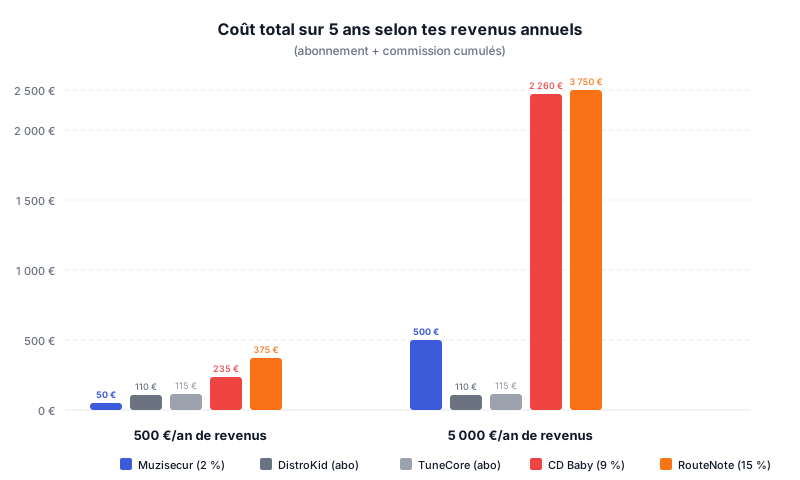
The true cost of a distributor is measured over 5 years. High commissions become a money pit as soon as your revenue grows.
Muzisecur: distribution built into real support
At Muzisecur, we don’t present ourselves as “the best digital distributor.” We are honest: distribution is a commodity. Every distributor sends your music to Spotify and Apple Music. That is not where the difference is made.
The Muzisecur model
Digital distribution is included for free for all Muzisecur members. No dedicated subscription. No per-release fee. In return, Muzisecur retains 2% on net amounts received — meaning 2% of what actually lands in your account, after platform fees are deducted.
Let’s do the math:
- 500 euros in annual revenue → 10 euros for Muzisecur. At DistroKid, you would have paid 22 euros. At CD Baby, 45 euros.
- 5,000 euros in annual revenue → 100 euros for Muzisecur. At CD Baby, 450 euros. At free RouteNote, 750 euros.
- 20,000 euros in annual revenue → 400 euros for Muzisecur. At CD Baby, 1,800 euros. You remain well below any competitor’s commission at significant volumes.
What you get beyond distribution
The real value of Muzisecur is not the distribution — it is everything around it:
- Full administrative management: contracts, accounting, declarations
- Neighboring rights: SCPP/SPPF tracking and filing
- Grant applications: CNM, regional grants, support funds
- Human support: a real contact who knows your file, not a chatbot
- Shared access to professional tools: Muzicast (radio tracking), promotion, etc.
- YouTube Content ID included
- Your music stays online: no removal if you change plans
It is the difference between renting a garage to park your car and having a mechanic, insurer, and advisor all under one roof.
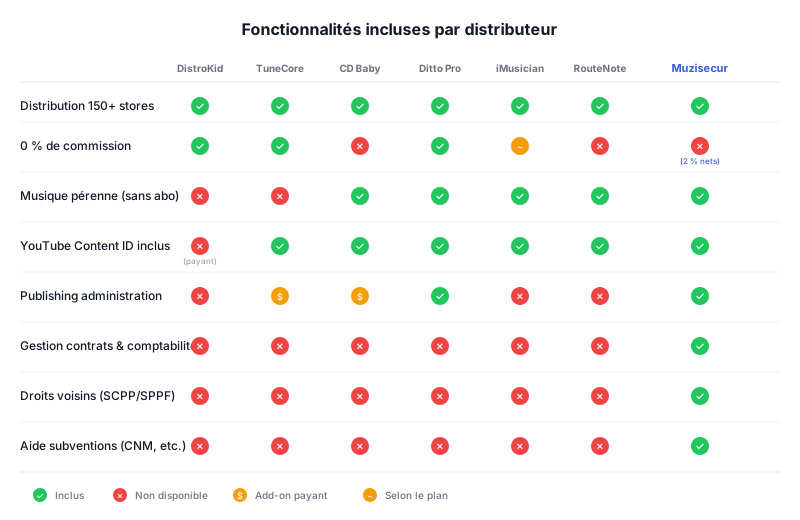
Distribution alone is not enough. This table shows what each platform actually includes — and where Muzisecur stands out.
Discover the Muzisecur offer →

How to choose your distributor: the method
Ask yourself these five questions in order:
1. What is my release volume?
If you release more than 5 singles per year, an unlimited subscription model (DistroKid, Ditto) is more economical than a per-release model. If you release one album every two years, a one-time payment (iMusician Rockstar, CD Baby) may be more relevant.
2. What are my foreseeable revenues?
If you earn less than 200 euros/year, the model barely matters — the amounts at stake are small. If you earn more than 1,000 euros/year, avoid high commissions (CD Baby 9%, RouteNote 15%, LANDR 15%). The difference amounts to hundreds of euros per year.
3. Do I want my music to stay online no matter what?
If the answer is yes, eliminate DistroKid (without add-on), TuneCore, and Ditto Starter. Favor CD Baby, iMusician Rockstar, or Muzisecur.
4. Do I need more than just distribution?
If you manage a label, if you have contracts with artists, if you need to declare your sales to SCPP or SPPF, if you want to access grants — none of these distributors will help you. That is where solutions like Muzisecur make all the difference.
5. Do I need a human contact?
If you want to be able to call someone when you have a problem, forget the low-cost distributors. Their business model relies on total automation and minimal support.
FAQ: digital distribution
What is the best digital distributor in 2026?
There is no universal “best.” DistroKid is the most popular for prolific artists, CD Baby is the most reassuring for beginners, iMusician is the best European deal, and Muzisecur is the best option if you want comprehensive support beyond simple distribution.
Do I keep my rights with a digital distributor?
Yes. Every distributor listed in this article lets you retain 100% of your rights. A distributor is not a label — it takes no rights over your music. If you see a distributor asking for a rights assignment, run.
Can I switch distributors?
Yes, but the process requires care. You need to remove your music from the old distributor, wait for the takedown to go through, then re-distribute via the new one. There may be a gap of a few days to a few weeks when your music is unavailable. And your Spotify stream counts won’t transfer if the ISRC changes.
What is the difference between distribution and publishing?
Distribution deals with neighboring rights (master): sending your recording to platforms and collecting streaming revenue. Publishing deals with copyright (composition): collecting royalties tied to songwriting and composing, through collecting societies (SACEM in France). These are two separate revenue streams. Most distributors only handle distribution, not publishing.
How long does it take for my music to go live?
Usually between 3 and 7 business days after submission. Some distributors like DistroKid can be faster (24-48 hours). Always plan a safety margin of at least 2 weeks before your official release date.
Do distributors take a cut of my SACEM royalties?
No. SACEM royalties (copyright) are collected directly by SACEM from the platforms. The distributor only touches master revenue (neighboring rights). These are two completely separate circuits.
Why was my music removed from platforms?
If you use a subscription-based distributor (DistroKid, TuneCore, Ditto Starter) and your payment fails or you don’t renew, your music is automatically removed. This is the number one cause of tracks disappearing from platforms.
Is Muzisecur’s 2% commission a lot?
On 1,000 euros of revenue, it is 20 euros. For comparison, CD Baby would take 90 euros, free RouteNote 150 euros, and LANDR about 150 euros. And unlike a fixed subscription, you pay nothing if you earn nothing. The 2% is only taken from net amounts actually received.
Conclusion
The digital distribution market in 2026 is a jungle of pricing models, hidden add-ons, and marketing promises. The truth is that all these distributors fundamentally do the same thing: they send your music to Spotify and Apple Music. The difference lies in the details — the permanence of your music, the real long-term cost, and most importantly, what happens beyond distribution.
If you are an artist or independent producer running your own label, you need far more than a pipe to the platforms. You need a partner who understands contracts, neighboring rights, declarations, grants, and who is there when you have a question. That is exactly what Muzisecur offers — with distribution included and a 2% commission that remains lower than every market alternative over the long term.
Want to distribute your music hassle-free and get comprehensive support? Discover Muzisecur — digital distribution included, 2% on net amounts, and a team that handles everything else.
Read next:
Related articles

Monetizing Your Music on YouTube, TikTok, and Instagram: Content ID, Social Distribution, and Revenue
Content ID, UGC, social distribution: learn how to earn money when your music is used on YouTube, TikTok, and Instagram in 2026.

How Much Does a Stream Pay on Spotify, Apple Music, Deezer in 2026?
Real streaming figures in 2026: how much each platform pays per stream, why it varies, and how to maximize your revenue as an independent artist.

Releasing a Single Independently: The Complete A-to-Z Checklist
From finalizing the master to playlist pitching, the 15 essential steps to release a single independently without missing anything. Actionable checklist and mistakes to avoid.