French Music Tax Credit (CIPP): Are You Eligible? (And How Much Can You Recover)

You invest thousands of euros in producing your artists, and you wonder if there is a way to recover some of those costs? Good news: the French phonographic tax credit (CIPP — Crédit d’Impôt Production Phonographique) is a French tax incentive that can reimburse up to 40% of your production expenses. It is one of the most powerful music production grants in France, and yet many producers miss it — either because they do not know the program exists, or because the administrative steps seem insurmountable.
In this article, we break down everything: the eligibility criteria, the recoverable amounts, the qualifying expenses, and above all the administrative steps to follow to build your application. And if the paperwork gives you cold sweats, know that Muzisecur can research and build your grant applications for you.
What is the phonographic tax credit?
The phonographic tax credit (CIPP) is a tax benefit created in 2006 and codified in articles 220 octies and 220 Q of the French General Tax Code (CGI). Its objective is clear: support French and European music production by reducing the tax burden on phonographic producers who invest in creating original recordings.
Concretely, it is a music production subsidy disguised as a tax credit. Instead of receiving direct aid, you reduce your corporate tax (IS) by a percentage of your eligible production expenses. If the credit amount exceeds your corporate tax, the difference is refunded by the tax authorities. In other words, even if your company pays no corporate tax this year, you can still recover money.
The program has been extended through December 31, 2027 by the finance law, giving you plenty of time to take advantage. It has also been strengthened over the years, with enhanced rates for SMEs and projects involving new talent.
Key takeaway: The CIPP is not a tax loophole reserved for majors. Any eligible phonographic producer — including small independent structures — can benefit. The amount can reach 40% of your production costs, up to a cap of 1,500,000 EUR per fiscal year.
Who can benefit from the phonographic tax credit?
The CIPP is aimed at phonographic production companies subject to corporate tax (IS) in France. This includes:
- Independent labels (SARL, SAS, SA)
- Majors and their subsidiaries
- Production companies that fund phonogram recordings
- Self-produced artists who have created a company (SAS, EURL) subject to corporate tax
What it excludes
The CIPP does not cover sole traders or artists filing as individuals under personal income tax (IR). It also does not cover music publishers, concert promoters, or distributors — unless they also have a phonographic production activity.
If you are an independent artist operating as a sole trader, you cannot directly benefit from the CIPP. However, if you create a SAS or EURL subject to corporate tax for your production, you become eligible. This is a point many overlook, and it can single-handedly justify a change in legal structure.
The 6 eligibility criteria in detail
To qualify for the phonographic tax credit, you must meet all 6 criteria simultaneously. If even one criterion is not met, you are not eligible.
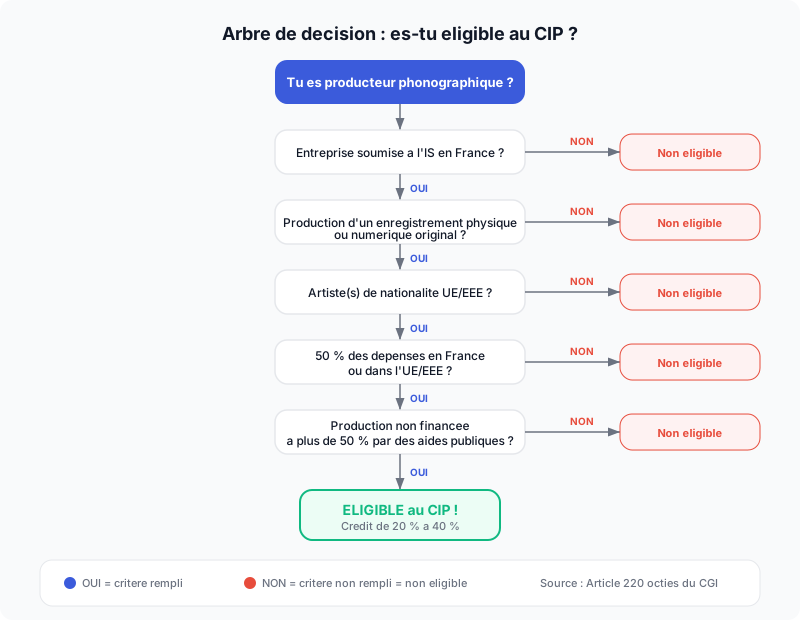
Decision tree: the criteria to meet for CIPP eligibility.
1. Be a phonographic production company
You must conduct business as a phonogram producer under article L. 213-1 of the French Intellectual Property Code. This means you take the initiative and responsibility for the first fixation of a sequence of sounds (the recording). You fund production and hold rights to the masters.
2. Be subject to corporate tax in France
Your company must be subject to corporate tax (IS) and have its registered office or a permanent establishment in France. Companies taxed under personal income tax are not eligible.
3. Produce original recordings
The expenses must relate to the production of original phonographic recordings — that is, new recordings, not reissues, compilations, or remasters of existing tracks. Compilations of previously released tracks are excluded.
4. Artists of EU/EEA nationality
The recordings must be made with performing artists who are nationals of an EU member state or the European Economic Area (EEA). This criterion concerns the nationality of the lead artist, not the location of recording.
5. Expense location
At least 50% of production expenses must be incurred in an EU or EEA member state. If you record in a Paris studio, mix in Berlin, and master in London, no problem. If you do everything in Los Angeles, you do not meet this criterion.
6. Public aid cap
Total public aid (grants, regional subsidies, CNM support, etc.) received for the production must not exceed 50% of total production cost. The CIPP itself is not included in this calculation, but other grants are.
Key takeaway: The most commonly overlooked criterion is number 4 (EU/EEA nationality of artists). If you produce an American or Canadian artist, you are not eligible for the CIPP on that specific project, even if everything else is in order.
Which expenses qualify for the CIPP?
Not all production expenses are eligible. The General Tax Code precisely defines the qualifying expense categories.
Direct production expenses
- Artistic personnel costs: performing artist fees, session musicians, backing vocalists, artistic directors’ salaries
- Technical personnel costs: sound engineers, studio technicians, producers
- Studio rental and recording equipment
- Mixing and mastering fees
- Production of associated images (covers, artwork, music videos within certain limits)
Manufacturing and distribution expenses
- Manufacturing costs for physical media (vinyl, CD)
- Physical and digital distribution costs
- Digitization and encoding for digital distribution
Promotion expenses
- Promotion and marketing costs directly related to the project (advertising, press officer, digital campaigns)
- Promotional tour costs (showcases, launch concerts)
What is NOT eligible
- General company overhead (office rent, accounting, insurance)
- Structural costs (administrative staff salaries)
- Expenses related to non-music projects
- Costs of acquiring existing catalogs or rights
| Category | Examples | Eligible? |
|---|---|---|
| Recording | Studio, sound engineer, musicians | Yes |
| Post-production | Mixing, mastering | Yes |
| Visuals | Cover art, music videos | Yes |
| Promotion | Press officer, advertising | Yes |
| Distribution | Aggregator, CD/vinyl pressing | Yes |
| Overhead | Office rent, accountant | No |
| Touring (non-promo) | Non-launch concerts | No |
How much can you recover: rates and caps
This is the central question. The phonographic tax credit amount depends on two factors: the applicable rate and the cap.
The two CIPP rates
The tax credit is calculated by applying a percentage to eligible expenses:
- Standard rate: 20% — for companies that do not meet the enhanced rate criteria
- Enhanced rate: 40% — for companies that meet at least one of these two conditions:
- The company is an SME under EU standards (fewer than 250 employees, revenue under 50M EUR or balance sheet under 43M EUR)
- The project involves a new talent (artist whose no previous album has exceeded 100,000 sales or equivalent streams)
In practice, the vast majority of independent labels qualify for the enhanced 40% rate, since they are almost all SMEs. This is a considerable advantage over large companies.
The cap
The tax credit is capped at 1,500,000 EUR per company per fiscal year. For most independent producers, this cap is more than sufficient — you would need to spend 3,750,000 EUR in eligible production to reach it at the 40% rate.
Offsetting and refund
The tax credit first offsets corporate tax due for the fiscal year. If the CIPP amount exceeds the tax due, the balance is immediately refundable by the tax authorities. You do not need to wait for future fiscal years to use the credit. This is a real cash flow advantage.
Key takeaway: As an SME or new talent producer, you recover 40 cents for every euro spent on production. On a 30,000 EUR album, that represents 12,000 EUR in tax credits.
Concrete calculation example
Let us take a concrete case to illustrate how the CIPP works in practice.
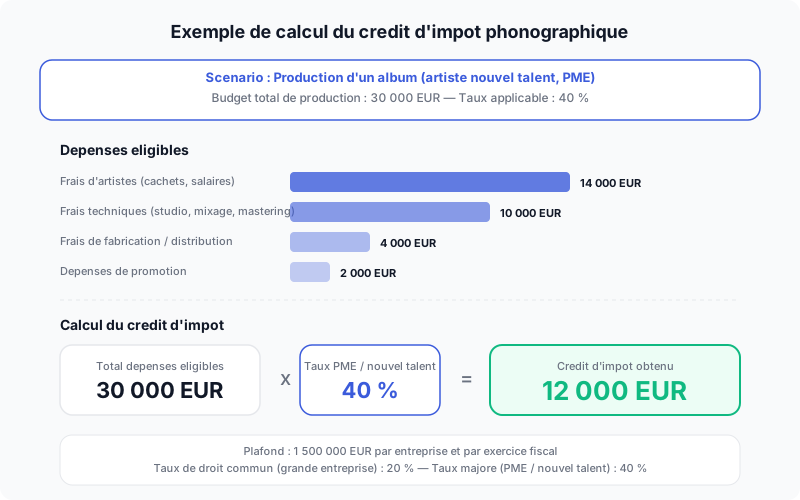
Calculation example: how the CIPP applies to a 30,000 EUR production budget.
The scenario
You are an independent label (SME, 3 employees). You are producing an album for an emerging French artist (new talent). Here is your production budget:
| Expense item | Amount |
|---|---|
| Artist and musician fees | 14,000 EUR |
| Studio rental + sound engineer | 6,000 EUR |
| Mixing and mastering | 4,000 EUR |
| Vinyl manufacturing (500 copies) | 2,500 EUR |
| Cover art and visuals | 1,500 EUR |
| Promotion (press officer + campaign) | 2,000 EUR |
| Total eligible expenses | 30,000 EUR |
The calculation
- Applicable rate: 40% (SME + new talent)
- Tax credit: 30,000 EUR x 40% = 12,000 EUR
- Corporate tax due by your company this year: 5,000 EUR
- Offset: 5,000 EUR deducted from tax = tax reduced to 0 EUR
- Refundable balance: 12,000 - 5,000 = 7,000 EUR refunded by the tax authorities
Result: on a 30,000 EUR investment, you recover 12,000 EUR. Your net production cost drops to 18,000 EUR. That is considerable — and it is exactly the kind of music production aid that can make the difference between a viable project and one that never sees the light of day.
The administrative steps, step by step
This is often the part that discourages producers. The steps to obtain the CIPP are real, but perfectly manageable — especially with support.
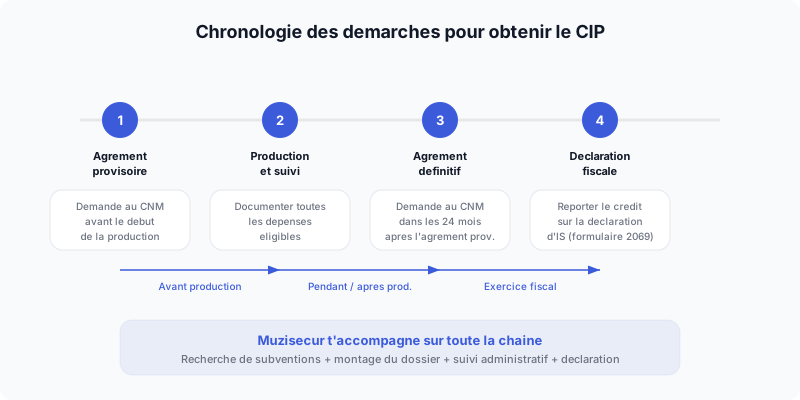
The 4 main stages to obtain your phonographic tax credit.
Step 1: Apply for provisional approval from the CNM
When: before production begins (or within 6 months of the first expenses at the latest).
You must file a provisional approval application with the Centre national de la musique (CNM), the body responsible for processing applications. The file must contain:
- The approval application form (available on the CNM website)
- A presentation of the artistic project
- A detailed budget with eligible expenses
- Proof of EU/EEA nationality of the artists
- Artist contracts (recording contracts, assignment agreements)
- Company bylaws and latest financial statements
The CNM reviews the application and verifies that the project meets artistic and economic criteria. It issues an opinion that the tax authorities (DGFiP) follow to grant approval.
Step 2: Rigorous expense tracking during production
Throughout production, you must meticulously document every eligible expense:
- Keep all invoices and proof of payment
- Maintain an expense tracking sheet by category
- Keep employment contracts and pay slips for artists and technicians
- Archive service contracts (studio, mixing, mastering, pressing)
Step 3: Apply for final approval
When: within 24 months of obtaining provisional approval.
Once production is complete (or commercialization has begun), you file a final approval application with the CNM. This second file must prove the project was carried out as planned and that actual expenses match the initial budget. You provide:
- The project’s actual financial report
- Documentation for all expenses incurred
- Proof of commercialization (distribution link, physical copies)
- Certification from your accountant or auditor
Step 4: Tax filing
When: when filing your corporate tax return for the relevant fiscal year.
You report the tax credit amount on your corporate tax return using form no. 2069-RCI and the specific declaration no. 2079-AV. Your accountant should be involved at this stage.
Key takeaway: The provisional approval application must be filed BEFORE or at the very start of production. This is producers’ number 1 mistake: starting production without filing the application, and finding themselves past the deadline.
Common mistakes to avoid
The CIPP is a powerful program, but it is governed by strict rules. Here are the most common pitfalls producers fall into.
1. Filing the approval application too late
Provisional approval must be requested before production starts or within a very short window after. If you wait until the album is finished to file your application, it is too late. The CNM will reject it.
2. Not documenting expenses
You spent 8,000 EUR on a studio but did not keep the invoice? You paid musicians in cash with no contract? Those expenses will not be counted. The CIPP requires flawless accounting documentation for every euro claimed.
3. Confusing original production with reissues
Only original recordings are eligible. If you remaster an existing album or compile previously released tracks, that is not original production under the CIPP.
4. Ignoring the nationality criterion
Producing a featuring with an American artist? If the project’s lead artist is not an EU/EEA national, the entire project may be deemed ineligible. Check this criterion upfront.
5. Exceeding the 50% public aid threshold
If you combine a CNM grant, a regional subsidy, and the CIPP, make sure total public aid (excluding CIPP) does not exceed 50% of production cost. Otherwise, you lose eligibility.
6. Not planning for processing times
The CNM takes an average of 2 to 4 months to process an approval request. If you file your application at the last minute, you risk blocking your tax return.
Why use Muzisecur for your CIPP application
Let us be honest: building a phonographic tax credit application is work. Between the approval form, gathering documentation, accounting tracking, and the tax declaration, it easily takes 15 to 20 hours of administrative work per project. And if your file is poorly prepared, the CNM will request additional documents — or worse, reject your application.
That is exactly what Muzisecur does for you:
- Grant research: we identify all the grants you are eligible for, not just the CIPP (CNM grants, regional subsidies, creative support funds, etc.)
- Application preparation: we prepare the approval form, structure the budget, and gather supporting documents
- Administrative follow-up: we ensure your expenses are properly documented during production
- Coordination with your accountant: we transmit the elements needed for your tax filing
Admin should never be a barrier to your creativity. While you focus on the music, Muzisecur handles the paperwork and maximizes your funding.
Key takeaway: Every year, thousands of euros in tax credits go unclaimed by eligible producers who do not file applications. Do not leave that money on the table.
FAQ: Phonographic tax credit
Is the CIPP stackable with other grants?
Yes, the phonographic tax credit can be combined with CNM grants, regional subsidies, and other support programs. The only limit is that total public aid (excluding CIPP) must not exceed 50% of total production cost.
Can a self-produced artist benefit from the CIPP?
Not as a sole trader. But if the artist creates a company subject to corporate tax (SAS, EURL taxed as a company) to carry their production, that company can be eligible, provided all other criteria are met.
Does the CIPP apply to singles or only to albums?
The CIPP applies to any original phonographic recording, whether it is a single, EP, or album. There is no minimum recording length required.
What happens if the album does not sell?
The tax credit is tied to production expenses, not revenue. Even if the album generates zero sales, you can still claim the credit as long as production actually took place and expenses are documented.
How long does it take to receive the reimbursement?
After filing your corporate tax return, the CIPP reimbursement typically arrives within 3 to 6 months. Timing may vary depending on the tax office.
Will the CIPP be renewed after 2027?
The program has been extended several times since 2006. The latest extension covers fiscal years through December 31, 2027. A further extension is likely given political support for the cultural sector, but nothing is guaranteed — all the more reason to take advantage now.
Do you need an accountant to file the CIPP?
It is not a legal requirement, but it is very strongly recommended. The CIPP involves precise calculations, rigorous expense categorization, and a specific tax filing. An accountant familiar with the music industry is a major asset.
Can you claim the CIPP for multiple projects in the same year?
Yes, you can file multiple approval requests for different projects within the same fiscal year. The 1,500,000 EUR cap applies to total credits combined for the fiscal year, not per project.
Conclusion
The phonographic tax credit is one of the most advantageous programs for music producers in France. With a rate of up to 40% of production expenses for SMEs and new talent projects, it can transform the economics of your productions. On a 30,000 EUR album, that is 12,000 EUR coming back to you.
But the CIPP does not fall from the sky. You need to plan ahead, document expenses, obtain approvals, and correctly declare the credit on your tax return. It is a real administrative effort — but the return on investment is massive.
If you are a phonographic producer and have never applied for the CIPP, it is time to start. And if the paperwork puts you off, Muzisecur is here to handle grant research and application building, from the first form to the tax filing. Focus on the music — we handle the rest.
Related articles

Independent Label: How to Structure the Admin Management of Your Artists
Contracts, distribution, rights, accounting, promotion: the 5 admin pillars of an independent label and how to structure them without drowning.

Monetizing Your Music on YouTube, TikTok, and Instagram: Content ID, Social Distribution, and Revenue
Content ID, UGC, social distribution: learn how to earn money when your music is used on YouTube, TikTok, and Instagram in 2026.

ADAMI and SPEDIDAM: The Complete Guide for Performing Artists
ADAMI or SPEDIDAM? Understand the difference, register with the right organization, and finally collect your performer rights. Practical guide with steps, grants, and mistakes to avoid.