How to Register with SACEM as a Songwriter-Composer: Complete 2026 Guide

You’ve just composed your first track, released it on Spotify and Deezer, and you’re starting to accumulate streams. Congratulations. But are you actually collecting all the revenue you’re entitled to? If you’re not registered with SACEM, the answer is no.
SACEM (Societe des Auteurs, Compositeurs et Editeurs de Musique) is the French organization that collects and redistributes copyright royalties every time your music is broadcast — on radio, via streaming, in a bar, at a concert, in an ad, or even in an elevator. Without registration, these royalties are collected… but nobody knows who to pay them to. They stay in a common pot you’ll never see.
This guide shows you exactly how to register with SACEM in 2026: the requirements, the documents, the step-by-step procedure, the costs, the timelines, and especially the mistakes that cost hundreds of artists time (and money) every year.
Why join SACEM
Before diving into the procedure, let’s clarify an essential point: SACEM is not a label or a distributor. It’s a collecting society. Its role is to collect the copyright royalties generated by the exploitation of your works and pay them to you.
Your distributor (DistroKid, TuneCore, CD Baby, etc.) pays you streaming royalties — the share that platforms pay for each listen. But there’s another category of revenue: copyright royalties, which are collected separately by SACEM from all broadcasters.
What SACEM collects for you
| Revenue source | Examples | Without SACEM |
|---|---|---|
| Radio/TV broadcast | Plays on NRJ, France Inter, M6 | Royalties lost |
| Streaming | Spotify, Deezer, Apple Music, YouTube | Copyright royalties not paid |
| Public venues | Bars, restaurants, shops, waiting rooms | Royalties lost |
| Concerts & festivals | SDRM on admissions, performance rights | Royalties lost |
| Synchronization | Ads, films, series, video games | Individual negotiation needed |
| Private copying | Levy on storage devices (USB sticks, hard drives) | Royalties lost |
| International | Agreements with 230+ societies worldwide | No foreign collection |
SACEM vs doing nothing: what you lose
Let’s take a concrete example. An independent artist who accumulates 500,000 streams per year on platforms and whose tracks get local radio play can expect:
- Distributor royalties: roughly 1,500 – 2,000 euros (depending on platform and country)
- SACEM streaming royalties: roughly 300 – 600 euros on top
- Radio royalties: variable, but potentially 200 – 1,000 euros per year depending on frequency of broadcast
- Public venue royalties: a share of the common pot redistributed proportionally
Without SACEM, you’re potentially leaving 30 to 50% of your total revenue on the table. And the more your music is broadcast, the wider the gap.
Key takeaway: SACEM doesn’t replace your distributor. It complements it. One pays you streaming royalties, the other pays copyright royalties. You need both.
Requirements for joining SACEM
Registration with SACEM isn’t automatic. There are a few conditions to meet:
- Be a songwriter, composer, or songwriter-composer of at least one musical work
- Have at least one commercially released work — published on a streaming platform, performed at a concert, broadcast on radio, or fixed on a commercial medium
- Provide proof of release — streaming link, concert poster, sync contract, etc.
- Be of legal age (or have parental authorization for minors)
- Pay the membership fees of 154 euros (tax included)
Key takeaway: You don’t need a label, a publisher, or a distributor to join. A 100% independent artist can register as soon as they have a released track.
Songwriter, composer, or publisher: which status to choose
SACEM distinguishes three categories of members:
| Status | Role | Examples |
|---|---|---|
| Songwriter | Writes the lyrics (text) | Lyricist, rapper, spoken word artist |
| Composer | Creates the melody and/or arrangement | Beatmaker, composer, music producer |
| Publisher | Commercially exploits the work, manages rights | Music publishing company |
If you write and compose, you register as a songwriter-composer (both statuses combined). This is the most common case for independent artists.
If you’re a beatmaker producing instrumentals, you register as a composer. If another artist writes lyrics on your beat, they register as a songwriter, and you declare the work together with a rights split defined between you.
The 6 steps to register with SACEM
Here is the complete procedure, step by step. The entire process generally takes between 2 and 6 weeks depending on how complete your file is.
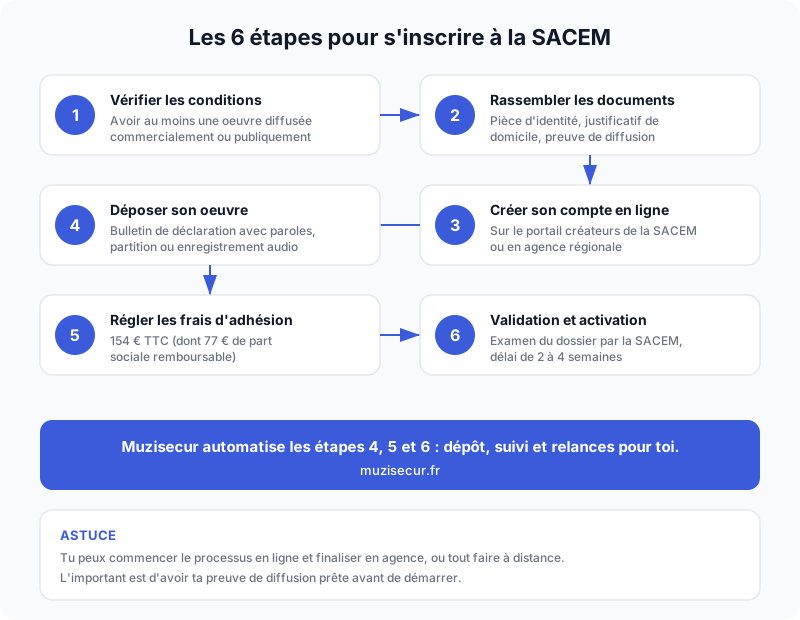
The 6 steps of SACEM registration — from checking eligibility to account activation.
Step 1: Check eligibility requirements
Before starting the process, make sure you meet the conditions listed above. The most important point is the proof of release. Here’s what’s accepted:
- Link to a streaming platform (Spotify, Deezer, Apple Music, YouTube Music, etc.)
- Screenshot of your artist profile with the track visible
- Concert poster or ticket where you performed your work
- Signed license or sync contract
- Broadcaster attestation (radio, TV)
If you don’t have a released track yet, start there. Use a digital distributor to release your first single, then come back once it’s live.
Step 2: Gather the required documents
Prepare the following documents before starting the online process — it’ll save you back and forth:
| Document | Accepted format | Note |
|---|---|---|
| Government-issued ID | National ID card, passport, residence permit | Must be current |
| Proof of address | Utility bill, rent receipt, tax notice | Less than 3 months old |
| Proof of release | URL link, screenshot, contract | See list above |
| Bank details | Bank account statement (RIB in France) | To receive your royalties |
| Lyrics and/or score | Text, chord chart, audio file | Of the work you’re registering |
Key takeaway: If your artist name differs from your legal name, you’ll also need to provide a pseudonym declaration. SACEM records it so that your royalties are correctly attributed, regardless of the name under which your music is released.
Step 3: Create your account on the creators portal
Go to the creators portal on SACEM (createurs.sacem.fr). Click “Become a member” and fill in the online registration form.
You’ll need to provide:
- Your full legal identity (last name, first name, date of birth)
- Your postal address
- Your artistic pseudonym (if applicable)
- Your status (songwriter, composer, or songwriter-composer)
- Your bank details
You can also complete the process in person at one of SACEM’s regional offices. This is sometimes faster if you have specific questions or an unusual case.
Step 4: Register your first work
This is the key step. You must fill in a declaration form for at least one work. This form contains:
- The title of the work
- The songwriters and composers involved (with their SACEM number if already members)
- The rights split between the various rights holders
- The complete lyrics (for works with text)
- An audio recording or score (lead sheet minimum)
- The musical genre of the work
If you’re the sole songwriter-composer, the split is simple: 100% for you. If you co-write with others, you need to agree before registration on the exact split.
Step 5: Pay the membership fees
Membership fees are 154 euros (tax included), broken down as follows:
- 77 euros entry fee (non-refundable)
- 77 euros membership share (refundable upon resignation)
Payment can be made online by credit card or in person by check. Once payment is confirmed, your file goes into review.
Step 6: Validation and account activation
SACEM reviews your application. If everything is in order, your membership is validated within 2 to 4 weeks. You then receive:
- Your SACEM member number
- Full access to the creators portal to manage your works
- The ability to register new works online at any time
If your file is incomplete, SACEM contacts you to request the missing documents. This is where timelines can stretch considerably if you haven’t prepared your documents properly.
How much does SACEM registration cost
Let’s recap the costs clearly:
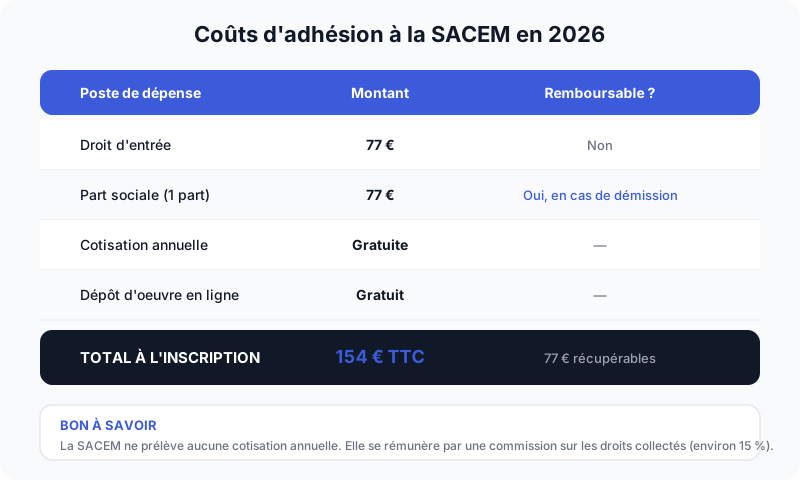
Breakdown of SACEM membership fees — 154 euros total, including 77 euros refundable membership share.
Some important details:
- No annual fee: unlike other organizations, SACEM doesn’t charge you anything each year. It earns through a commission deducted from the royalties it collects (about 15% on average).
- Registering works is free: you can register as many works as you want at no additional cost.
- The membership share is an investment: this 77 euros makes you a voting member of SACEM. You participate in votes at general assemblies and get this sum back if you ever leave the society.
Expected timelines
The time between your first step and your first royalty payment can seem long. Here’s a realistic timeline:
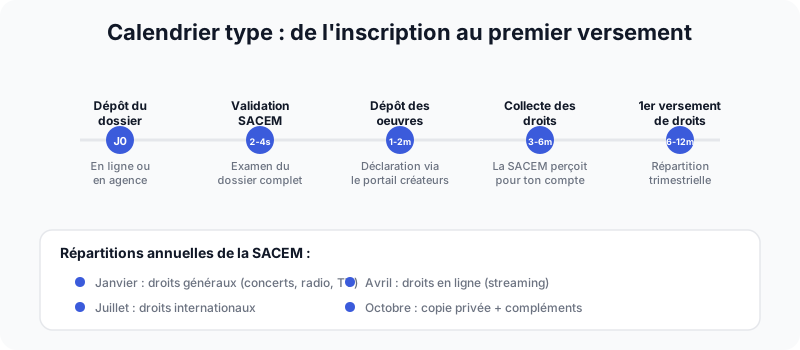
From filing your application to the first payment: between 6 and 12 months depending on distribution schedules.
| Step | Estimated time |
|---|---|
| Preparing your file | 1 to 3 days |
| Online registration | 30 minutes |
| SACEM validation | 2 to 4 weeks |
| Registering first work | Immediate after validation |
| First royalties collected | 3 to 6 months after broadcast |
| First payment | At the next quarterly distribution |
SACEM carries out four main distributions per year: in January, April, July, and October. If you register in March and your royalties start being collected in April, you could receive your first payment as early as July or October of the same year.
Key takeaway: Don’t wait until you have “enough” tracks to register. The sooner you register, the sooner your royalties are collected. Every day without registration is a day of potentially lost royalties.
How to register a work with SACEM
Once registered, you can submit your works at any time through the creators portal. This is a crucial step because an undeclared work generates zero royalties, even if it’s being broadcast everywhere.
The declaration form
For each work, you fill in a declaration form that includes:
- General information: title, subtitle if any, musical genre, duration
- Rights holders: list of all songwriters and composers with their respective shares
- Lyrics: complete lyrics for songs
- Musical support: score (lead sheet), chord chart, or audio recording
- Release information: first release date, formats (digital, physical, etc.)
Online registration is free and unlimited. You can register a single or a full album of 20 tracks.
Splitting rights between co-writers
This is often the sticking point. SACEM requires that the rights split be defined at the time of registration. Here are the default rules:
- Lyricist: “PA” share (paroles / lyrics)
- Composer: “MU” share (musique / music)
- Publisher: “ED” share (edition / publishing)
The standard split between a lyricist and a composer is 50/50 (50% lyrics, 50% music). But you’re free to define a different split if you wish, provided all co-writers sign the form.
If you’re a songwriter-composer with no publisher, you receive 100% of the songwriter and composer shares. If you sign with a publisher, a portion of your royalties will be redirected to them (usually between 30 and 50% depending on the publishing contract).
Key takeaway: Always define the rights split before going into the studio. It’s much easier to reach an agreement when the relationship is good than after a hit (or a conflict). Muzisecur lets you generate clear, electronically signed split agreements before you even file the registration.
Common mistakes to avoid
After helping hundreds of artists, here are the most common mistakes we see during SACEM registration and work declaration:
1. Waiting too long to register Many artists think they need to “deserve” registration or have a certain number of tracks. Wrong. One released track is enough. Every month without registration means royalties not collected for you.
2. Confusing copyright royalties with streaming royalties Your distributor pays you streaming royalties. SACEM pays you copyright royalties. These are two different, complementary revenue streams. Not being with SACEM doesn’t mean you’re not losing anything — quite the opposite.
3. Forgetting to declare each new work Registering with SACEM is not enough. Each track must be individually declared via a declaration form. If you release a new EP and forget to declare it, the royalties for those tracks won’t be paid to you.
4. Not defining the split with your co-writers If you co-write a track without formalizing the split, the registration will be blocked. Worse: disagreements may surface later and create costly legal disputes.
5. Submitting an incomplete file An expired proof of address, insufficient proof of release, a missing bank statement… Every missing document extends the validation timeline by several weeks.
6. Not declaring your stage name If you release music under an artist name different from your legal name and don’t declare it, SACEM won’t be able to link the broadcasts to your account.
7. Neglecting metadata The title declared at SACEM must match exactly the title on streaming platforms. A typo, a missing accent, or a poorly formatted “feat.” can prevent automatic matching and delay the collection of your royalties.
SACEM and streaming: how it works
The question comes up often: “If my distributor is already paying me for my streams, why does SACEM also owe me money?”
Here’s the simple explanation:
When a user listens to your track on Spotify, the platform pays two types of remuneration:
- Neighboring rights (royalties): paid to the phonographic producer (you if you’re independent, or your label) via your distributor. This is remuneration for the sound recording.
- Copyright royalties: paid to SACEM (or its equivalent in each country) which redistributes them to songwriters and composers. This is remuneration for the composition and lyrics.
In practice, Spotify pays roughly 25 to 30% of its revenue directly to collecting societies like SACEM for copyright. This amount is independent of what your distributor pays you.
So no, it’s not “double payment” — these are two distinct rights that pay for two different things.
Key takeaway: Even if you’re 100% independent and manage everything yourself, you need a distributor AND SACEM to capture all your music revenue.
How Muzisecur simplifies the process
Let’s be honest: the SACEM registration procedure isn’t insurmountable, but the day-to-day management — declaring each work, checking distributions, tracking payments, following up when a royalty isn’t collected — is an administrative burden that most artists have neither the time nor the desire to handle.
That’s exactly what Muzisecur automates:
- Automatic work registration: you enter the info once, Muzisecur generates the declaration form and sends it to SACEM
- Real-time royalty tracking: a dashboard that centralizes your SACEM, distributor, and other revenue sources
- Distribution alerts: you’re notified for each payment and in case of anomalies
- Co-writer management: rights splits formalized and electronically signed
- Automated contracts: publishing, co-writing, and assignment contracts generated in a few clicks
The goal is simple: you create the music, Muzisecur handles the admin.
FAQ
Is SACEM registration mandatory? No, registration is voluntary. But if you don’t register, the copyright royalties generated by the broadcast of your music won’t be paid to you. It’s therefore strongly recommended as soon as you have at least one released track.
Can you register with SACEM as a minor? Yes, but you need parental or legal guardian authorization. A minor cannot join on their own.
Can I join if I can’t read music? Absolutely. You don’t need to provide a traditional sheet music score. An audio recording of your composition is accepted as supporting material.
How long until I receive my first royalties? Between 6 and 12 months after registration, depending on when you join and SACEM’s distribution calendar. Distributions take place in January, April, July, and October.
Can I be a member of SACEM and another performing rights organization (ASCAP, BMI, etc.)? No. SACEM operates on the principle of exclusivity. As a member, you entrust SACEM with the management of all your copyright worldwide. It has reciprocal agreements with over 230 foreign societies to collect your rights internationally.
What happens if I leave SACEM? You can resign at any time by sending a registered letter. Your 77-euro membership share will be refunded. However, any royalties already collected will be paid according to the usual schedule.
Does SACEM take a commission on my royalties? Yes. SACEM deducts a commission to cover its management costs. The average rate is about 15%, but it varies depending on the type of right (online, radio, concert, etc.). It’s transparent and detailed in your distribution statements.
I’m a beatmaker and I only produce instrumentals. Should I register? Yes, absolutely. As a composer, you hold copyright on your instrumental compositions. And if an artist writes lyrics on your beat, you register the work together.
What is the difference between SACEM and SCPP/SPPF? SACEM manages copyright (lyrics and composition). SCPP and SPPF manage neighboring rights (the producer’s remuneration for the broadcast of the recording). These are complementary rights.
Conclusion
Registering with SACEM is one of the first administrative steps every songwriter-composer should take as soon as they have a released track. It’s not complicated, it’s not expensive (154 euros, half of which is refundable), and most importantly, it’s essential to capture all your music revenue.
To summarize the procedure:
- Verify that you have at least one released work
- Gather your documents (ID, proof of address, proof of release, bank details)
- Create your account on the creators portal
- Register your first work with the declaration form
- Pay the 154 euros membership fees
- Wait for validation (2 to 4 weeks)
And above all, don’t forget to declare each new work over time. An undeclared work is a work that earns you zero copyright royalties, even if it’s accumulating millions of streams.
If you want to save time and automate this entire process — from the initial registration to tracking payments — Muzisecur is here for that. You focus on the music, we handle the rest.
Related articles

Music Copyright: How It Actually Works
Songwriter, composer, producer, performer: who gets paid what and why? Understand copyright, neighboring rights, and private copying in music.

Split Sheet: How to Share Music Rights Between Co-Writers
The split sheet is the most important (and most forgotten) document in music. How to write one, what to include, and why you should never release a track without it.

Annual Sales Declaration SCPP SPPF: The Complete Guide to Collecting Your Neighboring Rights
How to declare your sales to SCPP or SPPF and collect your producer neighboring rights. The 5 steps, the pitfalls, and the essential codes.