Getting on Radio Playlists: The Complete Guide for Independent Artists
Getting on Radio Playlists: The Complete Guide for Independent Artists
You dream of hearing your track on NRJ, Skyrock, or Fun Radio, but you have no idea how the machine works? You are not alone. Every week, hundreds of new releases are pitched to major French radio stations, and only 3 to 4 make the cut. Getting on a radio playlist as an independent artist is a challenge, but it is far from impossible if you understand the rules of the game. In this guide, we break down the complete mechanics of radio playlists: rotation formats, the radio station hierarchy, French quotas imposed by ARCOM, tools like Muzicenter for reaching media decision-makers, and the real role of the press agent. By the end of this article, you will know exactly where to start and which mistakes to avoid.
Understanding the mechanics of radio playlists
A radio station’s music programming is built on a three-tier classification system that determines everything else. If you want to get on a radio playlist, you first need to understand how a track lives on air.
New release, recurrent, gold: the three statuses of a track
Every track played on radio goes through three distinct phases, measured by Yacast, the leading radio tracking organization in France.
The new release is a track that just came out and enters rotation for the first time. It is considered new for a window of 16 weeks. After that, it becomes a recurrent: it stays on air but is no longer classified as a new release for tracking purposes. Finally, after more than a year of rotation, the track becomes a gold — a classic that the station continues to program to retain its audience.
This 16-week cycle is fundamental. It means that if your track enters rotation on a small local station for two months before you pitch a major station, you have already burned eight weeks of “new release” status. The major station that might be interested will hesitate, because it knows it only has eight weeks left to establish the track before it becomes a recurrent.
Key takeaway: Your track is a new release for 16 weeks from its first radio broadcast tracked by Yacast. Every week that passes reduces your potential with major stations.
Programming ratios
Radio stations do not program randomly. They follow internal ratios between new releases, recurrents, and golds. For example, a station might operate with 30% new releases, 50% recurrents, and 20% golds. These proportions vary from one station to another, but the principle remains the same: there is a limited number of slots for new releases.
This is what makes getting on a playlist so competitive. When you look at the top 40 of a network station like NRJ, you see that the number one track can reach 70 plays per week — about 10 airplays per day. And in a typical week, there are only 3 to 6 new entries, sometimes from more than 200 pitches.
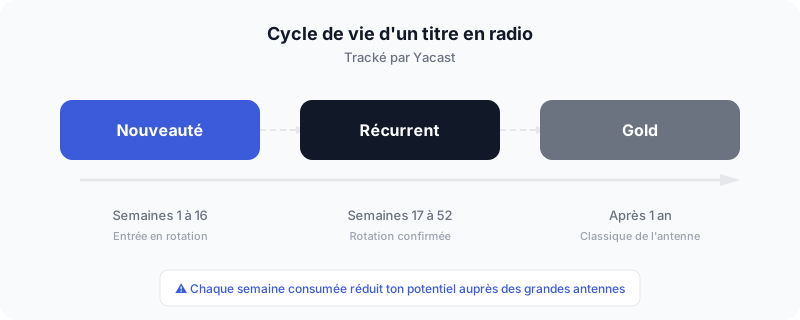
The lifecycle of a track on radio: from new release to gold, each phase has its own rules.
The types of radio stations in France
Not all radio stations carry the same weight in a promo strategy. There are three distinct categories, and the order in which you approach them changes everything.
Network stations: the “starters”
These are the major national stations: NRJ, Skyrock, Fun Radio, Virgin Radio, RTL2, Cherie FM, Energy, Europe 2, and others. They have the biggest audiences, the most impact, and they set the trend. When a track enters rotation on a network station, other stations notice.
They are called starter stations because they launch tracks. Ideally, you start with them, even though they are the hardest to access.
Independent stations: the “followers”
The independent panel includes about a hundred regionally important but non-national stations. For example, Hit West in the west of France, Contact FM in the north, Radio Star in Marseille, Black Box in Bordeaux, Happy FM in the east, and many more.
These stations are more accessible, but they function as followers. Concretely, if you call Radio Star saying you are on the playlist of a station in Rouen, it will not impress them. What they want to know is what is happening on the networks. Is NRJ, Skyrock, or Fun Radio playing you? If the answer is no, you will get at best what is called “courtesy plays”: one or two airplays per week, out of goodwill.
Community and secondary stations
These are small local stations with an audience limited to one city or a few municipalities. They are very accessible, but their impact on a career remains limited.
Key takeaway: In an ambitious strategy, you always start with network stations (starters), then build momentum with independent stations (followers). Starting at the bottom of the pyramid means burning your new-release weeks without creating any leverage.
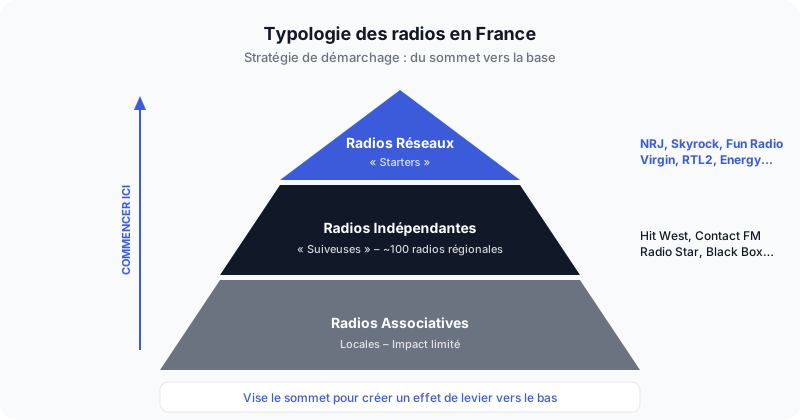
The radio hierarchy in France: aim for the top of the pyramid to create a leverage effect.
French quotas: an underestimated strategic lever
ARCOM (the French audiovisual regulator) requires radio stations to play at least 40% French-language songs, of which at least 20% must be new talents or new productions. This rule, often seen as a constraint by stations, is actually a golden opportunity for French-speaking independent artists.
Why singing in French gives you a competitive edge
Look at the English-language portion of a radio playlist: it is a battlefield dominated by international heavyweights. Ed Sheeran, Rihanna, Bruno Mars — artists backed by Warner, Sony, and Universal budgets on a global scale. You simply cannot compete with them.
On the French-language portion, however, the competition is much less fierce. There are fewer tracks available, fewer massive budgets, and most importantly, stations need these tracks to meet their quotas. When a station finds itself short on French quotas, it is what is known as a “French quota SOS”: it sends a message to all press agents and promo directors urgently requesting French-language tracks. This is an exceptional entry window.
The French quota hack
To earn the French quota certification, at least 51% of the sung content must be in French. You can apply for it through Yacast. If your track is in English, you have several options: record a French version, invite a French-speaking artist for a featuring, or simply make it a habit to send your singles in French to radio stations.
An industry tip: Creole is often considered French for quota purposes. For artists working in aesthetics like dancehall, reggae, or certain dance styles, this can be an additional lever for reaching the 51% threshold.
For more on promo strategies and media mechanics, check out Tarik Hamiche’s book: 99 Methodes pour faire connaitre sa musique — a concentrated set of field-tested actionable strategies.
The entry-exit system and audience testing
A zero-sum game
A radio station’s playlist works like a shelf: to add a track, you have to remove one. It is a zero-sum mechanism. In a typical week, NRJ might remove 6 tracks and add only 4. This means playlist entry is extremely competitive, and timing is critical.
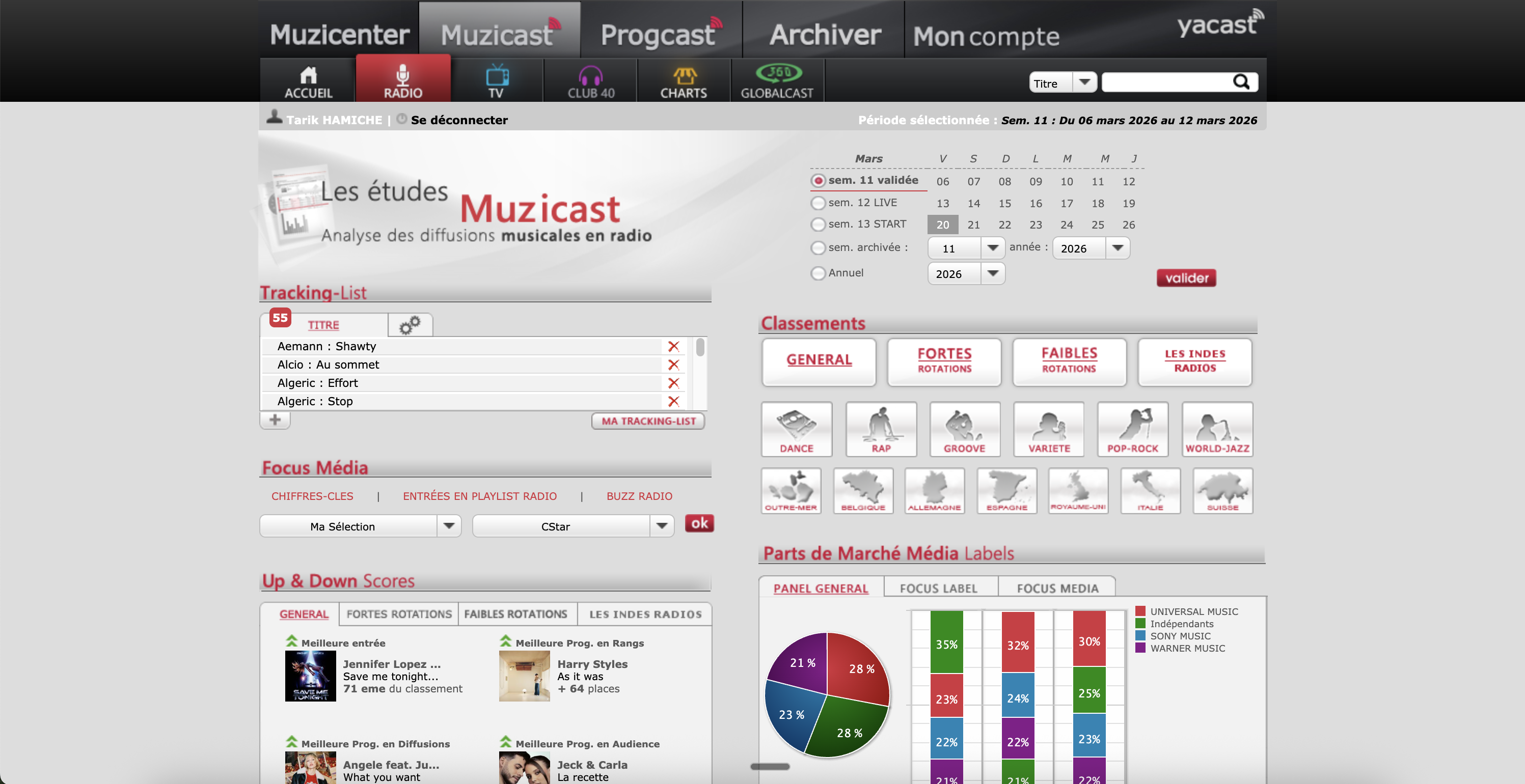
By analyzing playlist movements on Muzicast (Yacast’s tracking tool), you can spot which stations shuffle their playlists the most, which ones remove more tracks each week, and therefore which ones are more likely to welcome new entries.
Mediametrie testing: the ultimate judge
Here is how a station decides whether to keep or drop a track. After about 15 days of light rotation (5 to 7 plays per week), the station commissions a test from Mediametrie. The survey is straightforward: a random panel of people is called, they hear 10 seconds of the track, and they are asked questions. Do you recognize the artist? The title? Have you heard it before? On which station? Do you like it or not?
If the results are good, the track moves into heavy rotation (up to 10 plays per day). If the results are bad, the track is pulled from the playlist. It is that simple and that brutal.
This is why having a solid fanbase before pitching radio stations is decisive. When your fans already know the track because it has been circulating for months on streaming and in clubs, the survey results come back positive naturally.
What radio stations respond to today
Forget the iTunes chart, a record label logo, or a packed tour schedule. Today, programmers are sensitive to two primary indicators: streaming scores (Spotify, Deezer, Apple Music) and the Shazam ranking. Shazam is particularly powerful because it indicates that people are hearing the track somewhere and want to know what it is — an organic interest signal that stations cannot ignore.
A third factor, rarer but formidable: an active fanbase. If your fans call the station’s switchboard to request your track, it carries weight. This has happened to several independent artists: a simple social media post encouraging fans to call the station was enough to send rotations through the roof.
Reaching media decision-makers with Muzicenter
The industry-standard tool
Muzicenter (Yacast) is the platform used by the entire French music industry to send new releases to media decision-makers. It gives you access to over 1,300 contacts: programmers at network stations, independent stations, affiliated European stations, TV channels, the web panel, the France Bleu panel, and the overseas panel.
The advantage of Muzicenter is that it delivers your track in a format compatible with radio programming software (like Selector). The programmer just has to download and integrate — a significant time-saver that facilitates playlist entry.
The submission process
Submitting through Muzicenter is straightforward. You select the format (single in 99% of cases — you never send an album to a radio station), upload your audio in WAV quality, fill in the metadata (title, artist, label, ISRC, genre, credits), add a promo pitch and a video link if available, then select your target media. A mass submission reaches all 1,382 decision-makers; a targeted submission lets you segment by media type (radio only, club, TV, etc.).
For timing, aim for a submission on Tuesday or Thursday around 9-10am, just before the listening meetings that typically take place on those days.
The real role of the press agent
What they do (and don’t do)
A music press agent is an intermediary between the producer and the media. Their role is to know programmers personally, have a rapport with them, and raise awareness about your release. Concretely, they call, they follow up, they make the case. But that is all.
They don’t work miracles. They can’t place a track that isn’t “placeable.” And if they have no selling point (no streaming scores, no Shazam ranking, no emerging buzz), they can’t keep following up without burning their network.
The classic approach (that doesn’t work)
The classic scenario goes like this. You walk into a nice office with gold records on the wall. The press agent listens to your track, tells you it is amazing. You are offered a promo campaign at 3,000, 5,000, or 7,000 euros. You pay, and for three months, you receive vague reports: “It’s on the right pile,” “Under consideration,” “Haven’t been able to chat with the boss yet.” At the end of the quarter, nothing has happened, and you are offered to move on to the next single.
The effective approach (the one you should follow)
The approach recommended by experienced producers is radically different. You start by building your fanbase. You promote your single to your audience. If the track doesn’t take off (which happens in 99% of cases), you move on to the next one — that is life. But if the track blows up and you sense an emerging phenomenon (exploding streaming scores, rising Shazam ranking, viral video), that is when you approach a press agent.
The difference? You arrive with ammunition. And most importantly, you can negotiate: no entry fee, a co-exploitation deal with performance bonuses. The press agent accepts because they know the track has potential and it is in their own interest.
Tarik Hamiche’s take (founder of Producteur a Succes): “Your press agent only has weight if you are capable of doing without one. That is the secret. If you have no streaming scores, no Shazam ranking, and no fanbase, no press agent in the world can force a station to play you. But if you arrive with an emerging phenomenon, they can amplify what is already catching on. That is where they are useful.”
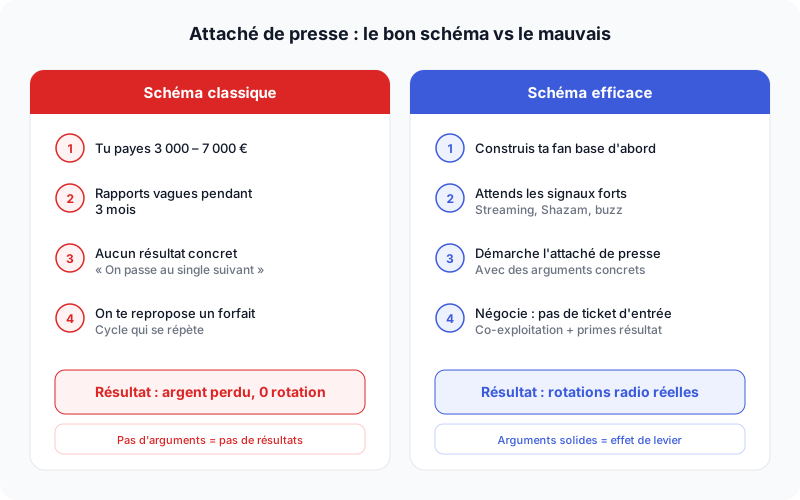
The classic approach is expensive and yields nothing. The effective approach starts from the market and exploits positive signals.
For a deeper dive into building a solid career strategy and understanding the role of each team member, check out Tarik Hamiche’s book: Le Secret pour Vivre de sa Musique — the complete action plan from fanbase building to contract signing.
Tracking your promo with Muzicast
Muzicast (Yacast) is the essential tool for monitoring what happens once your track is sent out. It lets you check in real time how many times your track is broadcast, on which stations, at what times, with estimated audience reach. You can even listen to the broadcast clip to verify playback conditions.
This tool is also your best ally for holding your press agent accountable. If they tell you that you are “in rotation on such-and-such station,” you can verify instantly. If they claim three plays per day when you only see one per week, you know where you stand.
Muzicast also lets you analyze trends: which tracks are rising, which are falling, which stations are likely to free up slots soon. It is a strategic intelligence tool that every industry professional uses daily.
With Muzisecur, you get regular broadcast reports without needing to manage an individual Yacast subscription. That is the whole point of pooling tools: you get the same weapons as the majors at a fraction of the cost. Discover Muzisecur’s promo features ->
Three advanced levers to go further
1. The power of radio live events
Radio live events are concerts organized by stations, often free for the public, with massive on-air promotion. Energy Music Tour, Hit West Live, Fun Radio night events — these can draw 10,000 to 40,000 people.
For an artist programmed at a radio live event, it is a guarantee of being blasted on air during the weeks leading up to the concert. The station wants the audience to know your track by heart so they can sing along on the day. Result: you might get 8 plays per day for two months, simply because you are participating in the event.
A press agent with headliners in their roster can even push a young talent onto a live event lineup in exchange for their star artist’s participation. This kind of leverage works when the relationship with the station is solid.
2. Building a long-term relationship with media
Programmers are humans. They appreciate artists and teams who make the effort to visit them, build a genuine connection, and aren’t only there out of self-interest. A lunch during a tour, a small local gift when you are in their city, a supportive call when the station is going through a rough patch — all of this builds invaluable goodwill.
You mobilize this goodwill when you need it. When your press agent tells you they are stuck with a station, a personal phone call can unlock a special show, a morning slot, or a few courtesy plays. This is not favoritism: it is the natural mechanics of long-term professional relationships.
3. Collaborating with media “favorites”
By analyzing broadcast data on Muzicast, you can identify which artists are regularly programmed on a given station. Proposing a collaboration (featuring, duet) with an artist who is already in a station’s good graces is like borrowing their pass.
If the station already plays that artist 20 times a week, they will naturally be more inclined to program a track they appear on. It is a strategic shortcut that combines artistic creativity and commercial intelligence.

FAQ: getting on radio playlists as an independent
How long is a track considered a new release on radio?
A track is classified as a “new release” for 16 weeks from its first broadcast tracked by Yacast. After that, it becomes a “recurrent.” This is why the timing of your promo push is critical: every week wasted upfront shrinks your window of opportunity on major stations.
Do you need to sing in French to get radio airplay?
It is not mandatory, but it is a major strategic advantage. ARCOM requires radio stations to play a 40% quota of French-language songs. Tracks certified as “French quota” by Yacast therefore have an additional entry point. If you sing in English, consider a French version or a French-language featuring.
How much does a promo push via Muzicenter cost?
The annual Muzicenter subscription is approximately 1,700-1,800 euros (excl. tax), plus about 120 euros (excl. tax) per single push.
Can a press agent guarantee a playlist placement?
No. A press agent is an intermediary, not a miracle worker. They can only place a track that already shows strong signals (streaming scores, Shazam ranking, active fanbase). Without compelling arguments, their follow-ups will go nowhere.
Which radio station should you approach first?
Ideally, a network station (NRJ, Fun Radio, Skyrock, Virgin, Energy…). These are “starters”: when a track enters their rotation, independent stations follow. Starting with a small local station means burning your new-release weeks without creating any leverage.
Conclusion
Getting on radio playlists as an independent artist is not about luck or budget. It is about understanding the mechanics (new release, recurrent, gold), strategy (targeting starters, exploiting French quotas), timing (16 weeks, not one more), and market signals (streaming, Shazam, fanbase). The effective approach is to build your audience first, then capitalize on an emerging phenomenon with the right tools and the right people.
Want to simplify your promo management and access pro tools without breaking the bank? Discover Muzisecur and benefit from shared access to Muzicenter, Muzicast broadcast reports, and full administrative support for your label or independent artist career.
Read next:
Related articles

Make a Living from Music: The Complete Income Guide for Independent Artists
Streaming, live, copyright, sync, merch: discover the 7 income streams for independent artists and a concrete strategy to make a living from music in 2026.

Digital Distribution Comparison 2026: DistroKid, TuneCore, CD Baby, Ditto & More
Which digital distributor should you pick? An honest comparison of DistroKid, TuneCore, CD Baby, Ditto, iMusician, RouteNote, LANDR, Amuse, UnitedMasters.

Monetizing Your Music on YouTube, TikTok, and Instagram: Content ID, Social Distribution, and Revenue
Content ID, UGC, social distribution: learn how to earn money when your music is used on YouTube, TikTok, and Instagram in 2026.